
FundingLatest Deals5 MIN READ

Publicis Completes Its LiveRamp Acquisition and Launches an AI Growth Engine Promising Clients Full Control of Their Data

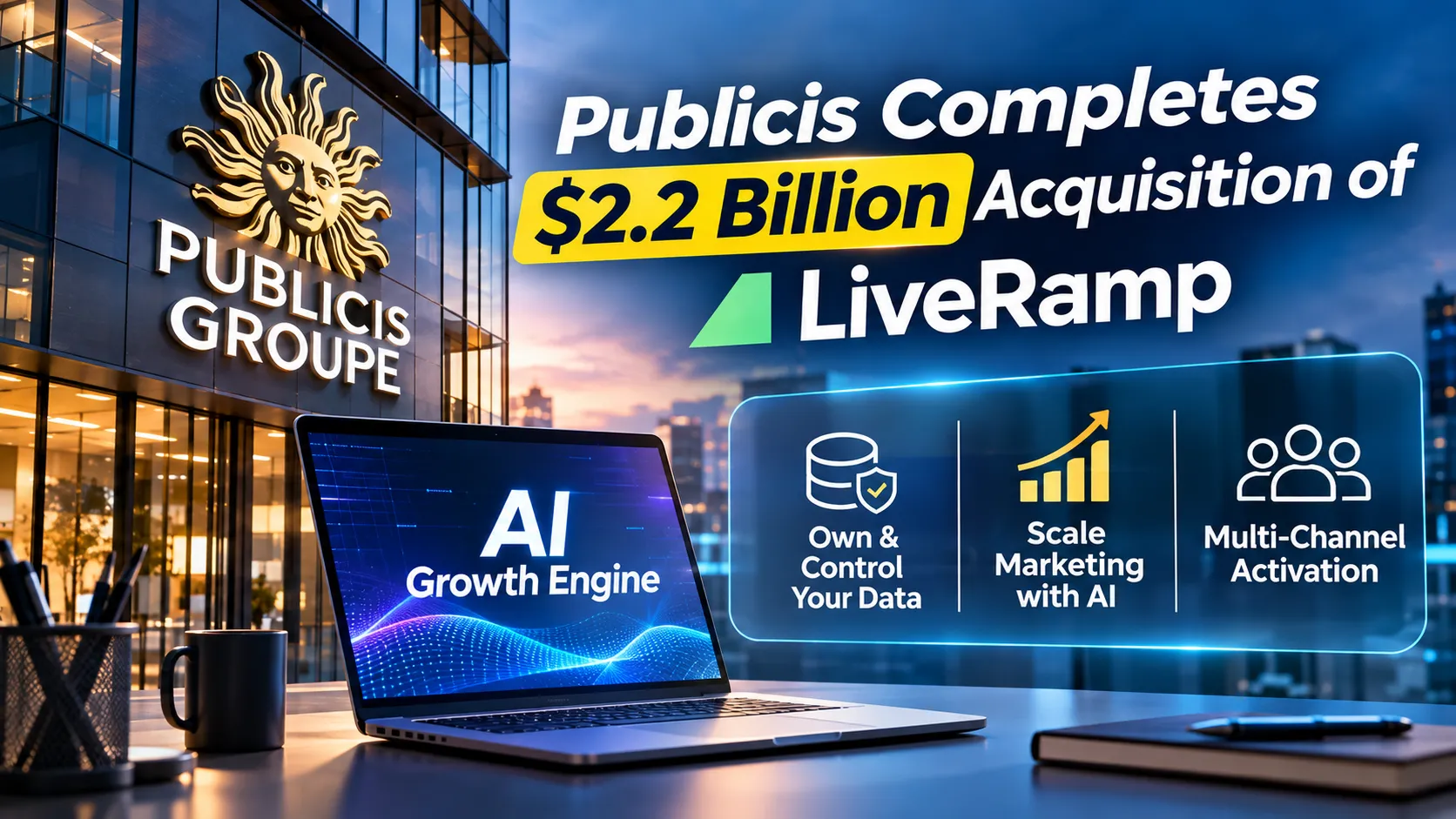
Publicis Groupe completed its acquisition of data collaboration company LiveRamp on November 2, a deal reported at about $2.2 billion, and launched what it calls the industry's first plug-and-play AI growth engine that clients fully own and control. The deal gives the French advertising giant a data hub used by rival agencies, raising questions about neutrality.

By Shaym Kumar · Author3 November 2026New
Publicis Completes Its LiveRamp Acquisition and Launches an AI Growth Engine Promising Clients Full Control of Their Data

Publicis Groupe has completed its acquisition of LiveRamp, the data collaboration company used by many of the world's largest brands and media companies, and immediately launched a new artificial intelligence offering that it says will let clients scale their marketing without surrendering control of their data to the big technology platforms.

The French advertising group announced the closing of the deal on Monday, November 2. The acquisition was valued at about $2.2 billion, according to B&T and Adweek, which have reported the figure. Publicis had agreed to buy LiveRamp earlier this year, and on October 19 announced an agreement with the US Federal Trade Commission related to the acquisition, according to the company's announcement.

The AI growth engine

Alongside the closing, Publicis launched what it described as "the industry's first AI growth engine," a plug-and-play "Connected Data and AI Network" that it can install in clients' own technology environments.

The system combines LiveRamp's data collaboration platform with the identity capabilities of Epsilon, the data marketing company Publicis acquired in 2019. It allows clients to enrich their own customer data, activate it across media channels, personalise content, measure results and generate proprietary intelligence for their AI agents, according to the announcement.

LiveRamp's connected ecosystem includes 25,000 publishers and 500 technology and data partners, as well as retail media networks, walled gardens, large language model integrations and Publicis's own media network, the company said. Clients can add "thousands of attributes" to their first-party data, making "billions of prospects addressable."

The ownership pledge

Publicis framed the offering around a pledge it calls "Own & Control." Under this approach, client data stays in the client's own environment, clients co-create and own proprietary data and AI assets, and there is "zero platform lock-in," allowing clients to choose their own technology and partners.

"Clients are at a point in their transformation journey where they need to simultaneously run and reset," said Arthur Sadoun, chairman and chief executive of Publicis Groupe. He said brands should not have to "surrender their data to walled gardens for easy scale, and lose control."

The new system is designed "so clients can drive business impact without giving up autonomy over their data, their technology, or their future," Sadoun said.

"Joining Publicis allows us to give clients a foundation to scale agentic marketing with complete data ownership," said Scott Howe, chief executive of LiveRamp.
2f84e844-5a9c-4538-99ee-67876c6baf17.png

What LiveRamp does

LiveRamp, based in San Francisco, provides technology that allows companies to connect and share customer data securely and in compliance with privacy rules. Its "clean room" technology lets brands, retailers and media companies match their customer data without exposing personal information to each other, which has become increasingly important as privacy regulations have tightened and third-party cookies have declined.

LiveRamp's identity resolution technology helps advertisers recognise consumers across different devices and platforms, enabling targeted advertising and measurement.

The neutrality question

LiveRamp's value has rested partly on its position as a neutral intermediary used by many companies, including Publicis's rivals among the major advertising holding companies. The acquisition has raised questions about whether rival agencies and their clients will continue to trust LiveRamp now that it is owned by a competitor.


“Joining Publicis allows us to give clients a foundation to scale agentic marketing with complete data ownership.”
— Scott Howe, CEO, LiveRamp

Sadoun said Publicis will preserve "LiveRamp's identity, culture, and neutrality" while bringing the companies together. Some industry figures remain sceptical. Benoit Vatere, chief media and digital commerce officer at beverage brand Liquid Death, wrote in a LinkedIn post: "Who in their right mind will let an holdco own your data and graph," according to B&T.

Publicis's data strategy

The deal is the latest step in Publicis's long-running strategy of building data and technology capabilities to differentiate itself from rival agency groups. The acquisition of Epsilon for about $4.4 billion in 2019 and of Sapient in 2015 transformed Publicis from a traditional advertising group into a marketing, data and technology company. Publicis has outperformed many of its rivals in recent years, which it attributes partly to these investments.

The strategy reflects the pressures facing advertising agencies as AI transforms marketing. AI tools can now generate advertising content, plan media and optimise campaigns, potentially reducing the need for some traditional agency services. Agencies are seeking to remain relevant by offering data, technology and AI capabilities that clients cannot easily build themselves.

Industry consolidation

The LiveRamp deal is part of a wave of consolidation in advertising technology. Independent adtech companies have struggled to compete with Google, Amazon and Meta, which together are estimated by research firm WARC to capture almost 60% of global advertising spending outside China this year, according to Adweek.

On the same weekend, Indian adtech company Affle agreed to acquire Israel's Perion Network for about $420 million. Nielsen agreed in August to take DoubleVerify private for $2.15 billion, and other independent adtech companies have been the subject of takeover interest.

Implications for India

Publicis has a substantial presence in India, through its agencies and through Publicis Sapient, which has large technology and engineering operations in the country. Indian brands are also rapidly adopting data-driven and AI-powered marketing. The LiveRamp acquisition could bring new data collaboration capabilities to Indian clients, while India's Digital Personal Data Protection Act will shape how such capabilities can be used.

The FTC agreement

The deal was completed after Publicis reached an agreement with the US Federal Trade Commission in October, according to the company's announcements. Regulators have paid increasing attention to how data is collected, shared and used in advertising, and to competition in digital advertising markets.

Data collaboration and clean rooms have become central to advertising as privacy rules tighten and as retailers, streaming services and other companies build their own advertising businesses based on first-party data. LiveRamp's technology sits at the centre of many of these data partnerships, which makes its ownership commercially and strategically significant.

What comes next

Publicis will focus on integrating LiveRamp and persuading clients, including those working with rival agencies, that it can be trusted as a neutral data partner. The success of its AI growth engine will depend on whether brands see sufficient value in the "own and control" approach compared with the scale and simplicity offered by the walled gardens. The deal will be a test of whether agencies can reinvent themselves as AI and data companies in an industry being reshaped by technology.

TagsPublicis GroupeLiveRampEpsilonArthur SadounScott Howeadvertisingadtechdata collaborationclean roomsAI marketingagentic marketingmergers and acquisitionswalled gardensfirst-party datamarketing technologyadvertising agenciesFTCdata privacyPublicis Sapientinvestors

Reader reviews

Sign in to rate and review this article.
Loading reviews…
