India's corporate earnings season delivered a mixed set of results on Friday, October 23, with more than 75 companies reporting numbers for the July-September quarter. Industrial companies benefited from strong infrastructure and freight activity, while pharmaceutical and real estate companies faced company-specific pressures.
Here is what four of the day's most closely watched companies reported.
Tata Motors: back in the black
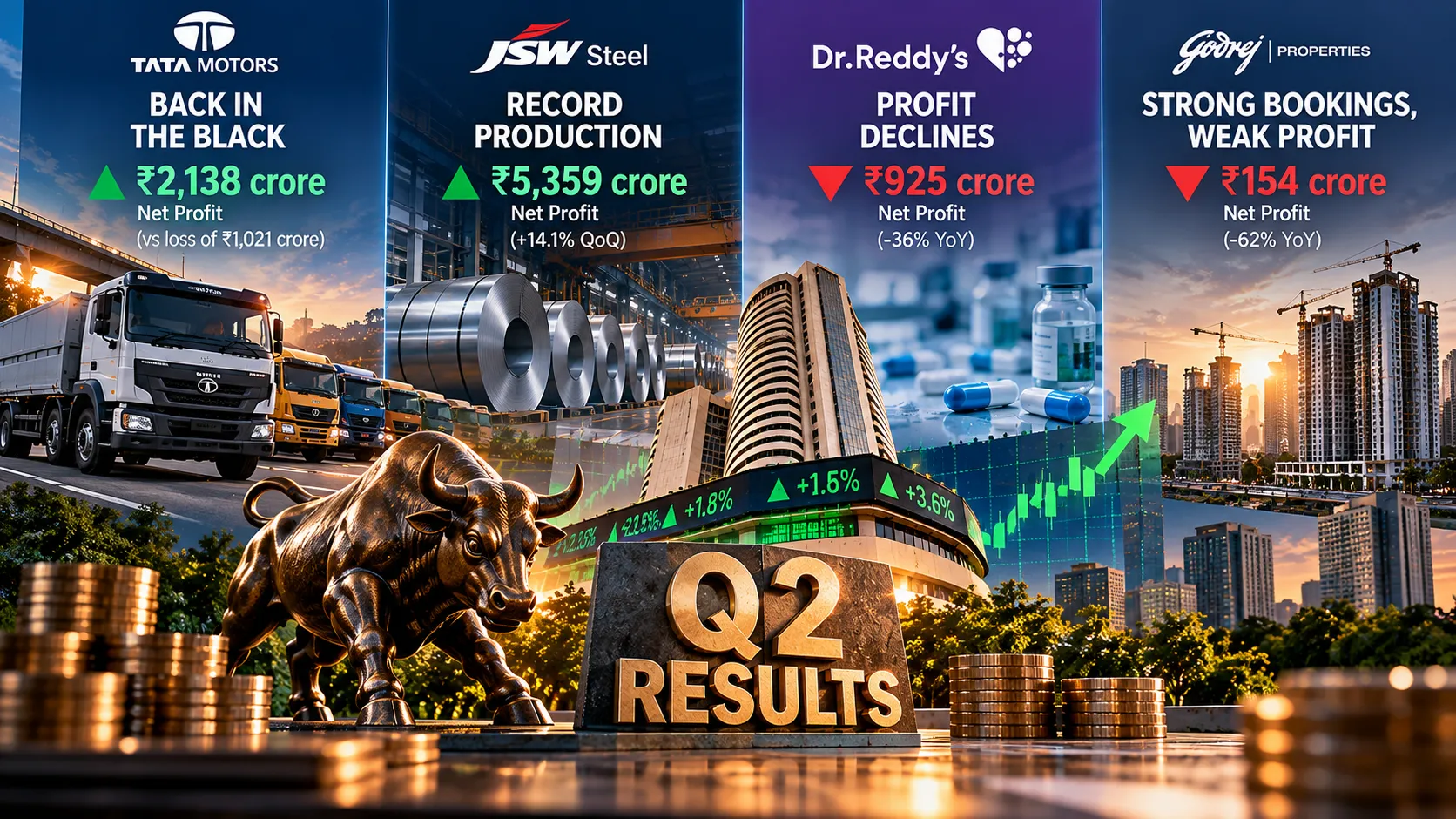
Tata Motors swung to a net profit of ₹2,138 crore (about $225 million) for the quarter, compared with a loss of ₹1,021 crore a year earlier, Reuters reported. The company cited healthy demand for commercial vehicles amid strong freight and infrastructure activity.
Tata Motors, now focused on commercial vehicles after the demerger of its passenger vehicle business into a separately listed company, is India's largest truck and bus maker. Commercial vehicle demand is closely linked to economic activity, particularly construction, mining, logistics and e-commerce, making the results a useful indicator of the health of the broader economy.
Government spending on roads, railways and other infrastructure has supported demand for trucks and tippers, while growth in freight volumes has encouraged fleet operators to expand. However, rising commodity costs weighed on margins, according to Business Standard.
JSW Steel: record production
JSW Steel reported consolidated profit after tax of ₹5,359 crore, up 14.1% from ₹4,696 crore in the previous quarter, with profit attributable to owners of ₹5,279 crore. Revenue from operations rose 15% sequentially to ₹54,486 crore, and EBITDA rose 8% to ₹10,120 crore, Business Standard reported.
The company said it achieved its "highest-ever quarterly crude steel production and saleable steel sales," with domestic sales from its India operations reaching a record 6.29 million tonnes.
Steel demand in India has been supported by infrastructure, construction and manufacturing, and Indian steelmakers have been expanding capacity rapidly. However, the industry faces pressure from imports, particularly from China, and volatile prices for raw materials such as coking coal and iron ore. JSW Steel's shares were among the top losers on the Nifty 50 on Friday, in line with a sharp fall in metal stocks.
Dr Reddy's: the lenalidomide cliff
Dr Reddy's Laboratories reported a 36% fall in consolidated net profit to ₹925 crore, as revenue slipped 1.5% to ₹8,670.8 crore. The decline was driven mainly by lower sales of lenalidomide, a generic version of the cancer drug Revlimid, in North America, where competition has intensified as more generic makers entered the market.
North American revenue fell 23% to ₹2,489 crore. But excluding lenalidomide, the company's base business grew at double-digit rates. Its North America base business grew 12.4%, compared with market growth of 2.4%, and the company launched six products in the US during the quarter.
Elsewhere, emerging markets revenue rose 24% and India revenue grew 17%, with Dr Reddy's moving up to eighth place in the Indian pharmaceutical market from tenth a year earlier.
"We continued to improve the overall health of our business, delivering double-digit base business growth," said co-chairman and managing director G V Prasad.
The company also faces higher costs from the Middle East conflict, which has raised prices for key starting materials and freight, with an estimated impact of about 100 basis points on margins in the quarter. Chief executive Erez Israeli said the company was "on track to resolve issues associated with the semaglutide API," and expects to relaunch its version of the weight-loss and diabetes drug in November, supplying 6 to 7 million packs across 10 markets, mainly Canada.
Godrej Properties: strong bookings, weak profit
Godrej Properties reported a 62% fall in consolidated net profit to ₹154 crore from ₹405 crore, while EBITDA fell 72% to ₹171 crore. Total income, however, rose 38% to ₹2,575 crore.
Profit at real estate developers can be volatile because revenue is recognised when projects are completed and handed over, rather than when homes are sold. Operating metrics told a stronger story. Bookings in the first half rose 7% to a record ₹16,659 crore, and second-quarter cash collections rose 31% to ₹5,318 crore, the highest ever for the period.
"Q2 was a very strong operating quarter with sustenance sales growth of 83 per cent Y-o-Y," said chairperson Pirojsha Godrej. The company expects collections of ₹15,000 crore in the second half and plans over ₹32,000 crore of project launches. It is targeting positive free cash flow and a 20% return on equity in fiscal 2028.
What the results say about India Inc
Taken together, the results show an economy where infrastructure and industrial activity remain strong, supporting companies such as Tata Motors and JSW Steel. Pharmaceutical companies face product-specific challenges, while real estate demand remains healthy despite volatile reported profits.
The broader earnings season has also highlighted the impact of high oil prices and the Middle East conflict on costs across sectors, from pharmaceuticals to consumer goods.
Market reaction
The results came on a difficult day for Indian markets. The Nifty Metal index fell 2.71% and the Nifty Realty index 2.38%, while midcap and smallcap indices suffered their worst week in 20 months as Brent crude neared $115 a barrel. In such an environment, even good results may not be enough to lift share prices.
The commodity cost squeeze
Across sectors, companies are grappling with higher input costs linked to the oil price surge and the Middle East conflict. Steelmakers face higher prices for coking coal and energy, automakers for steel, aluminium and other materials, and pharmaceutical companies for solvents, key starting materials and freight. Consumer goods companies are also contending with higher packaging and raw material costs.
Companies with pricing power can pass some of these increases on to customers, but in competitive markets, margins often take a hit. The extent to which companies can protect profitability will be a key theme for the rest of the earnings season.
What comes next
The earnings season continues next week with results from more banks, consumer companies and industrial firms. Investors will be watching for signs of how companies are managing higher input costs and whether demand holds up through the festive season. Analysts will also be watching guidance from management teams on demand in the second half of the fiscal year, including the impact of the festive season, government infrastructure spending and the trajectory of commodity prices. Those signals will shape earnings estimates and market sentiment heading into 2027.