FundingAnalysis5 MIN READ

Late-Stage Startup Funding Slips to $994 Million in Q3 as Growth-Stage Rounds Reach $1.1 Billion

Indian startups raised $2.2 billion in July–September, but money moved towards Series A and B rounds while large late-stage cheques thinned out, Inc42 data shows, with AI and cleantech leading the sectors.

By Nisha Omkumar · Author8 October 2026New
Late-Stage Startup Funding Slips to $994 Million in Q3 as Growth-Stage Rounds Reach $1.1 Billion

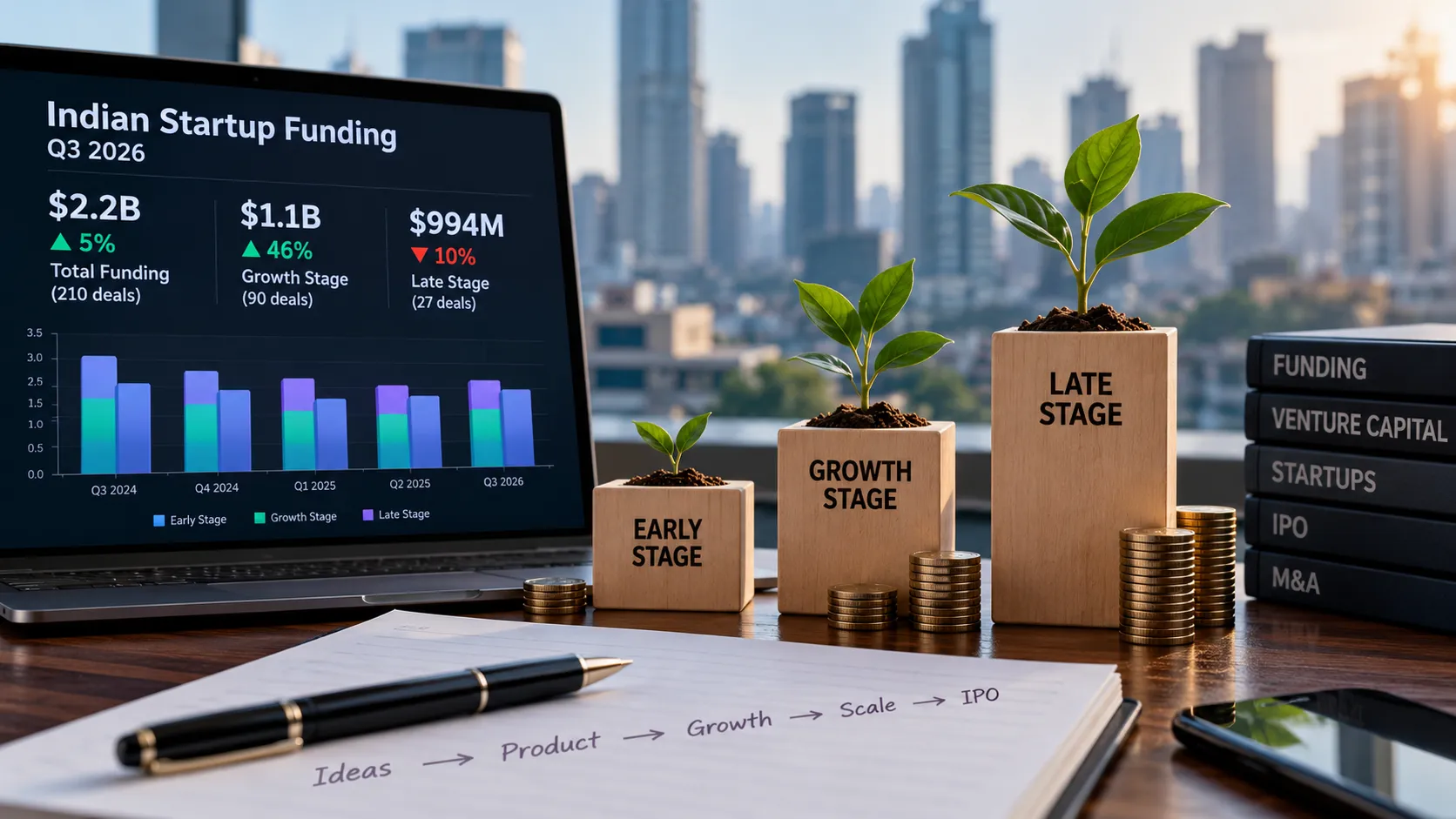
Late-stage funding for Indian startups slipped to $994 million in the July–September quarter, while growth-stage companies raised $1.1 billion, as investors shifted capital away from large Series C-and-beyond cheques towards younger businesses with more room to grow, according to data compiled by Inc42.

Overall, Indian startups raised $2.2 billion across 210 deals in the quarter, up 5% from $2.1 billion a year earlier, Inc42's quarterly funding report, published on 30 September, showed. The number of deals fell 13% from 240, and the count of active unique investors dropped 24% to 511 from 676.

The headline number hides a sharp split. Growth-stage funding, covering Series A and B rounds, rose to $1.1 billion across 90 deals, a jump of 46% year on year according to a follow-up Inc42 analysis published on 7 October. Late-stage funding, for Series C and above, reached $994 million across 27 deals.

def2404a-2da6-46d1-9a0b-8c02b59b7757.png

Reading the numbers

Inc42's quarterly report put the late-stage decline at 10% year on year. Its subsequent analysis described the same figure as broadly flat, with a slip of about 1%. On either reading, the direction is clear: late-stage capital has stopped growing while growth-stage money has surged. The number of late-stage deals fell 10% to 27, and the median late-stage cheque dropped 18% to $18 million.

At the growth stage, the median ticket rose 4% to $8.3 million and the number of deals rose 38% to 90. Early-stage funding moved the other way, falling 18% to $164 million across 93 deals, although the median early-stage cheque rose 20% to $1.2 million.

The quarter's largest rounds included Emergent, an AI company, at $130 million, electric two-wheeler maker River at $120 million, and Navi and spacetech firm Pixxel at $100 million each. There were four deals of $100 million or more, compared with one a year earlier. Emergent and Astrotalk became unicorns during the quarter.

Other trackers count differently. Entrackr, which uses its own methodology, put total Q3 startup funding at $2.9 billion, down from $3.5 billion in the previous quarter, NewsBytes reported. Differences in what each tracker includes, such as debt or undisclosed rounds, mean the totals rarely match, but both point to a quarter of selective investing.

Measured against recent history, the quarter was subdued. Inc42's $2.2 billion total was below the $3.4 billion raised in the same quarter of 2024 and under the roughly $2.7 billion average of the previous eight quarters.

AI and cleantech take the lead

Artificial intelligence was the most funded sector, attracting $438 million across 35 deals, up 265% year on year. Cleantech came a close second with $433 million across 23 deals, more than three times its level a year earlier, with electric vehicle companies making up 57% of the sector's deals. Deeptech raised $290 million, up 176%, from a flat 28 deals.

Older sectors lost ground. Ecommerce recorded the most deals, 44, but its funding fell 31% to $245 million. Fintech funding dropped 11% to $249 million across 13 deals. Apoorva Ranjan Sharma, co-founder of Venture Catalysts, told Inc42 that these “are now more mature sectors and investors expect stronger numbers from them.”

The shift towards frontier technology helps explain the stage mix. Sectors such as AI, deeptech and cleantech have longer gestation periods, so investors tend to back companies early and wait for commercial validation before committing larger sums. That pushes capital into Series A and B rounds and delays the bigger late-stage cheques.


“Growth continues to be important, but growth alone is no longer enough.”
— Apoorva Ranjan Sharma, Co-founder, Venture Catalysts

Geography was concentrated. Bengaluru-based startups raised more than $1.4 billion across 80 deals, up 157% year on year and 64% of the national total. Delhi NCR raised $301 million, down 27%, and Mumbai $223 million, down 64%. By deal count, the most active investors were 3one4 Capital with 19 deals, Zerodha-backed Rainmatter with 16 and IvyCap Ventures with 15.

Vikram Gupta, founder and managing partner of IvyCap Ventures, said the growth-stage rise was a natural result of a larger early-stage base. “If the number of early stage funds has increased, very naturally you will see a growth in the early to growth stage,” he told Inc42, pointing to an ecosystem of roughly 2.5 lakh startups.

Why late-stage money is harder to find

Investors cited several reasons for the late-stage slowdown. Valuations at that stage are higher, leaving less margin for error. Some companies raised money at peak valuations during earlier funding booms and have yet to grow into them. Attractive yields on US Treasuries have also given global investors a less risky place to park capital.

India also has a thin bench of investors able to write very large cheques. “The larger dollar capital comes from the US and other geographies,” Gupta said, adding that India would need at least $100 billion to be globally competitive. Overseas dollar capital has become harder to deploy, investors told Inc42.

Those who do invest are attaching more conditions. Late-stage rounds are increasingly split into tranches released as companies hit agreed milestones. “If an investor is putting in $30-50 Mn, there has to be a clear plan for how that money will be used,” Sharma said, adding that profitability and a clear path to a public listing now weigh as heavily as top-line growth.

There are signs the exit pipeline is building. Six new-age tech companies listed during the quarter, including Shiprocket, ESDS Software and Rentomojo, and mergers and acquisitions rose 69% to 22 deals. In Inc42's survey of more than 85 institutional investors, 72% said they held late-stage companies with some degree of IPO readiness, while 63% said valuations of Indian AI companies had risen beyond comfortable levels.

Investors are also looking beyond public listings for returns. In the same survey, 38% said secondary sales, in which existing shareholders sell to new investors, would provide the most liquidity over the next two years, ahead of 32% who pointed to domestic IPOs. Notable deals in the quarter included upGrad's $200 million acquisition of Unacademy and Imarticus Learning's $84 million buyout of BELLS.

Listed peers have offered some encouragement. Inc42's New Age Tech Index, which tracks listed Indian internet and technology companies, gained 3.38% between 1 July and 25 September, outperforming the Nifty 50 by nearly seven percentage points. Strong public-market performance tends to make late-stage investors more comfortable paying for pre-IPO stakes.

For founders, the message is that capital is available but priced on fundamentals. Gupta expects more late-stage money to return as successful exits build confidence, while Sharma pointed to profitability, realistic valuations and well-received IPOs as the conditions for a recovery. Until then, the sharpest competition for deals is likely to remain at Series A and B, where investors see room to grow and lower valuation risk.

TagsStartup FundingQ3 2026Late Stage FundingGrowth StageVenture CapitalInc42AICleantechDeeptechFintechIPOIvyCap VenturesVenture CatalystsIndia

Reader reviews

Sign in to rate and review this article.
Loading reviews…