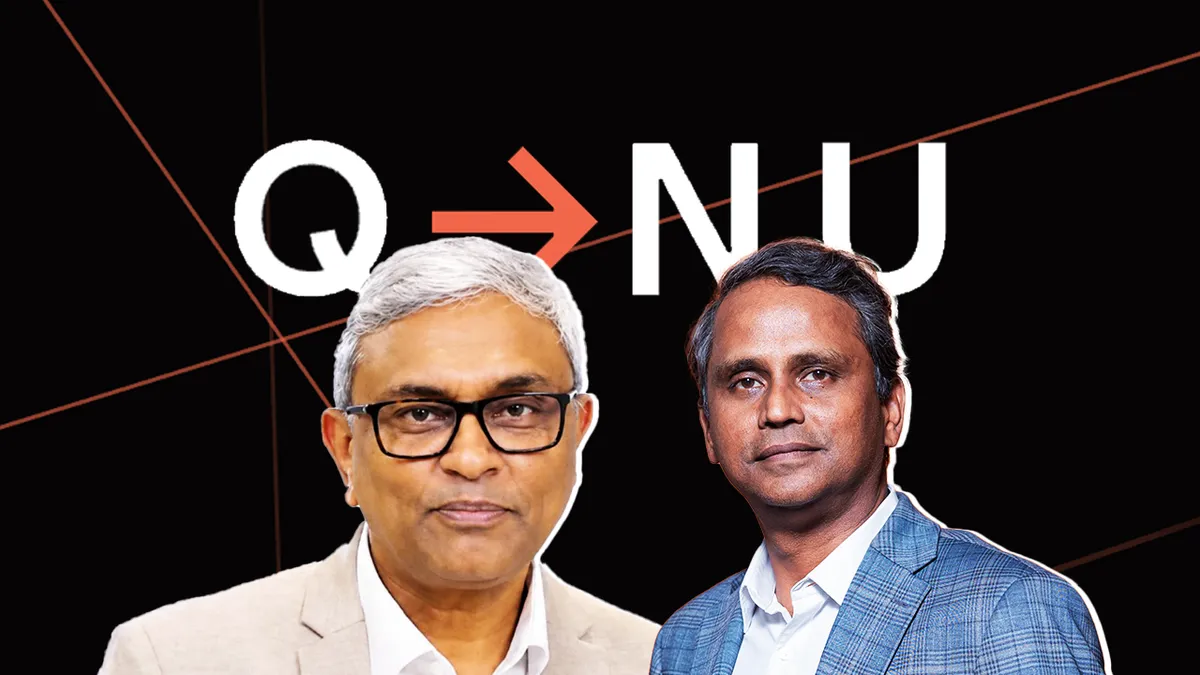
Bengaluru-headquartered QNu Labs has closed a Series A1 funding round of Rs 200 crore, co-led by India's National Quantum Mission and early-stage deeptech investor Speciale Invest, with participation from Sony Innovation Fund, Gaja Capital and Artha Ventures. The round, announced on September 9, positions QNu Labs among the best-capitalised quantum cybersecurity companies to emerge from India and signals growing institutional confidence in the country's nascent quantum technology stack at a moment when governments and enterprises worldwide are racing to future-proof their data against the eventual arrival of quantum-capable adversaries.
Alongside the equity round, QNu Labs has secured a separate Rs 150 crore convertible-debt facility approved under India's Research, Development and Innovation fund, a mechanism designed to channel patient, mission-aligned capital into frontier technology ventures that conventional venture funds often find too long-dated to underwrite alone. Taken together, market participants have pointed to a combined financing figure north of Rs 350 crore, underscoring the scale of ambition behind a company that has spent nearly a decade building quantum key distribution and post-quantum cryptography systems largely outside the media spotlight that trails consumer-facing AI startups.
QNu Labs' core proposition rests on the premise that classical encryption, however robust today, faces an expiry date once sufficiently powerful quantum computers become operational — a scenario security architects now refer to as 'harvest now, decrypt later,' in which adversaries stockpile encrypted data today in anticipation of cracking it once quantum hardware matures. The company's hardware-based quantum key distribution systems and quantum random number generators are pitched at banks, defence establishments, telecom operators and critical infrastructure operators who cannot afford a retroactive security failure once that threshold is crossed.
The fresh capital will be deployed to deepen research and development and to accelerate go-to-market efforts both within India and in overseas markets, according to the company, as it looks to compete with a small but growing global field of quantum-security specialists in the United States, Europe, China and Japan. India's National Quantum Mission, backed by a multi-year government outlay, has increasingly positioned itself as an anchor investor for exactly this category of company, treating quantum-safe infrastructure as a strategic national capability rather than a purely commercial bet.
For India's broader deeptech investing community, the round is being read as validation that specialised, hardware-intensive science ventures can attract serious late-stage-style capital even at a relatively early stage, provided they can point to credible government and strategic partners. Bengaluru's position as a magnet for quantum, space and semiconductor ventures continues to strengthen as a result, reinforcing the city's claim to being India's deeptech capital even as more visible headlines are dominated by consumer AI and fintech.
Looking ahead, QNu Labs' next milestones will likely be measured less in funding announcements and more in commercial deployments — pilot programmes with financial institutions, telecom carriers and government agencies that can demonstrate the technology working at production scale. As nations increasingly treat quantum readiness as a matter of sovereign digital security, companies like QNu Labs sit at the intersection of national policy and enterprise procurement, a position that could prove decisive for India's standing in the emerging global quantum economy.
For the diaspora and global investor audience TIGI serves, QNu Labs' trajectory offers a useful lens on how India's deeptech story is evolving beyond the software-services narrative that dominated the country's technology reputation for two decades. Hardware-anchored, IP-heavy ventures in quantum, space and semiconductors now routinely draw institutional cheques once reserved for consumer internet and SaaS companies, a shift that speaks to both maturing domestic capital markets and a government policy apparatus increasingly willing to co-invest alongside private funds in strategically important technology categories.
Comparable quantum-security plays overseas, from Europe's Toshiba-backed quantum networking ventures to a handful of well-funded US start-ups, have generally required far larger capital bases before reaching commercial deployment at scale, making QNu Labs' relatively capital-efficient path to a Rs 350 crore-plus combined financing figure a notable data point for investors benchmarking India's deeptech unit economics against global peers.
Quantum-readiness timelines remain genuinely uncertain even among specialists, with estimates for when cryptographically relevant quantum computers might emerge ranging from the early 2030s to considerably later. That uncertainty, rather than undermining the investment case for companies like QNu Labs, has if anything strengthened it: regulators in banking and critical infrastructure increasingly require migration planning to begin years ahead of the actual threat materialising, given how long it typically takes large organisations to overhaul core cryptographic infrastructure across legacy systems.