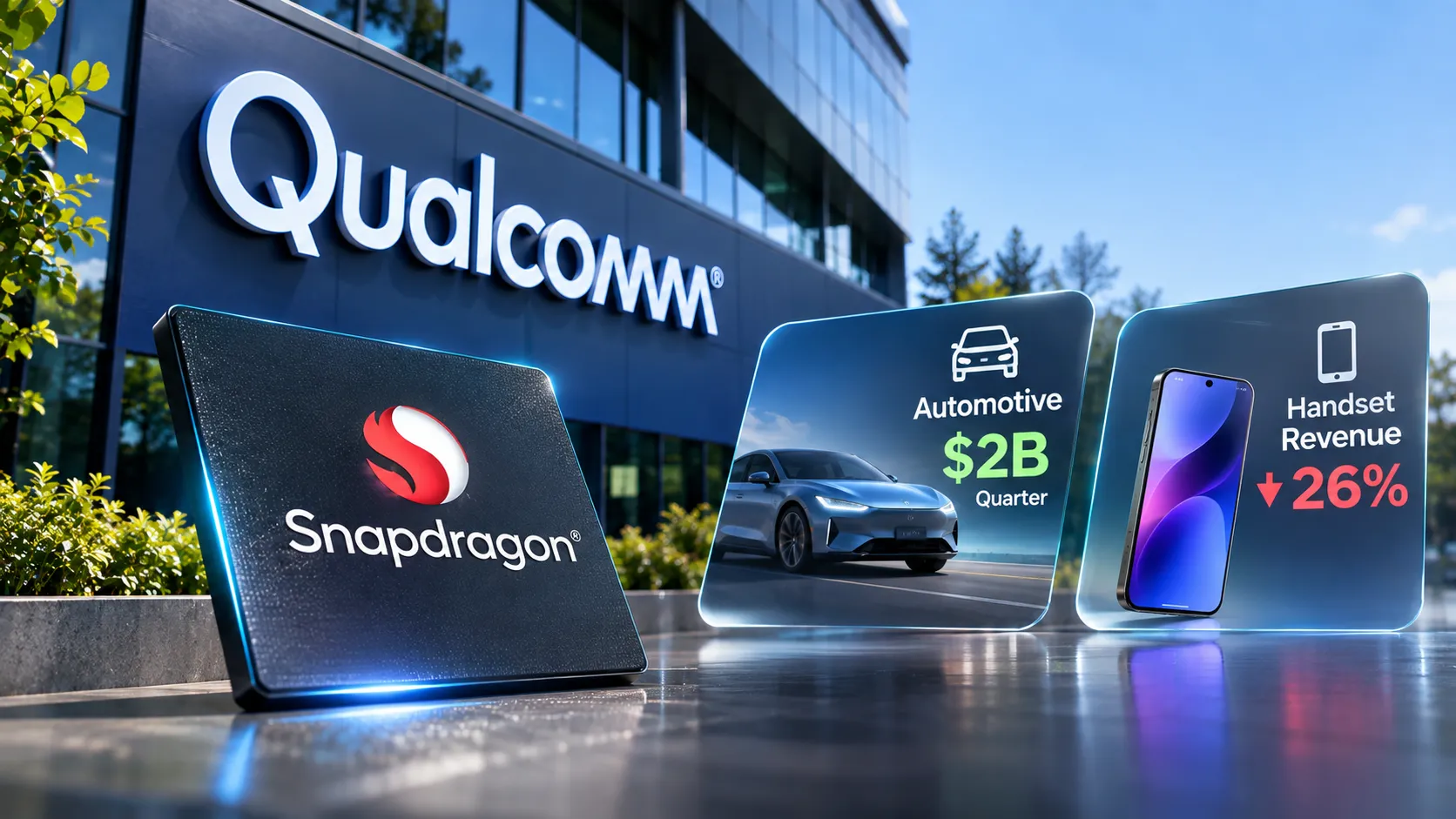
Qualcomm reported fiscal fourth-quarter results that beat Wall Street's expectations on Wednesday, November 4. The chipmaker's automotive business delivered its first $2 billion quarter, but its shares fell in after-hours trading as investors focused on rising supply costs and a weaker margin outlook.
For the quarter ended in late September, Qualcomm reported GAAP revenue of $10.32 billion, down 8% from a year earlier but above analysts' average estimate of about $10.11 billion. On a non-GAAP basis, revenue was about $10.4 billion, at the top of the company's guidance range. Non-GAAP earnings per share were $2.17, slightly ahead of the $2.16 analysts expected.
Despite the beat, Qualcomm's shares fell more than 6% in after-hours trading. They had closed 5.33% higher at $173.19 during the regular session, helped by a newly announced partnership with SpaceX's Starlink.
Handsets under pressure
Qualcomm's largest business, chips for smartphones, faced a difficult quarter. Handset revenue fell 26% to $5.14 billion. The company said memory supply constraints had affected smartphone makers' production, which reduced their demand for Qualcomm's chips.
Memory chips have been in short supply and rising in price this year, as demand from AI data centres absorbs a growing share of global production. That has squeezed smartphone makers, who need memory for their devices, and has had a knock-on effect on suppliers of other components such as processors.
Smartphones remain central to Qualcomm's business. Its Snapdragon processors power many of the world's premium Android phones. But the company has been working for years to reduce its dependence on the handset market, which has matured and become more cyclical.
Automotive hits a milestone
Qualcomm's diversification strategy delivered its strongest result yet in automotive. Auto revenue rose 89% to $1.99 billion, the first time the business has reached the $2 billion mark in a single quarter. That puts it on an annualised run rate of roughly $8 billion.
Qualcomm supplies chips for vehicle infotainment systems, digital dashboards, connectivity and advanced driver assistance. As cars become more software-driven and connected, the amount of computing power they need has increased sharply, creating a large market for chipmakers.
The company's internet of things (IoT) business, which supplies chips for devices such as wearables, industrial equipment and smart home products, grew 4% to $1.9 billion.
Diversification gains traction
Chief executive Cristiano Amon highlighted the progress of Qualcomm's non-handset businesses. "We are pleased to deliver fourth quarter non-GAAP revenues at the high end of our guidance, along with 36% year-over-year growth in combined QCT Automotive and IoT revenues," he said.
Qualcomm's chip business, known as QCT, generated revenue of about $9.0 billion in the quarter. Its licensing business, QTL, which collects royalties on wireless technology patents, generated about $1.3 billion, with a margin of about 70%.
The licensing business remains highly profitable and provides a steady stream of income. However, it is the chip business that will determine Qualcomm's growth over the coming years.
Full-year results
For fiscal 2026 as a whole, Qualcomm reported GAAP revenue of $43.1 billion, down 3% from the previous year. GAAP earnings per share for the year were $12.70, including a tax benefit of about $5.7 billion.
The full-year decline reflected weakness in handsets, partly offset by growth in automotive and IoT. The company has been investing heavily in new areas, including PCs, data centres and AI, which it hopes will drive growth in the coming years.
Outlook disappoints on margins
For the first quarter of fiscal 2027, Qualcomm guided for revenue of $10.4 billion to $11.2 billion and non-GAAP earnings per share of $2.15 to $2.35.
The main concern for investors was margins. Qualcomm guided for QCT operating margins of 20% to 22%, below the 24% it achieved in the fourth quarter. The company pointed to rising supply costs, including for wafers, packaging and memory.
Higher input costs are a challenge across the chip industry. Strong demand for advanced manufacturing capacity, driven by AI, has pushed up prices at chip foundries. Advanced packaging, which is essential for high-performance chips, has also been in short supply.
Data-centre ambitions
Qualcomm has set an ambitious goal of generating $5 billion in data-centre revenue in fiscal 2027. The company has been developing processors for AI inference, the stage at which trained AI models are used to answer queries and perform tasks.
The data-centre market for AI chips is dominated by Nvidia, but demand is so strong that several companies, including Qualcomm, see room for competition. Qualcomm argues that its experience in designing power-efficient chips for smartphones gives it an advantage in building data-centre processors that use less energy.
Success in data centres would significantly change Qualcomm's business mix. However, the market is intensely competitive, and the company will need to win major customers to reach its target.
The Starlink partnership
Earlier on Wednesday, Qualcomm and SpaceX announced a multiyear agreement for Qualcomm to build the ground network for Starlink Mobile, SpaceX's planned wireless carrier service. The deal helped Qualcomm's shares rise more than 5% during regular trading.
The partnership reflects the growing convergence between satellite and terrestrial communications. As satellite operators move into mobile services, they need the network technology that companies such as Qualcomm have developed for traditional mobile carriers.
What it means for India
Qualcomm has a large presence in India, with significant engineering and research operations in cities including Bengaluru, Hyderabad and Chennai. India is one of the company's most important locations for chip design and software development outside the United States.
India is also one of the world's largest smartphone markets, and Qualcomm's chips power many of the phones sold there. The pressure on smartphone production from memory shortages could affect device availability and prices in India.
Qualcomm has also been working with Indian carmakers and technology companies on automotive and IoT applications. As India's automotive industry adopts more advanced electronics and electric vehicles, demand for automotive chips is likely to grow.
Investor reaction and outlook
The after-hours fall in Qualcomm's shares shows how sensitive investors are to margin guidance in the current environment. Even with a revenue beat and strong growth in automotive, concerns about rising costs outweighed the positives.
In the coming quarters, investors will watch whether memory supply constraints ease, whether automotive growth continues at its current pace, and whether Qualcomm makes progress towards its data-centre revenue target.
For Qualcomm, the fourth quarter showed both the success of its diversification strategy and the challenges of operating in a chip industry reshaped by the AI boom. The company's growth businesses are expanding rapidly, but its core handset market and margins remain under pressure from forces largely outside its control.


