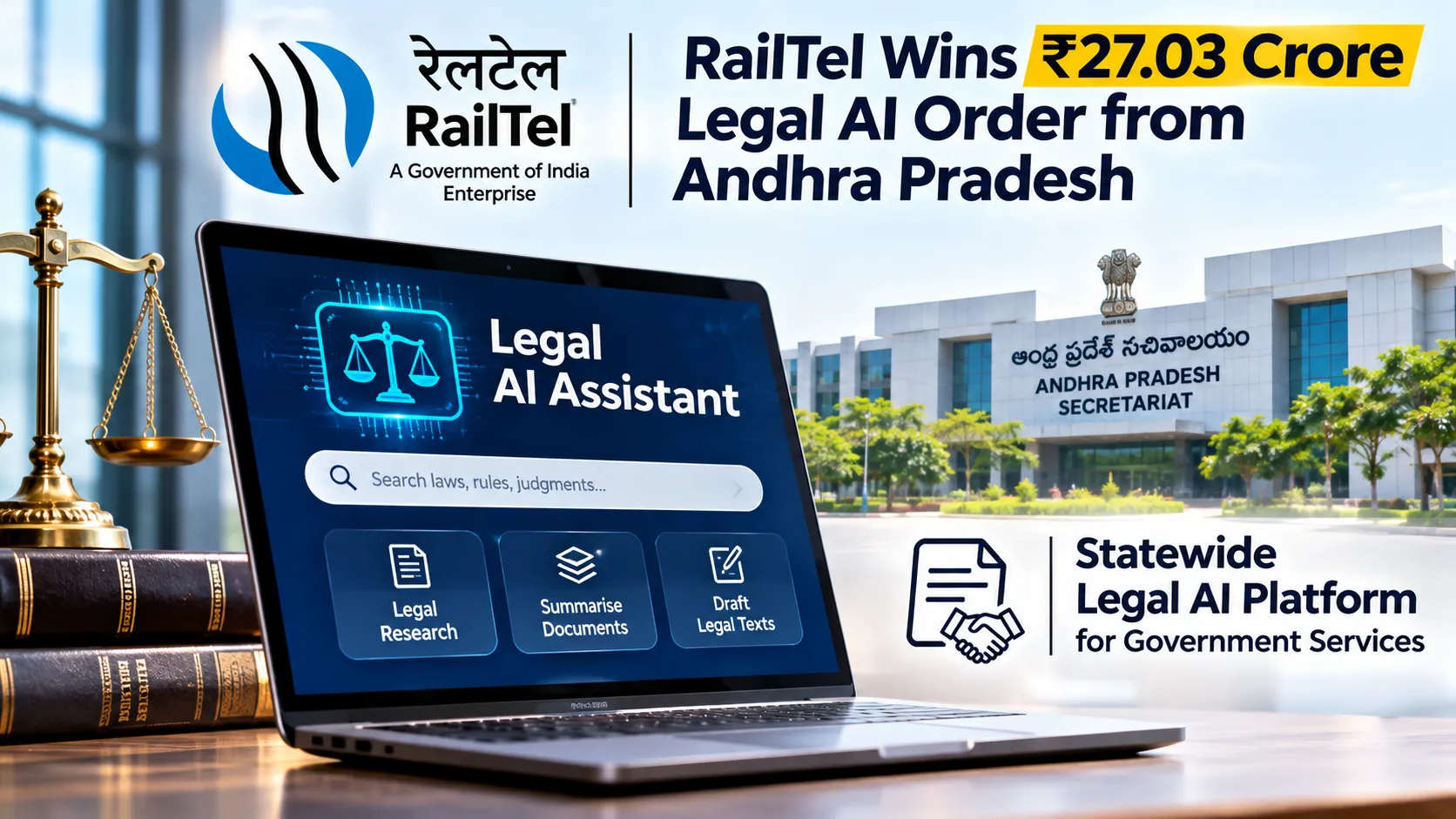
RailTel Corporation of India, the state-owned telecom infrastructure company, has won an order worth about ₹27.03 crore from Andhra Pradesh Technology Services (APTS) to build a statewide legal artificial intelligence assistant platform. The order was disclosed on November 22.
The precise value of the order is ₹27,02,56,350. The contract makes RailTel one of the first public sector companies to take on a large-scale generative AI deployment for legal services at the state level.
On the same day, another railway public sector undertaking, Rail Vikas Nigam Ltd (RVNL), disclosed a contract worth about ₹348.49 crore from East Coast Railway to augment the Vadlapudi Wagon Workshop near Visakhapatnam.
What a legal AI assistant could do
APTS is the Andhra Pradesh government's technology agency, responsible for procuring and managing IT systems for state departments. A statewide legal AI assistant would likely be designed to help government departments, legal officers and potentially citizens navigate legal information.
Such platforms typically use large language models trained or adapted to understand legal texts, including statutes, regulations, government orders and court judgments. They can help users search legal databases, summarise documents, draft standard legal documents and answer questions about procedures.
For state governments, legal workloads are significant. Departments handle large volumes of litigation, contracts, regulatory matters and administrative orders. AI tools could help legal officers manage cases more efficiently, track deadlines and draw on precedents.
If extended to citizens, a legal AI assistant could help people understand their rights, government schemes and legal procedures, particularly in regional languages. India's courts face an enormous backlog of cases, and improving access to legal information could have significant social benefits.
The full scope of the Andhra Pradesh platform has not been disclosed, so its exact functions and users remain to be seen.
Andhra Pradesh's technology ambitions
Andhra Pradesh has positioned itself as a technology-forward state. The government has promoted digital governance initiatives, data centre investments and AI adoption, and has sought to attract technology companies to cities such as Visakhapatnam.
Deploying AI across government services is part of that broader strategy. Several Indian states are experimenting with AI tools in areas such as citizen services, agriculture, health and education, and the legal assistant adds another domain.
RailTel's evolving business
RailTel was established to build and operate a telecom network along India's railway tracks, using railway right-of-way to lay optical fibre. It operates one of India's largest neutral telecom infrastructure networks, connecting railway stations and providing broadband and enterprise services.
Over time, RailTel has expanded into a wide range of information and communication technology services for government clients. These include data centre services, network projects, e-office systems, video surveillance, Wi-Fi at railway stations and IT projects for state governments.
Winning a legal AI order reflects RailTel's push to position itself as a system integrator for government digital transformation. Public sector companies often win such contracts because government departments can procure from them through simplified processes. RailTel typically partners with private technology companies to deliver specialised components.
RVNL's workshop contract
RVNL's ₹348 crore contract from East Coast Railway is for augmenting the Vadlapudi Wagon Workshop, which maintains and repairs freight wagons. RVNL, which executes railway infrastructure projects for the Ministry of Railways, has been winning a steady stream of contracts as Indian Railways expands capacity.
Freight wagon maintenance capacity is important as Indian Railways increases its freight volumes and aims to raise its share of the country's freight transport. Better maintenance facilities improve wagon availability and reduce breakdowns.
AI in government: opportunities and risks
The use of generative AI in government services is growing worldwide. Governments see potential to improve efficiency, reduce costs and make services more accessible. However, AI deployment in sensitive areas such as legal services also raises important concerns.
Accuracy is critical. AI systems can generate incorrect or fabricated information, sometimes called hallucinations. In legal contexts, errors could lead to poor decisions or misinformed citizens. Systems must be carefully designed, tested and monitored, with clear guidance that AI outputs do not replace professional legal advice.
Data privacy and security are also important. Legal platforms may handle sensitive personal information, and they must comply with India's Digital Personal Data Protection Act.
Transparency and accountability matter too. Users should understand when they are interacting with AI, and there should be mechanisms to correct errors and address complaints.
Investor perspective
Railway PSU stocks such as RailTel and RVNL have attracted significant retail investor interest in recent years, driven by government spending on railway modernisation. Order wins are closely watched as indicators of future revenue.
The legal AI order is modest in size relative to RailTel's overall business, but it is strategically significant as an entry into AI-driven government services. If successful, it could lead to similar projects in other states.
The bigger picture
For The Impactful Global Indian's readers, the RailTel order is an example of how India's public sector is beginning to adopt generative AI. India has launched the IndiaAI Mission to build computing infrastructure, datasets and AI applications for public good, and state governments are increasingly experimenting with AI tools.
Legal services are a particularly promising area. India's justice system faces large case backlogs, and many citizens find legal information difficult to access or understand. Well-designed AI tools could help bridge that gap, especially if they work in Indian languages.
The success of the Andhra Pradesh project will depend on careful implementation, robust safeguards and clear definitions of how the AI assistant should be used. If it delivers, it could become a model for other states seeking to apply AI to public services.
Language and access
One of the biggest potential benefits of a legal AI assistant in India is language access. Laws, government orders and court judgments are often written in English or in formal legal language that many citizens find difficult to understand. An assistant that can explain legal information in Telugu, the main language of Andhra Pradesh, could make government processes far more accessible. India's AI ecosystem, including IndiaAI Mission initiatives and startups building models for Indian languages, has been working to improve AI performance in regional languages. How well the Andhra Pradesh platform handles Telugu will be an important measure of its usefulness to ordinary citizens.


