Japan's ambitious attempt to leapfrog back to the frontier of semiconductor manufacturing is running into the hard realities of building the world's most advanced chips.
Rapidus, the company backed by the Japanese government and some of the country's largest corporations, is considering delaying the start of mass production of 2-nanometre chips by about a year, according to a Jiji Press report cited by Seoul Economic Daily on Wednesday, November 11. The delay would push the start of production from the second half of fiscal 2027, which runs from October 2027 to March 2028, to fiscal 2028, which runs from April 2028 to March 2029.
The report followed a Bloomberg News article on November 10 that said Rapidus was likely to miss its mass production deadline, according to Startup Fortune, which summarised the report.
The technical hurdles
According to Bloomberg, Rapidus has not yet produced a working SRAM cell, a basic memory block found in every processor, and a summer deadline for that milestone has passed, Startup Fortune reported. Bloomberg said progress was at least several months behind schedule and cited dust control in the company's clean room as a further problem.
The Jiji report said Rapidus is struggling to connect transistors to each other and integrate them with other components, making it difficult to achieve the high performance the chips require, according to Seoul Economic Daily. Yield improvement, the share of chips on a wafer that meet specifications, has also been slow.
Rapidus responds
Rapidus has not confirmed a delay. The company said it will "continue to do everything possible to meet the target of starting mass production in the latter half of fiscal 2027," according to Seoul Economic Daily. A spokesperson said the company was "fully pushing forward" towards its goal, according to Startup Fortune, and declined to give technical details, citing confidentiality.
Chairman Tetsuro Higashi said in October that the project was running almost on schedule.
A national project
Rapidus was formed in August 2022 by a public-private consortium backed by Toyota, Sony, NTT and SoftBank, among others, according to Seoul Economic Daily. Its mission is to restore Japan's position in advanced chipmaking, which the country lost decades ago after dominating the global semiconductor industry in the 1980s.
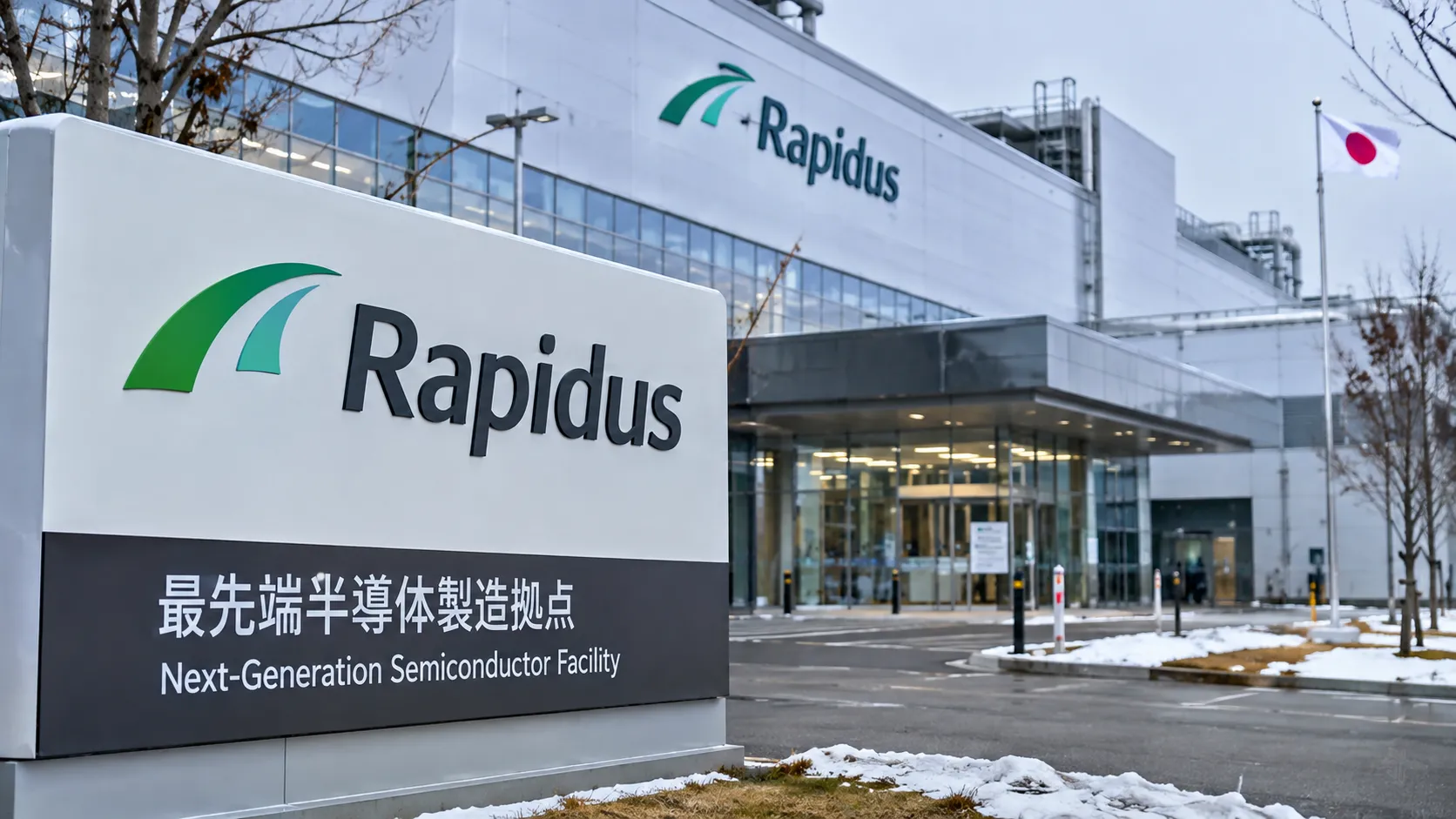
The company set out to jump directly from 40-nanometre technology, the most advanced that Japanese companies had produced domestically, to 2 nanometres, through a technology partnership with IBM of the United States. It is building its manufacturing facility in Chitose, Hokkaido, in Japan's northernmost main island.
In July 2025, Rapidus said it had produced a prototype transistor using its 2nm process.
Billions in public money
The Japanese government has committed vast sums to the project. It plans to provide more than 3 trillion yen in subsidies and equity investment through fiscal 2027, according to Seoul Economic Daily. Startup Fortune put the government's commitment so far at roughly 2.9 trillion yen, and said Rapidus still needs to raise about 4 trillion yen from banks and private investors.
A delay would raise questions about the return on this public investment and could make it harder for Rapidus to attract private capital and customers.
The customer question
Rapidus has not announced a customer committed to buying its chips in volume, according to Startup Fortune. It has released process design kits that allow potential customers to begin designing chips for its process. Winning customers is crucial, since a foundry must fill its factories with orders to be profitable.
Chip designers typically choose foundries based on proven performance, yields and reliability. Delays and technical difficulties could make customers more cautious about committing to Rapidus.
The competition
Rapidus faces formidable competition. Taiwan Semiconductor Manufacturing Company (TSMC) moved its N2 process into volume production in late 2025, and Samsung began first-generation 2nm mass production the same year, according to Startup Fortune. TSMC's record revenue in October reflects strong demand for its 2nm chips, Seoul Economic Daily reported. Intel is also working on advanced processes, and development of 1.4nm technology is advancing.
TSMC's dominance of advanced manufacturing, built over decades of experience and investment, gives it significant advantages in yields, cost and customer trust.
Why it matters globally
Rapidus is part of a broader effort by governments to diversify the global supply of advanced chips, which is heavily concentrated in Taiwan. Concerns about geopolitical risks, including tensions between China and Taiwan, have prompted the United States, Japan, Europe, South Korea and India to invest in domestic chip manufacturing.
Japan has also attracted TSMC to build factories in Kumamoto, in partnership with Sony and Denso, which produce less advanced chips. Rapidus is Japan's attempt to have its own homegrown company at the leading edge.
Lessons for India
India is pursuing its own semiconductor ambitions through the India Semiconductor Mission, which offers incentives for chip fabrication, assembly and testing plants. Tata Electronics is building a chip fabrication plant in Dholera, Gujarat, in partnership with Taiwan's Powerchip Semiconductor Manufacturing Corporation, focused on mature process technologies, and several companies are building assembly and testing facilities.
Rapidus's experience illustrates the difficulty of building advanced chipmaking capabilities from scratch, even with strong government support, partnerships with leading technology companies and the backing of major corporations. India's decision to start with mature nodes, where demand is large and technical risks are lower, reflects a more gradual approach.
The economics of a leading-edge fab
Building a leading-edge chip factory costs tens of billions of dollars and requires the most advanced manufacturing equipment, including extreme ultraviolet lithography machines made only by ASML of the Netherlands. A new entrant must also develop thousands of process steps, train skilled engineers and build relationships with suppliers of materials and chemicals.
Even established manufacturers struggle to achieve high yields on new processes. For a company starting from scratch, as Rapidus is, the learning curve is especially steep, which is why many industry observers considered its original timeline ambitious from the outset.
What comes next
Rapidus will need to resolve its technical challenges, demonstrate improving yields and sign customers. The Japanese government will face questions about its continued funding of the project. Whether Rapidus starts mass production in fiscal 2027 or 2028, its progress will be closely watched as a test of whether a latecomer can still compete at the frontier of the world's most complex manufacturing industry.