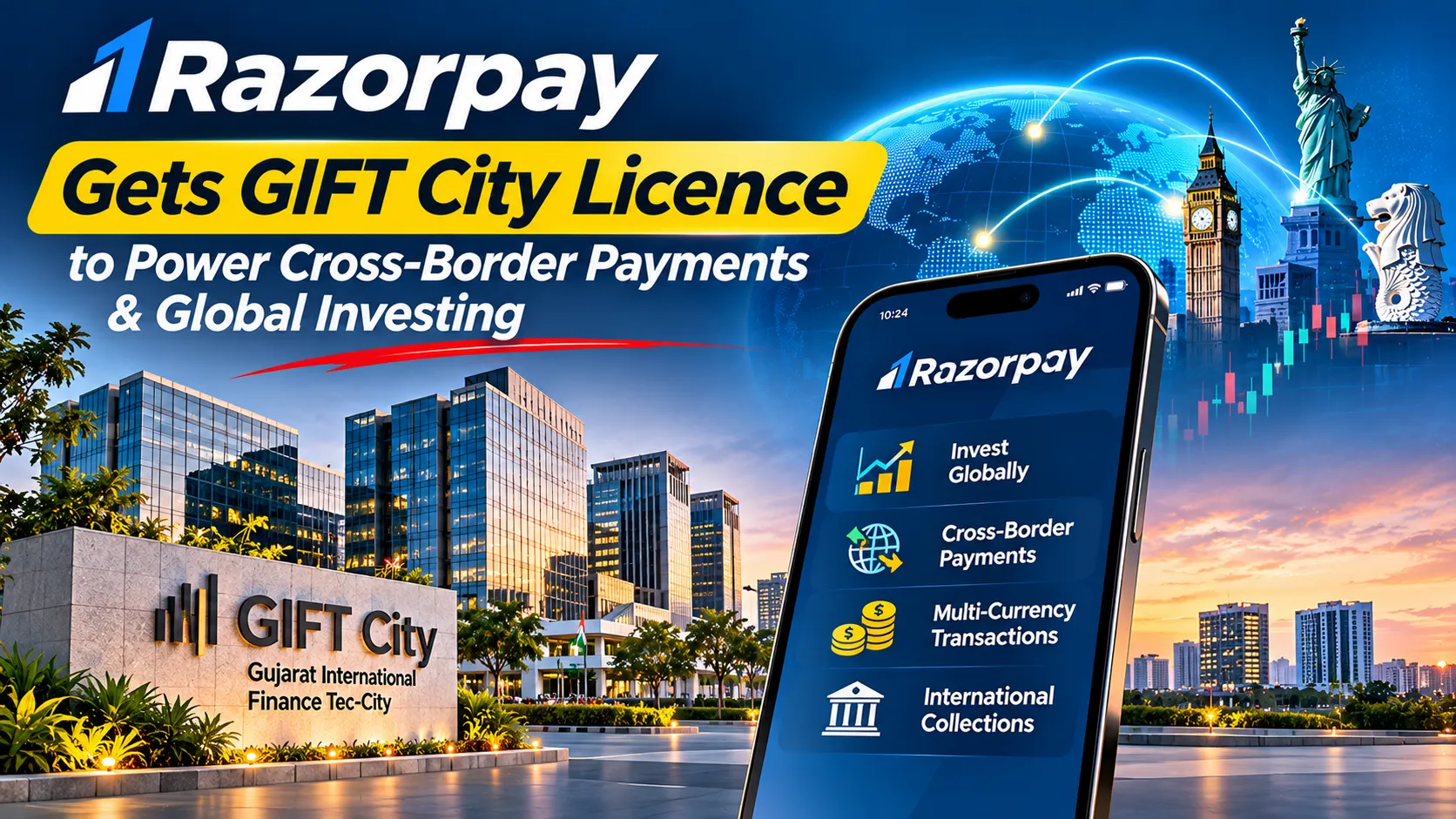
Razorpay, one of India's largest payment companies, has received final regulatory approval to operate as a payment service provider in GIFT City, Gujarat, giving it a single licence to move money into and out of India and expanding its reach into the fast-growing market for cross-border payments and overseas investing.
The company received a final Payment Service Provider (PSP) licence from the International Financial Services Centres Authority (IFSCA), the regulator for India's international financial services centre, according to Indian Startup News, which reported the development on Monday, November 2. The approval follows an in-principle clearance in April 2026.
The licence allows Razorpay to move money into and out of India from GIFT City "under a single regulatory framework," according to the report, enabling services such as global investing for Indian residents, international collections and settlements, multi-currency transactions and foreign currency transfers.
What the licence enables
Razorpay said it has already integrated with RBL Bank and ICICI Bank for the service, and that key investment platforms are expected to go live soon. Its infrastructure will allow investment platforms to integrate once and offer overseas investing to their customers in compliance with India's Foreign Exchange Management Act (FEMA) and GIFT City regulations.
The company said this could cut integration timelines for investment platforms from several months to two to three weeks. Razorpay also plans to offer services to non-resident Indians (NRIs) in the future.
Filling a regulatory gap
The GIFT City licence complements Razorpay's existing cross-border approvals. In December 2025, the company received a Payment Aggregator-Cross Border (PA-CB) licence from the Reserve Bank of India, covering export and import payments. That licence allows Indian businesses to receive payments in more than 130 currencies, and its users include Airbnb, Agoda, Klook, Hostinger and Shopify, according to Indian Startup News.
However, the PA-CB licence covers only current-account transactions, which involve trade in goods and services. It does not cover capital-account flows, such as investments abroad. The IFSCA PSP licence covers both, filling an important gap in Razorpay's offering.
In August 2026, Razorpay also launched a multi-currency account for exporters, allowing them to hold US dollars, euros, British pounds, UAE dirhams and Singapore dollars instead of converting all receipts into rupees.
How the IFSCA framework works
The IFSCA (Payment Services) Regulations, 2024, notified on January 29, 2024, cover five types of payment services: account issuance, e-money issuance, escrow, cross-border money transfer and merchant acquisition, according to Indian Startup News.
Approval comes in two stages: an in-principle approval, followed by a Certificate of Authorisation once conditions are met. Razorpay now holds the latter. Regular PSPs must have a minimum net worth of $100,000 at the start, rising to $200,000 by the end of their third financial year, while significant PSPs face higher thresholds.
A growing market
The licence comes as Indians are investing abroad in increasing numbers. Under the Liberalised Remittance Scheme (LRS), resident individuals can send up to $250,000 abroad each financial year for permitted purposes, including investments, education, travel and gifts.
Indian residents invested $2.65 billion in overseas stocks and debt in the financial year 2025-26, up 56% from the previous year, according to Reserve Bank of India data cited by Indian Startup News. Total LRS outward remittances fell nearly 2% to $28.98 billion in FY26, as spending on overseas education declined, but investment flows grew strongly. Data released on November 2 showed LRS outflows of $20.09 billion in the first eight months of 2026, with foreign equity and debt investments rising about 86% from a year earlier.