One of the most consequential questions in Indian insolvency law, whether telecom spectrum can be sold to repay lenders when an operator goes bust, is back before the Supreme Court.
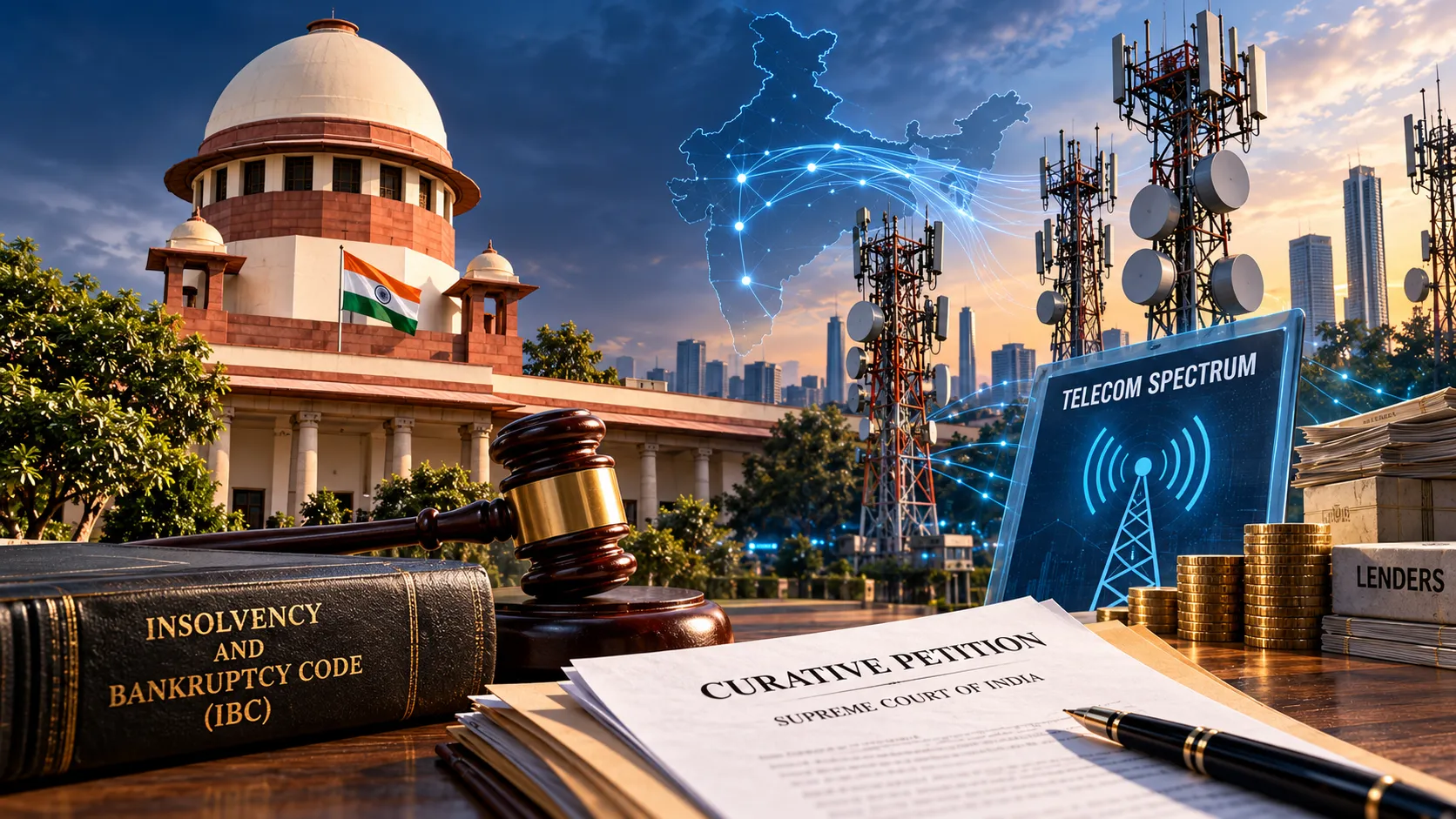
Anish Nanvaty, the resolution professional for Reliance Communications (RCom), has filed a curative petition asking the court to recall its February 13 judgment that spectrum allocated to telecom companies cannot be subject to insolvency proceedings under the Insolvency and Bankruptcy Code (IBC). The filing, reported by Business Standard on October 18, argues that the ruling is causing "irreversible harm."
A curative petition is the last legal remedy available against a final judgment of the Supreme Court. Such petitions are rarely successful, but the stakes in this case are high, both for the banks owed money by RCom and for the broader functioning of India's insolvency regime.
The February ruling
In its February 13 judgment, a bench of Justices P S Narasimha and A S Chandurkar held that spectrum allocated to telecom companies, even when shown as an asset on their balance sheets, cannot be subject to insolvency proceedings under the IBC. The ruling covered the cases of RCom and Aircel, two operators that collapsed under heavy debts during the intense price war in India's telecom market in the late 2010s.
Lenders, led by State Bank of India, had sought to monetise the spectrum held by the bankrupt companies to recover their dues. The court's decision settled a batch of petitions filed by SBI and the two insolvent operators, which challenged a 2021 order by the National Company Law Appellate Tribunal (NCLAT). The NCLAT had ruled that spectrum could be transferred or sold under a resolution plan only after all outstanding dues to the government were cleared.
The Supreme Court went further, effectively holding that spectrum, as a natural resource owned by the state and licensed to operators, sits outside the insolvency process.
The resolution professional's arguments
The curative petition makes several arguments. First, it contends that excluding spectrum removes the very asset that banks lent against, leaving them with loans and no recourse. For telecom companies, spectrum is often the most valuable asset on their books, and lenders typically factor its value into their decisions.
Second, it argues that the ruling creates a sectoral exception that has no basis in the IBC. The petition warns that the reasoning could be extended to other assets derived from state licences, such as mining leases, oil and gas licences, infrastructure concessions and hydropower water rights. If those assets were also placed beyond the reach of insolvency proceedings, the ability of lenders to recover money from companies in those sectors could be severely weakened.
Third, the petition says the judgment did not consider the explanation to Section 14(1) of the IBC, which provides that licences cannot be terminated during the insolvency moratorium as long as current dues are paid.
Finally, it takes issue with the treatment of the Department of Telecommunications (DoT). The DoT filed its claim of ₹31,276 crore as an operational creditor. The petition argues that admission of that claim effectively gave the government "de facto super-priority" over other creditors, which it says conflicts with the Supreme Court's own 2019 ruling in Swiss Ribbons, which upheld the constitutional validity of the IBC and its scheme of creditor priorities.
Why lenders are watching
For Indian banks, the outcome matters well beyond RCom. Telecom companies have borrowed heavily over the past two decades to pay for spectrum and build networks. If spectrum cannot be sold in insolvency, banks may become more cautious about lending to the sector, demand higher interest rates or require other forms of security.
The broader worry is about the precedent for other licence-based industries. Mining, oil and gas, power and infrastructure companies all depend on rights granted by the state. Lenders financing projects in those sectors have relied on the ability to transfer those rights to a new owner through a resolution plan if a borrower fails. A ruling that places such rights outside the IBC would fundamentally change the risk calculus for project finance in India.
The government's perspective
The government's position rests on the principle that spectrum is a scarce natural resource owned by the state, and that operators hold only a right to use it under licence conditions, including payment of fees and charges. Allowing spectrum to be sold in insolvency without clearing government dues would, in that view, let private creditors benefit from a public resource while the state's claims go unpaid.
That tension, between the public nature of spectrum and the commercial realities of lending, lies at the heart of the dispute. The Supreme Court's February ruling sided with the state's position, while the curative petition argues for a balance that preserves the effectiveness of the insolvency regime.
The long road for RCom
RCom, once one of India's largest telecom operators, entered insolvency proceedings in 2019 after failing to repay lenders. Its resolution process has been prolonged and complex, with disputes over the treatment of spectrum and government dues at the centre of the delays. Its collapse, along with that of Aircel and others, transformed India's telecom market into what is now effectively a three-player industry dominated by Reliance Jio and Bharti Airtel, with Vodafone Idea a distant third.
The stakes for lenders
The amounts involved in telecom insolvencies are large. Indian banks lent heavily to telecom operators during the sector's expansion, and the collapse of several operators left lenders with significant losses. Recoveries from insolvency processes in the sector have generally been low, in part because of disputes over spectrum and government dues.
Banks have since become more cautious about lending to the telecom sector, and the surviving operators have relied increasingly on equity raises, internal cash flows and government relief measures, such as the conversion of some dues into government equity in Vodafone Idea. The outcome of the RCom petition could influence how lenders price risk in the sector for years to come.
What comes next
The curative petition is pending, and no hearing date has been reported. Under Supreme Court procedure, curative petitions are first considered by the senior-most judges and the judges who delivered the original ruling, usually in chambers, and are heard in open court only if they meet strict criteria.
Whatever the outcome, the case highlights a central challenge for India's insolvency framework: balancing the rights of the state over natural resources and public licences with the need for creditors to recover their money efficiently. How that balance is struck will shape lending to some of the country's most capital-intensive industries for years to come.