Rebel Foods, the company behind cloud kitchen brands such as Faasos and Behrouz Biryani, has granted a fresh batch of stock options worth about ₹170 crore to its chief executive and co-founders, as it sharpens its focus on profitability and a potential stock market listing.
The company's board approved 25.36 lakh employee stock options at ₹670 per option, Entrackr reported on Thursday, October 22, citing regulatory filings.
Chief executive Ankush Grover received the largest share, 17.09 lakh options worth about ₹114.51 crore. Co-founder Jaydeep Barman received 4.27 lakh options worth about ₹28.63 crore, while Piyush Kakkad, Soumyadeep Barman and Ankur Sharma each received 1.34 lakh options worth about ₹8.95 crore. A significant part of Grover's options appears to be tied to milestones, according to the report.
A new leader, a new mandate
Grover took over as chief executive in July 2025, replacing co-founder Jaydeep Barman, who had led the company for years. Grover, who previously held senior roles at the company, was tasked with taking Rebel Foods to profitability and preparing it for a possible public listing.
The structure of the new grant, with Grover receiving the bulk of the options and much of it linked to performance milestones, suggests the board wants to align his incentives closely with those goals.
Employee stock options give holders the right to buy shares at a set price in the future. If the company's value rises, particularly through an IPO, the options can become highly valuable. For startups, they are a key tool for attracting and retaining talent and rewarding leaders for building long-term value.
Improving financials
Rebel Foods has been narrowing its losses. In fiscal 2026, operating revenue rose about 20% to ₹1,951.6 crore, while losses fell 16.3% to ₹281.8 crore, according to Entrackr.
The company has also been cutting back on cash-intensive bets. Earlier in 2026, it shut down QuickiES, its 15-minute food delivery app, because of high cash burn. The move reflected a broader shift among Indian startups away from expensive experiments and towards profitable growth.
Rebel Foods has raised nearly $803 million to date from investors including Peak XV Partners, Coatue, Qatar Investment Authority and Lightbox.
The cloud kitchen model
Founded in 2011 as Faasos, a wrap-focused food business, Rebel Foods pioneered the cloud kitchen model in India. Rather than operating dine-in restaurants, it runs kitchens that prepare food exclusively for delivery, mainly through platforms such as Swiggy and Zomato.
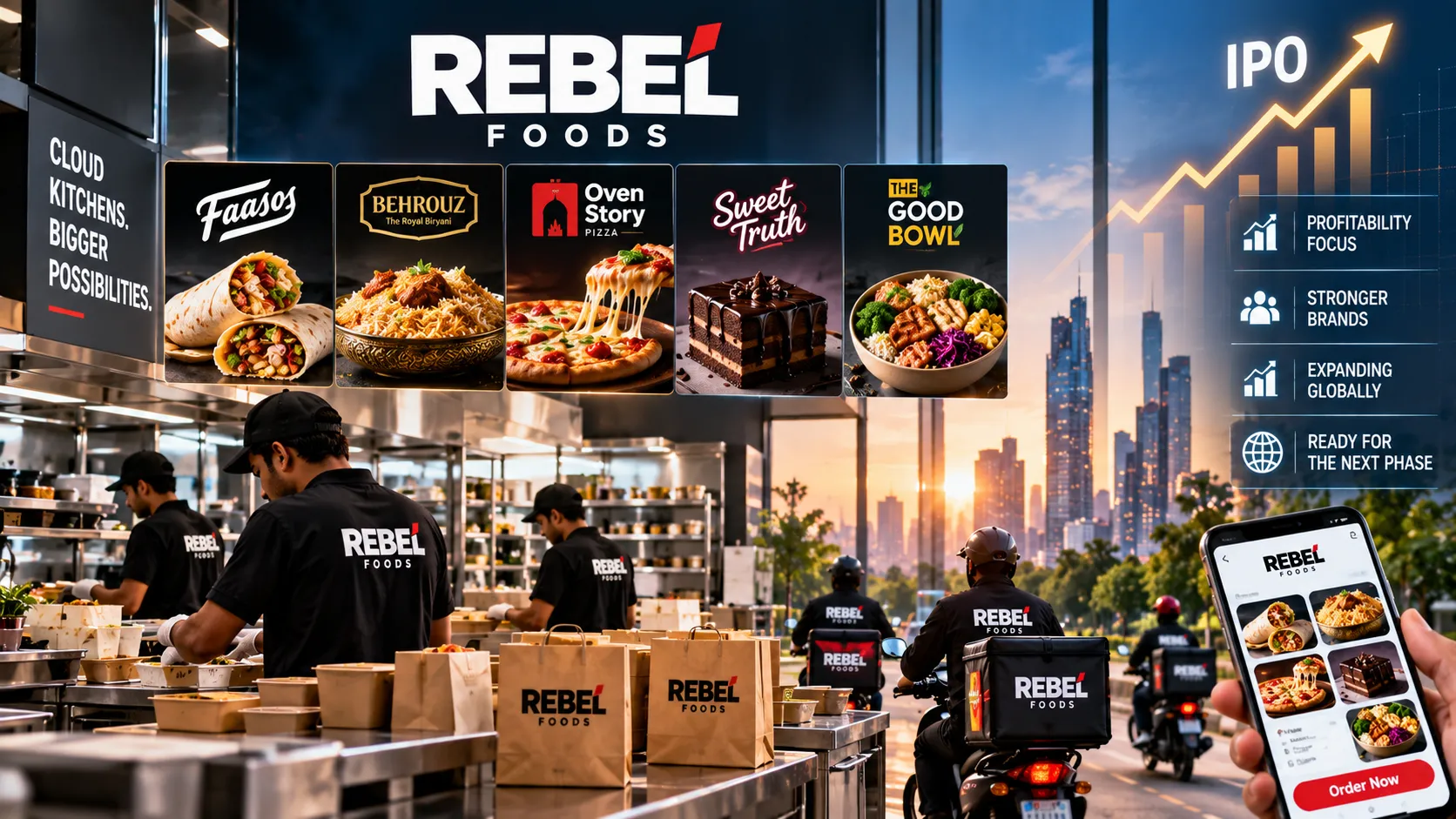
A single cloud kitchen can host multiple brands, sharing infrastructure, staff and supply chains. Rebel Foods operates a portfolio of brands, including Faasos, Behrouz Biryani, Oven Story Pizza, Sweet Truth and The Good Bowl. This model allows the company to serve different cuisines and price points from the same locations, maximising the use of each kitchen.
The company has also expanded internationally in some markets and has franchise partnerships for certain brands.
The economics of cloud kitchens
Cloud kitchens offer lower costs than traditional restaurants, since they do not require expensive dining space in prime locations. But they depend heavily on delivery platforms, which charge commissions on each order, and on marketing to stand out in crowded apps.
Rising commissions, advertising costs and competition have squeezed margins across the industry. Many cloud kitchen startups that emerged during the pandemic have shut down or consolidated. Rebel Foods, as the largest player, has scale advantages but must still manage these pressures.
Its own ordering app and website help it reduce reliance on aggregators, although most orders still come through Swiggy and Zomato.
The road to an IPO
Several Indian consumer internet and food companies have listed in recent years, including Swiggy and Eternal (formerly Zomato), giving investors more benchmarks to value businesses in the sector. However, Swiggy's share price has fallen sharply below its IPO price, and investors have become more demanding about profitability.
For Rebel Foods, the path to a listing will likely depend on demonstrating sustained profitability and growth. The company has not announced a timeline for an IPO.
Why ESOP grants matter
ESOP grants to founders and senior leaders are common in Indian startups, particularly ahead of major events such as IPOs. They can also be controversial when they result in significant dilution for other shareholders or when they are not clearly linked to performance.
Tying a large portion of the chief executive's options to milestones is increasingly seen as good practice, as it rewards leaders only if they deliver results that benefit all shareholders.
India's food delivery landscape
Food delivery in India is dominated by two platforms, Eternal's Zomato and Swiggy, which together account for the vast majority of orders. Restaurants and cloud kitchens depend heavily on them for customer reach, but commissions, advertising fees and discounting can take a significant share of each order's value. Restaurant associations have periodically complained about platform practices, and regulators have examined competition concerns.
New entrants, including Flipkart, which is preparing to launch food delivery with a lower commission model, and the government-backed Open Network for Digital Commerce, could change the dynamics. For Rebel Foods, more competition among platforms could improve its bargaining position.
The talent question
Stock options have become central to how Indian startups compete for leadership talent, particularly as they mature and prepare for public markets. Experienced executives often join startups for the potential upside of equity, accepting lower cash compensation in exchange. Successful IPOs, such as those of Zomato, Nykaa and others, created significant wealth for employees holding options, reinforcing their appeal.
However, falling valuations at some companies have left options underwater, reducing their value as retention tools. Companies have responded by repricing options or granting new ones, as Rebel Foods has done.
What comes next
Rebel Foods will now focus on building on its improving financial performance, expanding its brands and reducing losses further. Its progress will be watched as a test of whether the cloud kitchen model can deliver sustainable profits at scale.
For its leadership, the new stock options create a strong incentive to deliver. If Rebel Foods reaches its goals and lists successfully, they could be worth far more than their current value. The company's next set of results will offer an early read on whether the new leadership is delivering on that mandate. Investors and employees alike will be watching for signs of a listing timeline in the coming year.