RentoMojo, the Bengaluru-based platform that rents furniture and home appliances to urban consumers, has reported its first set of quarterly results since listing on the stock exchanges, delivering strong revenue growth but a sharp fall in profit that management attributed largely to one-off events.
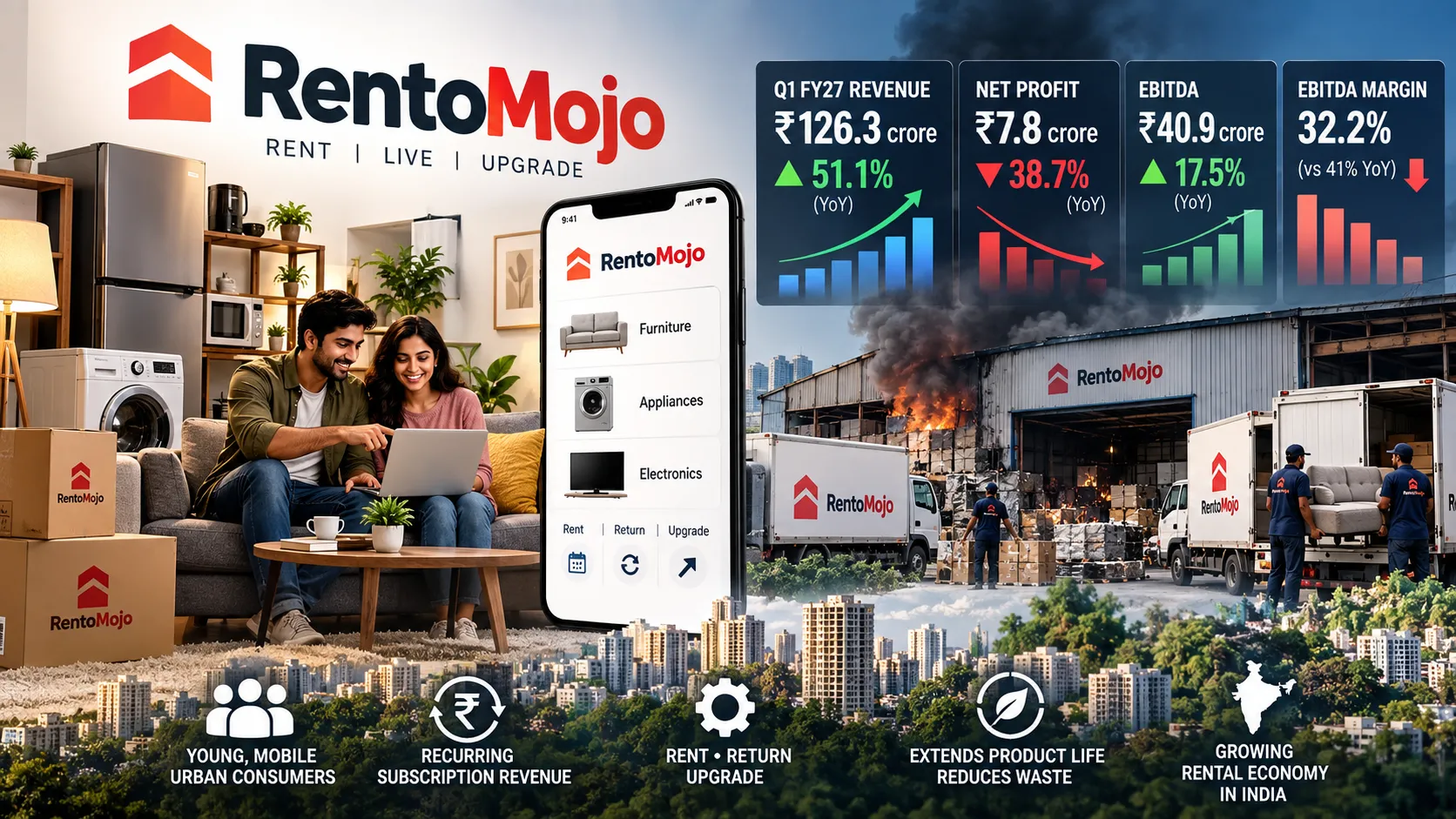
For the first quarter of FY27, the three months to June 2026, RentoMojo's revenue from operations rose 51.1% year-on-year to ₹126.3 crore, from ₹83.6 crore a year earlier, according to its disclosures published on 6 October 2026. Sequentially, revenue grew 15.2% from ₹109.5 crore in the fourth quarter of FY26.
Net profit, however, fell 38.7% year-on-year to ₹7.8 crore from ₹12.8 crore, and was down about 53% from ₹16.8 crore in the preceding quarter. EBITDA rose 17.5% to ₹40.9 crore, but EBITDA margin contracted to 32.2% from 41% in the year-ago quarter.
Management points to one-offs
In its investor communication, the company attributed the decline in reported profit primarily to non-recurring factors, including a fire at one of its warehouses and tax-related adjustments. Management highlighted a normalised EBITDA figure of ₹52.3 crore, arguing that the underlying operations remain healthy once the one-time charges are stripped out.
For a newly listed company, the distinction between reported and normalised performance matters. Public market investors are often willing to look past genuine one-offs, but they also watch carefully for whether such adjustments become recurring. The company's next few quarters will establish whether the margin contraction is temporary or reflects a structural shift in its cost base as it scales.
A business built on access rather than ownership
Founded in 2014, RentoMojo offers furniture, appliances and electronics on monthly subscription plans, allowing customers to rent, return, upgrade and relocate products without paying large sums upfront. Its core audience is young, mobile professionals in India's largest cities, many of whom move frequently for work and prefer flexibility over ownership.
The model has several attractive features. Subscription revenue is recurring and relatively predictable. Each product can be rented multiple times over its useful life, generating returns well above its purchase cost if utilisation remains high. And the company controls the full stack, from procurement and refurbishment to delivery and servicing, which allows it to manage quality and economics end to end.
The quarter's revenue growth was driven by an increase in the number of live products and items ordered through its platform, according to company commentary. That indicates expanding demand rather than simply higher prices, a positive sign for a consumer business.
Why margins tightened
The margin compression reflects the realities of a capital-intensive model. RentoMojo must buy inventory before it can rent it out, finance that inventory, maintain warehouses and refurbish products between customers. Rapid growth requires heavy upfront investment in stock, which pressures margins until those assets have been rented enough times to pay back.
A warehouse fire, while described as a one-off, highlights a risk specific to businesses that hold large physical inventories. Losses of stock, disruption to fulfilment and the costs of recovery can all weigh on results, even if insurance covers part of the damage.
The longer track record
RentoMojo's annual figures show a business that has grown steadily and turned profitable. Operating revenue rose from about ₹193 crore in FY24 to ₹266 crore in FY25 and ₹387 crore in FY26. Reported profit after tax for FY26 was about ₹104 crore, a figure that was boosted by tax items, while profit before tax was about ₹68 crore, according to financial data compiled from its filings.
That trajectory, combined with operating margins in the low forties, helped the company come to market during a busy period for Indian listings. Business Today reported that RentoMojo raised about ₹1,256 crore during the July to September quarter, which saw a wave of public offerings that also included Shiprocket, Milky Mist Dairy Food and Lalithaa Jewellery Mart. Its market capitalisation stood at roughly ₹5,400 crore in mid-September, according to market data. Promoter holding is relatively low, at about 19.8%.
How the market may read the numbers
For investors in new-age companies, RentoMojo's results present a familiar trade-off. On one side is revenue growth above 50%, an expanding customer base and a business model that has demonstrated profitability. On the other is a sharp fall in reported earnings in the very first quarter after listing, which can unsettle shareholders who bought into the IPO on the strength of recent profit growth.
Analysts will focus on three questions. The first is whether normalised margins return to the levels seen before the quarter's disruptions. The second is whether revenue growth can be sustained as the company expands into new cities and product categories. The third is capital efficiency, specifically how much inventory investment each additional rupee of revenue requires.
There is also a sustainability argument that the company and its supporters increasingly emphasise. Renting and refurbishing furniture and appliances extends the useful life of products, reduces waste and lowers the demand for new manufacturing. As urban consumers become more conscious of the environmental cost of disposable consumption, circular business models such as rental could benefit from a shift in attitudes, provided they can match the convenience and price of ownership.
For shareholders, the more immediate concern will be visibility. Clear disclosure on the financial impact of the warehouse fire, any insurance recoveries and the trajectory of normalised margins would help investors separate one-off noise from underlying performance in the quarters ahead.
The rental economy in India
RentoMojo's results are also a reference point for India's broader rental and subscription economy. Renting furniture, appliances, vehicles and even clothing has grown as urbanisation, job mobility and changing attitudes towards ownership reshape consumer behaviour among younger Indians. Competitors include Furlenco and a number of regional operators, and several larger consumer companies have experimented with subscription models.
The sector has had a mixed history, with several startups struggling to make the economics work during periods of rapid, venture-funded expansion. RentoMojo's path to profitability has made it one of the more closely watched players, and its performance as a listed company will influence how public investors view the category.
For now, the company's first report card as a public entity is a reminder that strong top-line growth is necessary but not sufficient. Investors will judge RentoMojo over the coming quarters on whether it can convert that growth into consistent profits, and whether the setbacks of the June quarter prove to be the exception rather than the rule.