TechArtificial Intelligence5 MIN READ

Restate, Built by the Creators of Apache Flink, Raises $20 Million as AI Agents Need Infrastructure That Never Forgets

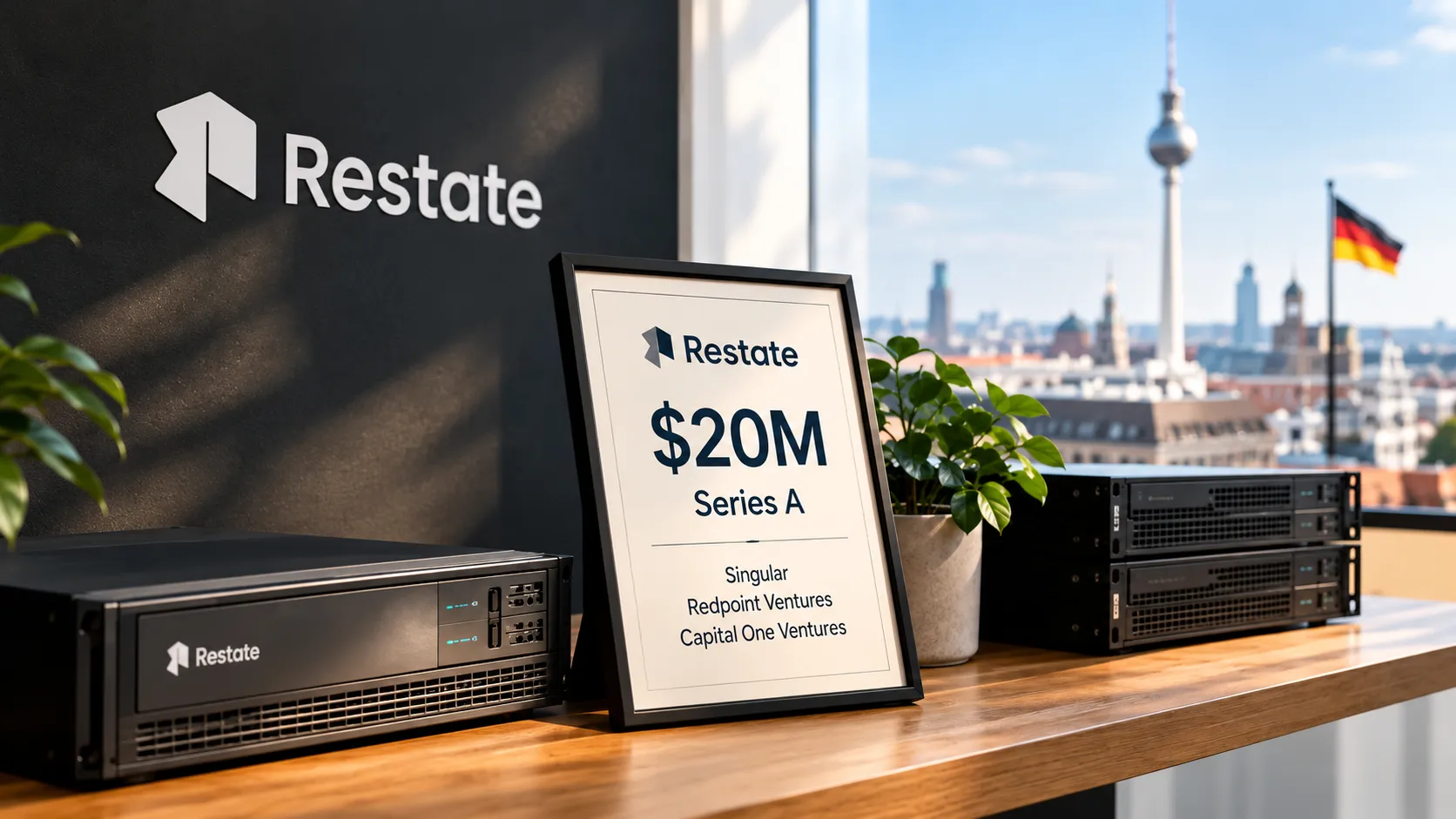
Berlin-based Restate, founded by members of the team behind open-source stream processor Apache Flink, has raised a $20 million Series A led by Singular, with Redpoint Ventures and Capital One Ventures, to scale its durable execution engine for AI agents. Replit already uses it to run its coding agent.

By Shaym Kumar · Author1 October 2026New
Restate, Built by the Creators of Apache Flink, Raises $20 Million as AI Agents Need Infrastructure That Never Forgets

Restate, a Berlin-based startup building infrastructure that keeps software workflows running reliably through crashes and failures, has raised $20 million in Series A funding as demand grows for systems that can support AI agents. The round, announced on 30 September 2026, was led by European venture firm Singular, with participation from Redpoint Ventures and Capital One Ventures. The company has now raised $27 million in total.

Restate was founded by Stephan Ewen, Igal Shilman and Till Rohrmann, engineers who previously helped create Apache Flink, one of the most widely used open-source frameworks for real-time data stream processing. Ewen serves as chief executive.

The problem AI agents create

AI agents are software systems that carry out multi-step tasks on behalf of users: researching information, writing and running code, calling external services, updating databases and making decisions along the way. Unlike a single chatbot response, an agent's work can span many steps and run for minutes or hours.

That creates a reliability challenge. If a server crashes, a network connection drops or an external service fails halfway through, the agent can lose track of what it has already done. Restarting from the beginning wastes time and money, and repeating some steps, such as making a payment or sending an email, could cause real harm.

Restate addresses that problem through what engineers call durable execution. Its system records each completed step and the application's state, so that when something fails, the workflow can resume exactly where it stopped, without repeating work that has already been done.

"You need to make sure you track exactly what you do to make it reproducible and have a consistent outcome," Ewen told TechCrunch.

Built before the agent boom

Restate did not set out to build infrastructure for AI. The company originally designed its system for distributed applications and business workflows, such as payment processing or order management, where reliability is critical.

"It never was built for agents in the beginning, but it just happened to be a perfect match for all these problems that agents surface," Ewen said.

Technically, Restate is built around a distributed log combined with an event-driven orchestrator. It supports durable functions, workflows and stateful objects without requiring developers to manage separate external databases for tracking progress. The company recently launched a Bring Your Own Cloud option, allowing customers to run a managed version of Restate within their own cloud accounts, an important feature for companies with strict data and security requirements.

"Durability has to become a property of the infrastructure itself," Ewen said.

Customers include Replit and Fortune 500 firms

Restate says hundreds of companies use its technology, including AI businesses and Fortune 500 organisations. One of its best-known deployments is with Replit, the software development platform, which uses Restate to handle durable orchestration for its coding agent. Restate also serves Fortune 500 customers in financial services, an industry where losing track of a transaction is not an option.

The company says it has closed multiple six- and seven-figure customer contracts in recent months, suggesting it is moving from developer adoption to substantial enterprise revenue.

The participation of Capital One Ventures, the venture arm of the large US bank, is a signal of interest from financial services, where the reliability of automated workflows is subject to regulatory scrutiny.
“Durability has to become a property of the infrastructure itself.”
— Stephan Ewen, Co-founder and CEO, Restate

image.png

Where the money will go

Restate will use the funding to hire a go-to-market team, add more engineers and expand its office in the San Francisco Bay Area, which will serve as a commercial hub for the US market.

That expansion reflects a familiar path for European infrastructure startups: build the technology and engineering team in Europe, where talent is strong and costs are often lower, then scale sales in the United States, the largest market for developer and infrastructure software.

A pedigree in open-source infrastructure

The founders' history with Apache Flink gives Restate credibility among engineers. Flink became a standard tool for real-time data processing at large technology and financial companies worldwide, and its creators built a commercial company around it that was acquired by Alibaba in 2019.

That experience in building distributed systems that must process enormous volumes of data reliably is directly relevant to durable execution, where correctness under failure is the central design challenge.

A growing infrastructure category

Durable execution has become a recognised category in software infrastructure, with several companies offering competing approaches. The rise of AI agents has accelerated interest, because agent workflows combine long-running processes, unpredictable external calls and expensive computation, all of which make failure handling more important.

Infrastructure for AI agents is attracting significant investment more broadly. Companies building tools for agent orchestration, memory, security, observability and evaluation have all raised funding as enterprises move from experimenting with agents to deploying them in production. The shift mirrors earlier technology waves, in which the companies providing reliable underlying infrastructure often built durable businesses alongside the applications that captured public attention.

Ewen believes durable execution will become a standard component of software architecture. "If we fast-forward a couple of years, it's one of those tools, like a database, that I think pretty much any company will have a use case for," he said.

Relevance for India's software industry

The shift towards agentic systems is also significant for India's technology sector, which builds and maintains a large share of the world's enterprise software through IT services firms and global capability centres. As those companies help clients deploy AI agents in banking, insurance, retail and manufacturing, the reliability of the underlying orchestration becomes a delivery risk they must manage. Infrastructure such as durable execution engines could become part of the standard toolkit for engineering teams in Bengaluru, Hyderabad and Pune building agentic applications for global customers.

Why it matters

As businesses hand more tasks to AI agents, the cost of failure rises. An agent that crashes halfway through processing an insurance claim, reconciling accounts or deploying code can leave systems in an inconsistent state that is difficult to fix. Reliable infrastructure is a precondition for trusting agents with important work.

For Europe, Restate is also an example of the region's strength in deep infrastructure software, built by engineers with world-class open-source credentials. With fresh capital and a growing list of enterprise customers, it is well positioned to become one of the foundational layers of the agentic software stack.

TagsRestateAI AgentsDurable ExecutionApache FlinkDeveloper ToolsInfrastructureSeries ARedpoint VenturesCapital One VenturesBerlin StartupsReplitOpen Source

Reader reviews

Sign in to rate and review this article.
Loading reviews…