TechFuture Tech5 MIN READ

Rivian Buys UK World-Model Startup Third Dimension to Speed Up Self-Driving Work for Its Uber Robotaxi Plans

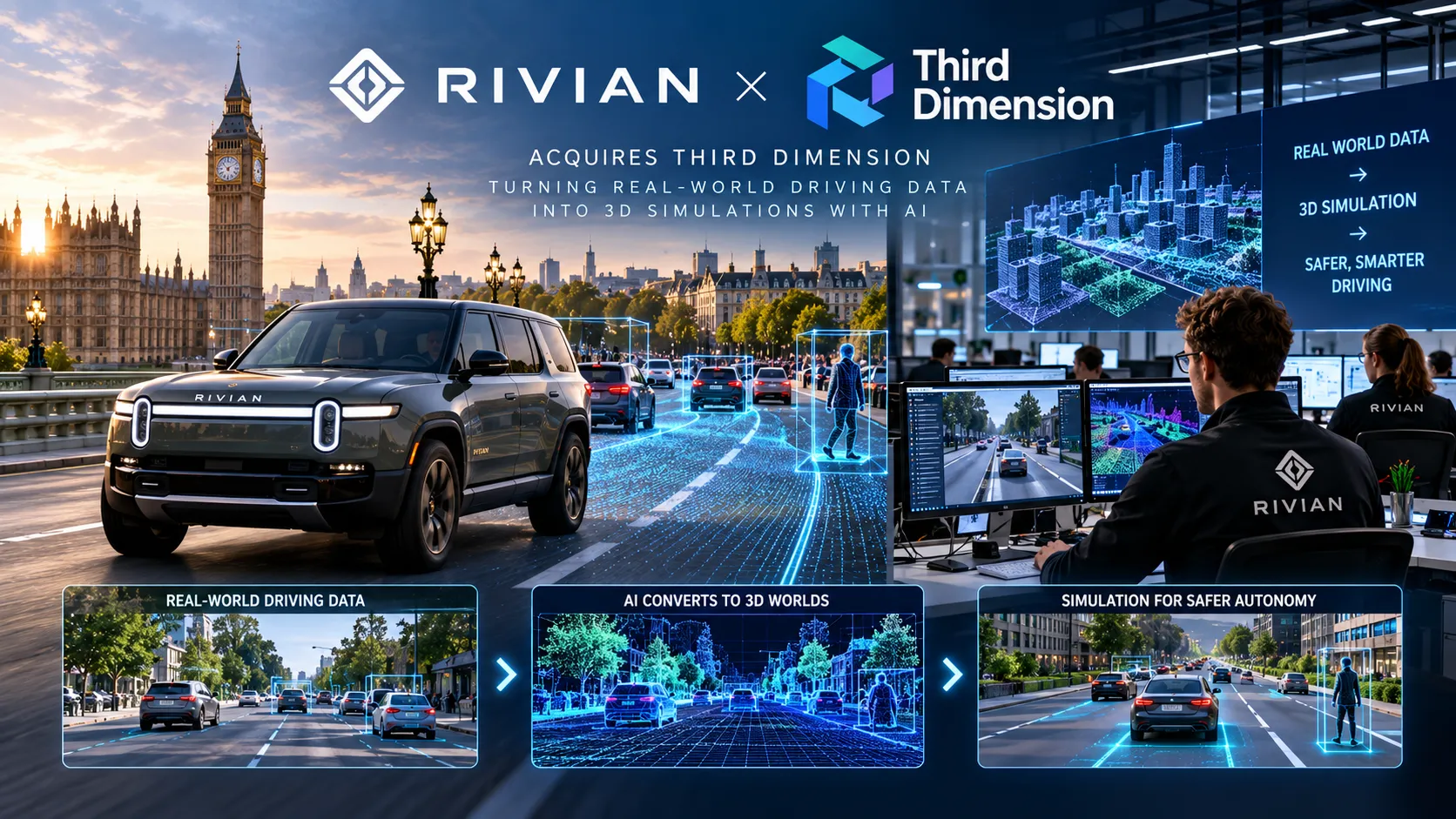
Electric vehicle maker Rivian has acquired Third Dimension, a London-based startup that uses AI to turn images and video into lifelike 3D worlds, to accelerate its driver-assistance and self-driving development. The 15-person team will join Rivian's autonomy group and help build simulations for the robotaxi system Rivian plans to supply to Uber.

By Aravind Kumar · Author23 October 2026New
Rivian Buys UK World-Model Startup Third Dimension to Speed Up Self-Driving Work for Its Uber Robotaxi Plans

Rivian, the US electric vehicle maker, has acquired Third Dimension, a British artificial intelligence startup, in a deal aimed at accelerating its development of driver-assistance and autonomous driving technology.

Third Dimension uses AI to turn ordinary images and videos into lifelike 3D worlds, TechCrunch reported on Thursday, October 22. Rivian plans to use the technology to transform real-world driving data into simulated environments where it can train and test its self-driving software. Financial terms were not disclosed.

The startup's 15 employees, most of them based in the UK, will join Rivian's autonomy and AI team, led by James Philbin. The deal also allows Rivian to expand its AI hub in London.

What Third Dimension does

Founded in 2024 by chief executive Tolga Kart and Piotr Sokólski, Third Dimension is part of a new generation of companies working on "world models," AI systems that can understand and generate realistic representations of physical environments. The company had raised $7 million in seed funding from Abstract Ventures, MVP, Soma Capital and Solari Capital.

"The team is excited to be able to focus on one problem," Kart said, describing autonomous driving as an area "where our technology makes a true difference."

World models have become one of the hottest areas of AI research. Companies including Google DeepMind, Nvidia and several startups are developing systems that can simulate physical worlds, with applications in robotics, autonomous vehicles, gaming and film.

Why simulation matters for self-driving

Developing autonomous vehicles requires exposing software to an enormous variety of driving situations. Many of the most important scenarios, such as unusual road layouts, sudden pedestrian movements or extreme weather, are rare in real-world driving. Waiting to encounter them naturally would take years.

Simulation allows developers to recreate and vary these scenarios at scale. By turning real camera footage into 3D environments, Third Dimension's technology could let Rivian build realistic simulations based on actual roads and conditions, then modify them to test how its software responds to different situations.

Rivian has a substantial source of real-world data. Tens of thousands of owners of its R1S and R1T vehicles, delivery vans and new R2 SUV have enabled external camera data sharing, and the company receives more than 400,000 driving sequences a day from its fleet, according to TechCrunch. The data is aggregated and anonymised.

The Uber partnership

The acquisition supports Rivian's plans to supply vehicles and self-driving technology for robotaxis to Uber. The partnership puts Rivian among a growing group of carmakers and technology companies aiming to compete in autonomous ride-hailing, a market led by Alphabet's Waymo and contested by Tesla, Zoox and Chinese players.

Rivian has made autonomy a central part of its strategy. It has developed its own in-vehicle AI models and a custom autonomy chip, built with Arm and TSMC, aiming to reduce reliance on outside suppliers and control its technology stack. Its chief executive, RJ Scaringe, has said autonomy will enable "dramatically different" vehicle designs.

Competition in autonomy

The race to develop self-driving technology has intensified. Tesla is preparing to sell its Cybercab robotaxi and expand its autonomous services, while Waymo operates commercial driverless services in several US cities. General Motors said this week that it is betting on computing power and AI to compete with Chinese carmakers, which are rapidly advancing driver-assistance features.

“The team is excited to be able to focus on one problem.”
— Tolga Kart, CEO, Third Dimension

Acquiring specialised startups is one way carmakers can accelerate their capabilities. Small, focused teams with expertise in AI, simulation and computer vision are in high demand.

c2ad81ba-8c3f-408a-aa8d-4918731de152.png

London as an AI hub

The deal underscores London's position as a centre for AI talent. The UK capital hosts research operations of major AI companies, including Google DeepMind, and a growing number of startups. Rivian's decision to expand its London AI hub reflects the appeal of tapping European talent pools.

What it means for India

India has a large and growing pool of AI and automotive engineering talent, and many global carmakers and technology companies run research and development centres in the country. Simulation, computer vision and AI for autonomous systems are areas where Indian engineers and startups are increasingly active.

While fully autonomous vehicles face significant challenges on India's complex roads, advanced driver-assistance features are spreading rapidly in Indian cars, and the underlying technologies, including simulation and AI perception, are relevant to Indian manufacturers and suppliers.

The world model wave

The term "world model" refers to AI systems that learn representations of how the physical world looks and behaves. Unlike language models, which are trained mainly on text, world models are trained on images, video and sensor data, allowing them to generate realistic scenes, predict how environments will change and simulate the consequences of actions.

These capabilities are valuable for training robots and autonomous vehicles, which need to understand physical environments. Generating synthetic training data in simulation can be far cheaper and faster than collecting real-world data, and allows developers to create scenarios that would be dangerous or impractical to stage.

Nvidia has promoted world models as a key technology for "physical AI," releasing platforms that developers can use to build simulations. Google DeepMind has unveiled models that can generate interactive 3D environments from text or image prompts.

Rivian's financial position

Rivian has faced financial pressures as it scales production and works towards profitability. The company has benefited from investments by Volkswagen, through a joint venture on software and electrical architecture, and from its long-standing relationship with Amazon, which ordered its electric delivery vans. Its R2 SUV, a lower-priced model, is central to its plans to reach a mass market.

What comes next

Rivian will integrate Third Dimension's team and technology into its autonomy programme. The impact will be measured by how quickly the company can improve its driver-assistance features and move towards the robotaxi system it has promised to Uber.

For the AI industry, the deal is another sign that world models are moving from research labs into commercial applications, with autonomous driving among the first beneficiaries. For Rivian, the deal is a modest but strategic step in a long race. The company's ability to deliver competitive autonomy features could become a key differentiator as it seeks to expand sales of the R2 and compete with Tesla and a growing number of Chinese electric vehicle makers that are investing heavily in driver-assistance technology.

TagsRivianThird Dimensionworld modelsautonomous vehiclesself-drivingrobotaxiUberAI simulation3D reconstructionelectric vehiclesJames PhilbinTolga KartLondon AIADASR2acquisitionAI startupsmobilityEV industrycomputer vision

Reader reviews

Sign in to rate and review this article.
Loading reviews…

