StartupsUnicorns Tech5 MIN READ

Munich's RobCo Becomes Europe's Newest Robotics Unicorn as Its CEO Moves to America

Industrial robotics startup RobCo has passed a $1 billion valuation through a $40 million-plus employee share sale, doubling its value in nine months, as co-founder Roman Hölzl relocates to the US.

By Prathista Lazar · Author6 October 2026New
Munich's RobCo Becomes Europe's Newest Robotics Unicorn as Its CEO Moves to America

RobCo, a Munich-founded maker of autonomous industrial robots, has crossed the $1 billion valuation threshold, joining a small but growing group of European robotics companies that have reached unicorn status as investors pour money into what has become known as physical AI.

The company said on 5 October 2026 that it had completed a share transaction valuing it at more than $1 billion, roughly double its valuation of nine months earlier. The deal centred on a secondary sale of more than $40 million of shares held by long-serving employees, alongside fresh investment into the company. RobCo did not disclose the total amount of new capital raised.

At the same time, chief executive and co-founder Roman Hölzl has relocated to the United States to focus on what the company describes as its fastest-growing market. RobCo now operates from San Francisco, Austin and Munich.

A secondary-led milestone

Unlike many unicorns, which reach a billion-dollar valuation through a large primary funding round, RobCo's milestone came primarily through a transaction that allowed employees to sell part of their holdings. The company said demand from investors to buy into RobCo was strong, and it used that moment to offer liquidity to staff while bringing in new backers.

Hölzl said that he could think of no better way to mark the milestone than by giving the people who helped build the company the chance to realise part of the value they had created. He added that while the valuation was a notable achievement, the company's priority was bringing the next generation of autonomous industrial robotics onto factory floors.

Secondary sales of this kind have become more common among late-stage startups in the United States, where they help retain talent by allowing employees to benefit financially before an initial public offering. In Europe they remain less frequent, and RobCo's transaction is a sign that the region's technology ecosystem is maturing in its approach to employee ownership.

Investors old and new

RobCo's existing investors, including Sequoia Capital, Lightspeed Venture Partners, Greenfield, Kindred, Lingotto and Promus Ventures, participated in the transaction. New investors include Berlin-based Cherry Ventures and the European Tech Collective, a group of founders of successful European technology companies.

Earlier in 2026, the company raised a Series C round of roughly €85 million, or about $100 million, led by Lightspeed and Lingotto, the investment arm of Italy's Exor. That round valued RobCo at around $500 million, according to reports. Doubling that valuation within nine months reflects both the company's commercial progress and the intensity of investor interest in robotics.

What RobCo builds

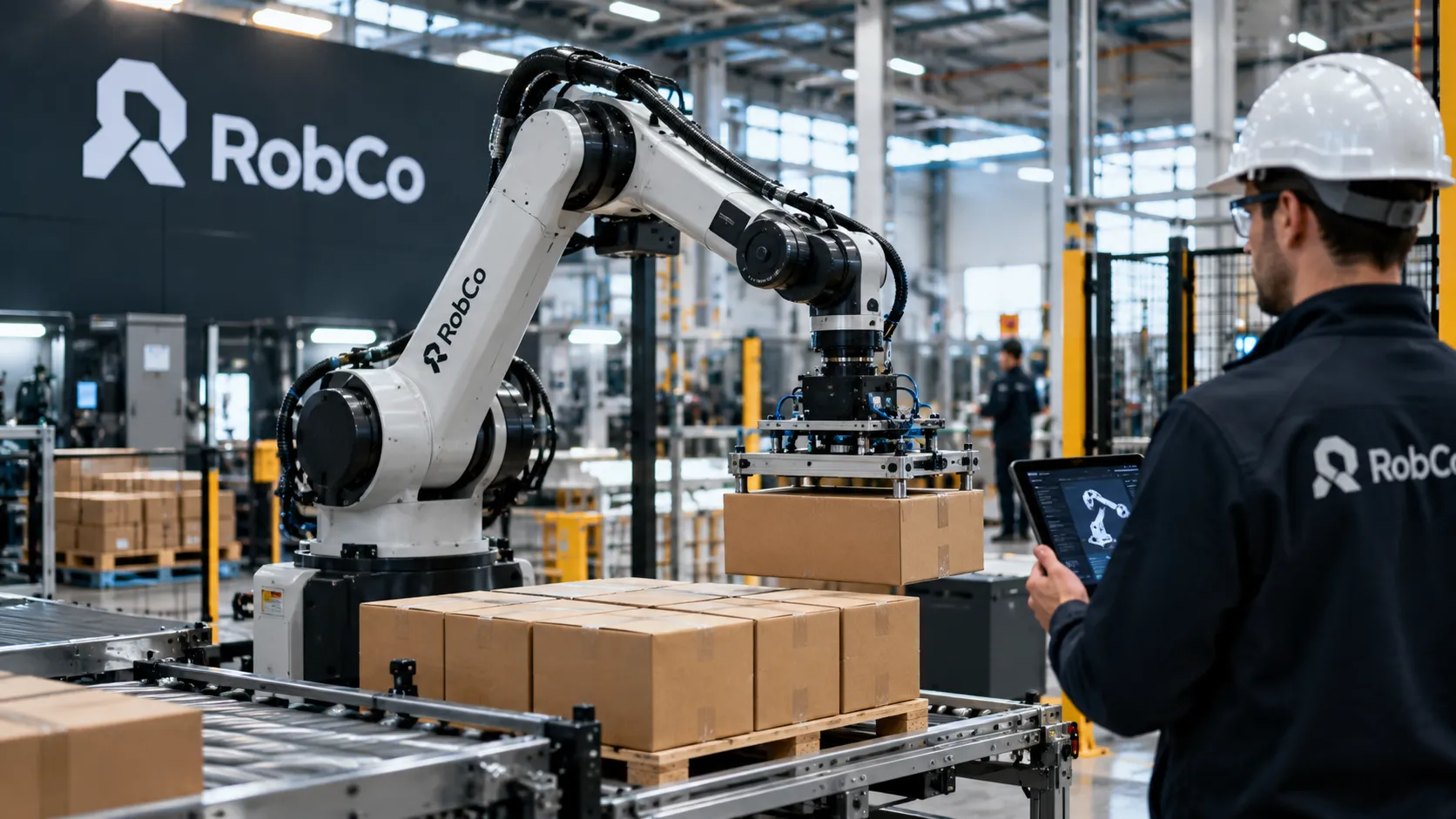
Founded in 2020 by Roman Hölzl, Paul Maroldt and Constantin Dresel, researchers from the robotics and machine intelligence institute at the Technical University of Munich, RobCo builds modular industrial robots that automate repetitive physical tasks such as palletising and weighing raw materials. Its customers include large manufacturers, among them the BMW Group, as well as smaller industrial companies.

A central part of its business model is Robotics-as-a-Service. Rather than requiring manufacturers to make large upfront capital investments in automation, RobCo offers its systems on a subscription basis. That lowers the barrier for small and mid-sized factories, which often lack the budgets and in-house engineering teams to deploy traditional industrial robots.

The company's next major product is Alfie, an autonomous industrial robot that it says combines perception, reasoning and execution to handle high-mix, unstructured and safety-critical work. Such tasks have historically been difficult to automate because they involve frequent changes, variable objects and close interaction with human workers. Alfie is approaching commercial launch.
“RobCo reached unicorn status not by raising a giant round, but by letting the people who built it cash in, a sign of a maturing European ecosystem.”
— TIGI Analysis
7dd6e7a7-b097-4d81-b155-90012ddaad38.png

The physical AI boom

RobCo's milestone comes amid a surge of investment into robotics and AI-powered hardware. According to PitchBook data, robotics and physical AI startups attracted $33.4 billion of investment in the first half of 2026. The logic behind that flow of capital is that advances in AI models, particularly in vision and reasoning, are finally allowing robots to operate in less structured environments than the tightly controlled production lines of the past.

Demand-side forces are also powerful. Manufacturers in Europe, the United States and Asia face persistent labour shortages, ageing workforces and pressure to bring production closer to end markets. The International Federation of Robotics reported that factories worldwide installed 603,000 industrial robots in 2025, an increase of 11%, while the global operational stock of industrial robots reached about 5.08 million, up 9%.

Europe has produced several high-profile robotics companies in this cycle. Germany's Neura Robotics raised up to $1.4 billion in June, while Agile Robots and the UK's Humanoid have also reached billion-dollar valuations. Compared with some of those peers, particularly humanoid robot developers, RobCo's valuation looks restrained. It is focused on practical industrial applications with paying customers rather than on general-purpose humanoid machines.

Why the CEO is moving

Hölzl's relocation to the United States reflects a broader pattern among European technology companies. The US offers a larger addressable market, deeper pools of growth capital and, in manufacturing, policy support for reshoring production. Many European startups find that success in America is essential to reaching global scale.

For RobCo, the move signals that the US is no longer simply an export market but a central part of the company's future. It also raises familiar questions about whether Europe can retain the economic benefits of the technology companies it creates, a recurring theme in debates about the region's competitiveness.

The company's US expansion will also test its business model in a different commercial culture. American manufacturers have historically been quicker to adopt subscription and service-based technology offerings, which could favour RobCo's Robotics-as-a-Service approach. At the same time, competition for engineering talent and customers in American industrial hubs is intense, and the company will need to build local sales, deployment and support teams quickly to capitalise on demand.

The road ahead

RobCo's challenge now is to convert investor enthusiasm into sustained commercial growth. The launch of Alfie will be an important test of whether its technology can handle the complex, variable tasks it is designed for, and whether customers will adopt it at scale. Competition in industrial robotics is intense, ranging from established automation giants to well-funded startups in the United States and China.

For the wider startup community, including Indian founders building in robotics and deep tech, RobCo's journey offers lessons. It shows the value of focusing on concrete industrial problems, of business models that reduce customers' upfront costs and of treating employee ownership as a genuine part of company building. Its billion-dollar valuation is a milestone. Whether it becomes a lasting industrial company will depend on how many factory floors its robots ultimately reach.

TagsRobCoUnicornRoboticsPhysical AIIndustrial AutomationRobotics-as-a-ServiceGermanyMunichSequoiaLightspeedSecondary SaleStartups

Reader reviews

Sign in to rate and review this article.
Loading reviews…