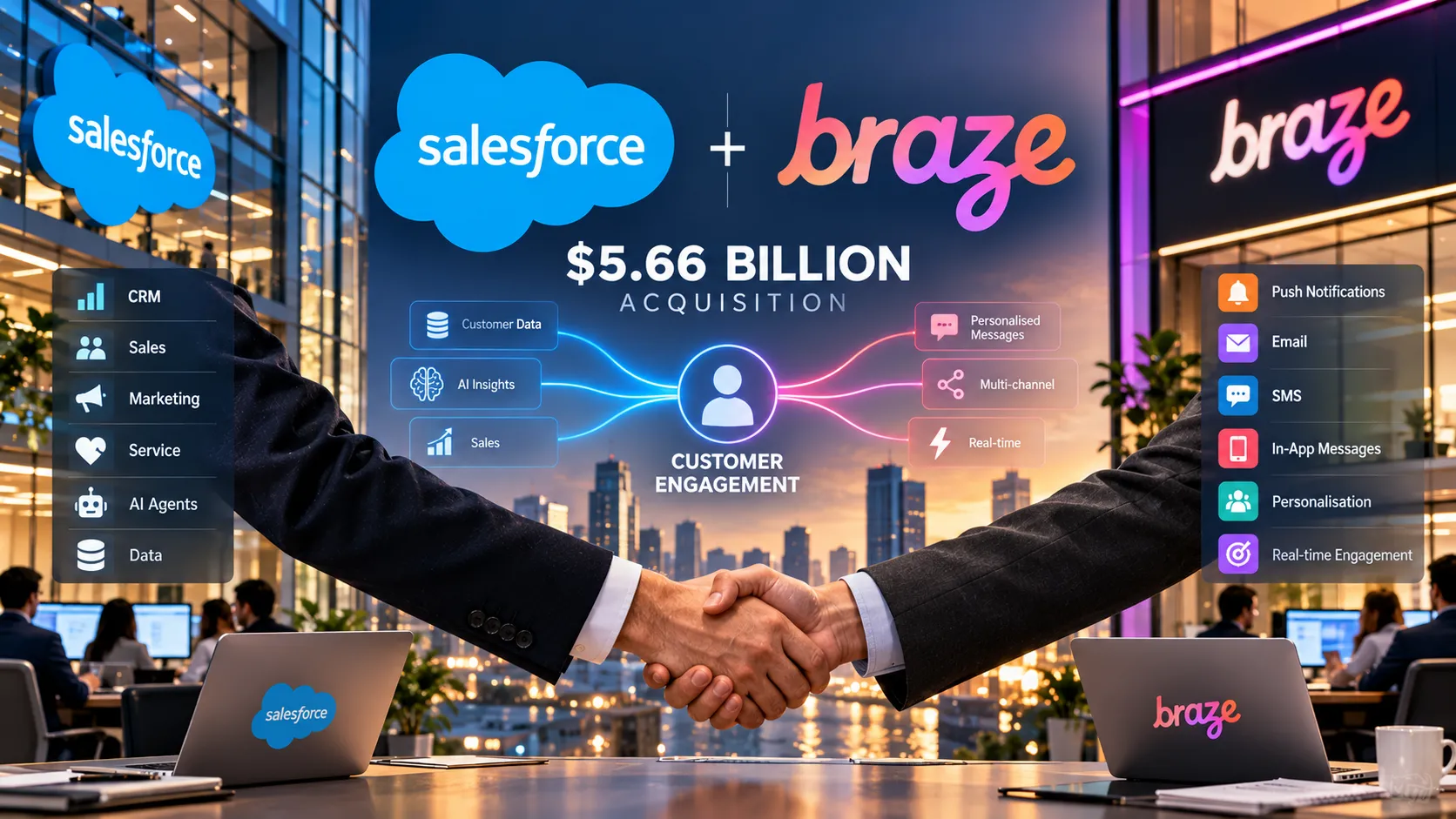
Salesforce has struck another major acquisition in its race to reinvent itself for the age of artificial intelligence. The world's largest customer relationship management software company agreed on Tuesday, October 20, to buy Braze, a customer engagement platform, for about $5.66 billion in cash, Reuters reported.
Salesforce will pay $47.50 per Braze share, a premium of about 58.1% to Braze's last closing price. Braze shares jumped more than 50% on the news.
The deal is expected to close in Salesforce's fiscal year 2028 and is not expected to change the company's forecast for fiscal 2027. J.P. Morgan Securities is advising Salesforce, while Qatalyst Partners is advising Braze.
What Braze does
Braze helps companies communicate with their customers across channels such as mobile push notifications, email, SMS and in-app messages, using data about customer behaviour to personalise messages in real time. Its platform serves about 2,770 customers, including design platform Canva, grocery delivery company Instacart and payments app Venmo.
The company has built AI tools that help marketers decide which content, offers and channels are most likely to engage each customer, and when to send them. For consumer-facing brands, especially mobile apps, timely and relevant messaging can make a significant difference to user retention and revenue.
Shay Boloor of Futurum Equities said Salesforce is buying "a real-time engagement layer that its marketing business has historically lacked."
Salesforce's AI transformation
The acquisition is the latest step in Salesforce's effort to accelerate its transition to AI. The company has been pushing AI agents, software that can carry out tasks such as answering customer queries, qualifying sales leads and running marketing campaigns, as the future of enterprise software.
Earlier this year, Salesforce agreed to buy AI agent platform Fin for $3.6 billion, and last year it struck an $8 billion deal for data management company Informatica, according to Reuters. Together, these acquisitions aim to give Salesforce the data, AI and engagement capabilities needed to compete in a rapidly changing market.
The push reflects investor concerns that AI could erode demand for traditional software. If AI agents can perform tasks that once required employees using software applications, companies may need fewer software licences, threatening the subscription model on which companies like Salesforce have built their businesses. Software stocks have been volatile as investors weigh which companies will benefit from AI and which will be disrupted.
By owning more of the data and engagement layer, Salesforce hopes to ensure that its platform remains central to how companies interact with customers, even as AI changes how that work is done.
Deal protections
The agreement includes termination fees on both sides. Salesforce would pay $300 million if the deal is abandoned under certain circumstances, while Braze would pay $191.4 million if it walks away, according to the terms.
The deal will require regulatory approvals and the approval of Braze shareholders. Given Salesforce's size and its existing marketing cloud business, antitrust regulators may examine the transaction, although the market for marketing technology remains crowded with competitors.
A crowded marketing technology market
Braze competes in a busy market that includes Adobe, Oracle, Twilio's Segment, HubSpot, Iterable and Klaviyo, as well as Salesforce's own Marketing Cloud. Consolidation has been a recurring theme as large software companies seek to offer comprehensive suites rather than individual tools.