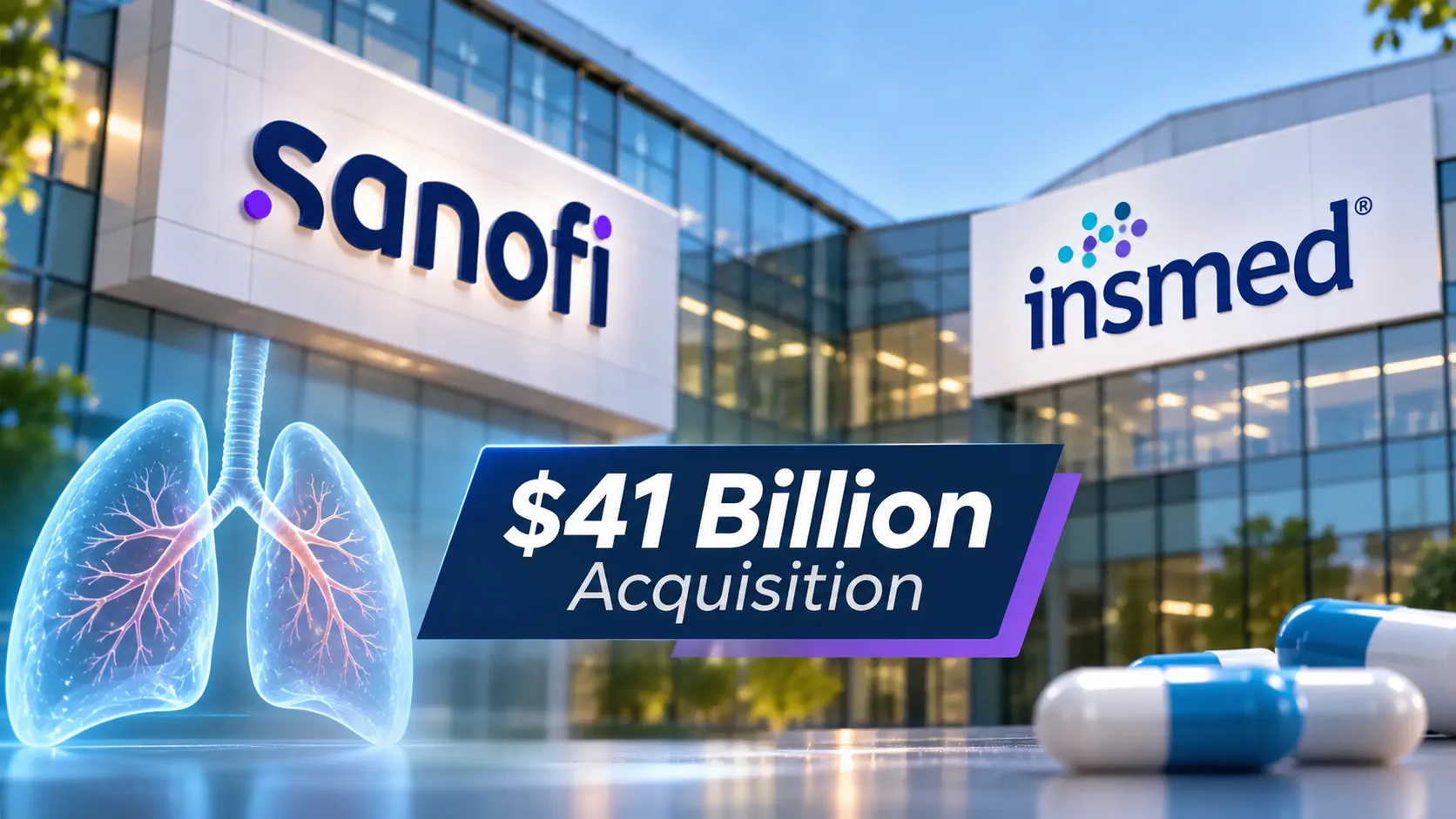
One of Europe's largest drugmakers has made its biggest bet in years, paying a premium price for a fast-growing respiratory drug that it hopes will power its growth into the next decade.
Sanofi announced on Tuesday, November 24, that it has agreed to acquire Insmed, a US biopharmaceutical company, for $175 per share in cash, according to a statement filed with the US Securities and Exchange Commission. The deal gives Insmed a total equity value of about $41.0 billion, or €37.6 billion.
The acquisition will be funded through debt financing and cash on hand, with committed financing in place. Sanofi expects the transaction to add to earnings per share by the end of 2028 and to have no impact on its 2026 guidance.
The deal is expected to close in the first half of 2027, subject to approval by Insmed shareholders, US and certain non-US regulatory clearances, and other customary conditions.
The prize: Brinsupri
At the heart of the transaction is Brinsupri, the brand name for brensocatib, a once-daily oral medicine for non-cystic fibrosis bronchiectasis (NCFB). Bronchiectasis is a chronic lung condition in which the airways become permanently widened and damaged, leading to persistent cough, excess mucus and repeated lung infections.
Brinsupri works by inhibiting an enzyme called DPP1, which plays a role in activating inflammatory cells in the lungs. It is the first approved treatment specifically for the condition.
The drug is approved in the United States, the European Union, the United Kingdom and Japan, with indicated patient populations varying by region. Since its US launch in August 2025, it has generated $1.09 billion in revenue through September 30, 2026, according to the filing, a rapid start that suggests strong demand from patients and doctors.
More than one product
Sanofi is also acquiring Arikayce, an inhaled antibiotic for a difficult-to-treat lung infection caused by nontuberculous mycobacteria. Arikayce generated revenue of $433.8 million in 2025.
The deal also brings TPIP, an inhaled therapy in Phase 3 development for several rare respiratory diseases, as well as earlier-stage programmes and research capabilities in immunology and rare diseases.
What Sanofi says
"This acquisition is a major strategic step to significantly accelerate our mid- and long-term growth trajectory," said Belen Garijo, Sanofi's chief executive, in the statement.
Sanofi said the deal broadens its presence in respiratory medicine, an area of significant unmet need, and adds two commercialised products and a differentiated late-stage pipeline. It said it would maintain its progressive dividend policy and strong credit rating.
Will Lewis, Insmed's chair and chief executive, said: "This transaction delivers immediate, certain cash value for Insmed shareholders and ensures the momentum we have built continues."
The Dupixent cliff
The deal must be understood in the context of Sanofi's dependence on Dupixent, its blockbuster immunology drug developed with Regeneron. Dupixent treats conditions including eczema, asthma and chronic obstructive pulmonary disease, and it has become one of the best-selling medicines in the world.
However, key patents on Dupixent are expected to expire in the early 2030s, after which cheaper biosimilar versions could erode its sales. Pharmaceutical companies facing such "patent cliffs" often turn to acquisitions to replace lost revenue, buying companies with drugs that are already on the market or close to approval.