Scimplify, a Bengaluru-based company that uses artificial intelligence to develop and manufacture specialty chemicals and critical materials, has raised $25 million in an all-equity strategic round led by Hitachi Ventures, the corporate venture arm of the Japanese conglomerate.
Two of the company's own customers, German chemicals and adhesives group Henkel and US polymer compounder Teknor Apex, joined the round as new investors. Existing backers Accel India, Bertelsmann India Investments, Omnivore and 3one4 Capital also participated. The round takes Scimplify's total equity funding to about $80 million.
The company declined to disclose its valuation. A person familiar with the deal told TechCrunch the round valued Scimplify at about $250 million post-money, up from $150 million at its $40 million Series B in March 2025.
A Business Built on Supply Chain Anxiety
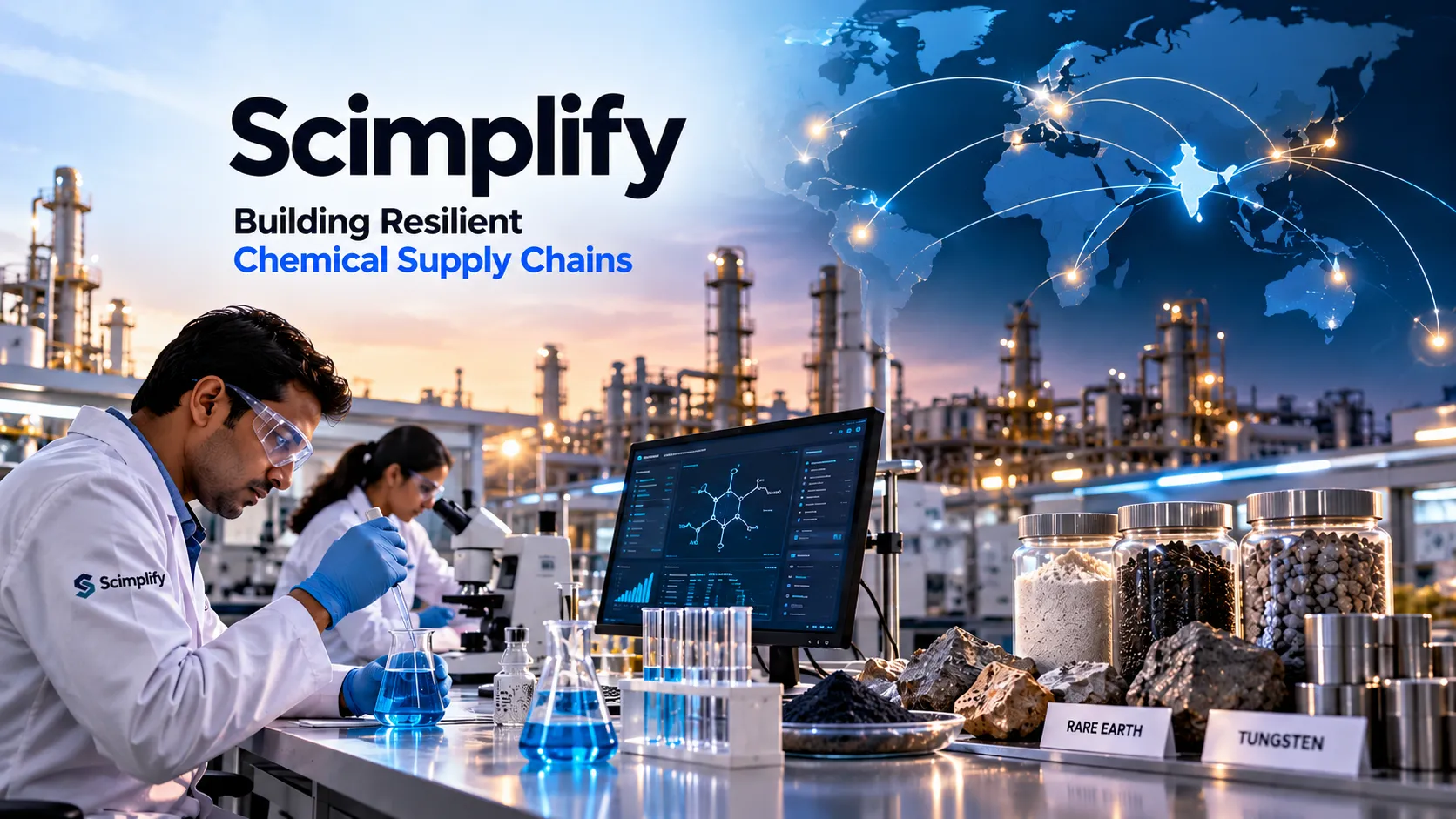
Scimplify's pitch has sharpened considerably since its founding in 2023. What began as a platform to help businesses develop, source and manufacture specialty chemicals has evolved into something more strategic: a way for global manufacturers to build alternative supply chains for materials that are concentrated in China and a handful of other countries.
That shift reflects a wider change in industrial priorities. After years of optimising for cost, manufacturers in electronics, energy and defence are now paying a premium for resilience. Geopolitical tension, export controls and the memory of pandemic-era disruption have pushed procurement teams to qualify second and third sources for inputs they once bought from a single region.
Scimplify says its work now includes producing tungsten derivatives from scrap and developing rare-earth materials, two categories where supply is especially concentrated. Energy, electronics and defence together account for about 45 to 50 per cent of revenue, up from less than 15 per cent a year earlier, the company told TechCrunch.
Growth That Has Outrun Expectations
The financial trajectory is striking for a company barely three years old. Scimplify says its annualised revenue run rate has reached about $200 million, triple the level of a year ago, and it is targeting a $400 million run rate over the next year.
The company has been EBITDA-positive for the past two months and expects to turn a profit after tax this month, according to TechCrunch. Regulatory filings previously reported by Indian media showed operating revenue of ₹200 crore in the year to March 2025, up from ₹17.74 crore a year earlier, alongside a net loss of ₹25.38 crore. The latest figures suggest that growth has continued to compound while losses have narrowed.
Its customer base has also become decisively international. Scimplify says it serves more than 1,000 customers and delivers to over 40 countries. Customers outside India now account for more than half of revenue, compared with less than 5 per cent roughly 18 months ago. Named customers include Japan's TDK, Germany's BASF and Hitachi itself.
An Asset-Light Model With a Scientific Core
Unlike traditional chemicals companies, Scimplify does not rely on building its own large plants. Its research facilities in Bengaluru and Hyderabad develop production processes, which are then transferred to a network of more than 500 partner manufacturing facilities. An in-house team of scientists and engineers oversees production across that network. About 90 per cent of manufacturing currently takes place in India.
The model allows Scimplify to move quickly and scale without the capital burden of owning factories, while drawing on India's large base of small and mid-sized chemical manufacturers that often lack direct access to global customers. In some cases, the company says, it has gone from a customer's requirements to finished material in two months, against a typical industry timeline of 12 to 18 months.
Underpinning that speed is Scinode, a proprietary AI platform that identifies suitable production routes and facilities and tracks quality and regulatory requirements. Specialised AI agents support research, manufacturing and quality control. Co-founder Sachin Santhosh told TechCrunch that the system "helps us move a lot faster and remember customer context even for future references."
Why Strategic Investors Matter Here
The composition of the round is as telling as its size. Corporate investors that are also customers bring more than capital: they validate the quality and reliability of a supplier in a sector where qualification can take years and a single failed batch can halt a production line.
For Hitachi, which is both an investor and a customer, the deal offers exposure to a supplier that can help diversify its own materials sourcing. For Henkel and Teknor Apex, taking equity in a supplier signals a long-term commitment and aligns incentives around performance and capacity.
The participation of existing investors including Accel, Omnivore and 3one4 Capital suggests continued confidence among Scimplify's early backers as the company moves into more technically demanding and strategically sensitive categories.
The US Push
A significant share of the new capital is aimed at the United States. Scimplify plans to allocate about $7.5 million to US expansion, including building out manufacturing there, and about $2 million to further develop Scinode, although the company noted the US allocation could change.
The US is already a large and fast-growing market. Scimplify says its US annualised revenue run rate has risen sixfold to about $60 million, from $10 million a year earlier, and that the country now accounts for roughly 30 per cent of its business. The company also plans to expand production into the US and Japan over the next year, a move that could help it serve customers who want suppliers closer to home or outside any single geography.
Scimplify employs about 340 people, including roughly 70 scientists. Most are based in India, with local teams in the US, Japan, Indonesia and the UAE.
India's Opportunity in the China-Plus-One Era
Scimplify's rise speaks to a larger opportunity for India. Global manufacturers have spent several years discussing "China-plus-one" strategies, but execution in chemicals and materials has been slow. The sector is technically complex, heavily regulated and dependent on deep process know-how.
India has a large chemicals industry with strong capabilities in pharmaceuticals and agrochemical intermediates. What it has historically lacked is the connective tissue that links thousands of mid-sized producers to demanding international buyers with exacting quality and documentation requirements. Platforms such as Scimplify attempt to provide that layer by combining process development, quality assurance and global sales under one roof.
The risks are real. Specialty chemicals are cyclical, and revenue can swing with customer inventory cycles. Relying on partner factories demands rigorous oversight to maintain consistent quality. Moving into rare earths and defence-related materials brings regulatory scrutiny and longer qualification cycles. And competition will intensify as other suppliers chase the same diversification budgets.
The Road Ahead
Still, Scimplify enters its next phase with momentum that few industrial startups achieve. It has revenue scale, emerging profitability, marquee customers that are now also shareholders, and a funding round led by one of Japan's largest industrial groups.
If it hits its $400 million run-rate target, Scimplify would rank among the more consequential industrial technology companies to emerge from India's startup ecosystem in recent years. More importantly for its customers, it would provide evidence that resilient, diversified supply chains for critical materials can be built faster than many in the industry assumed.