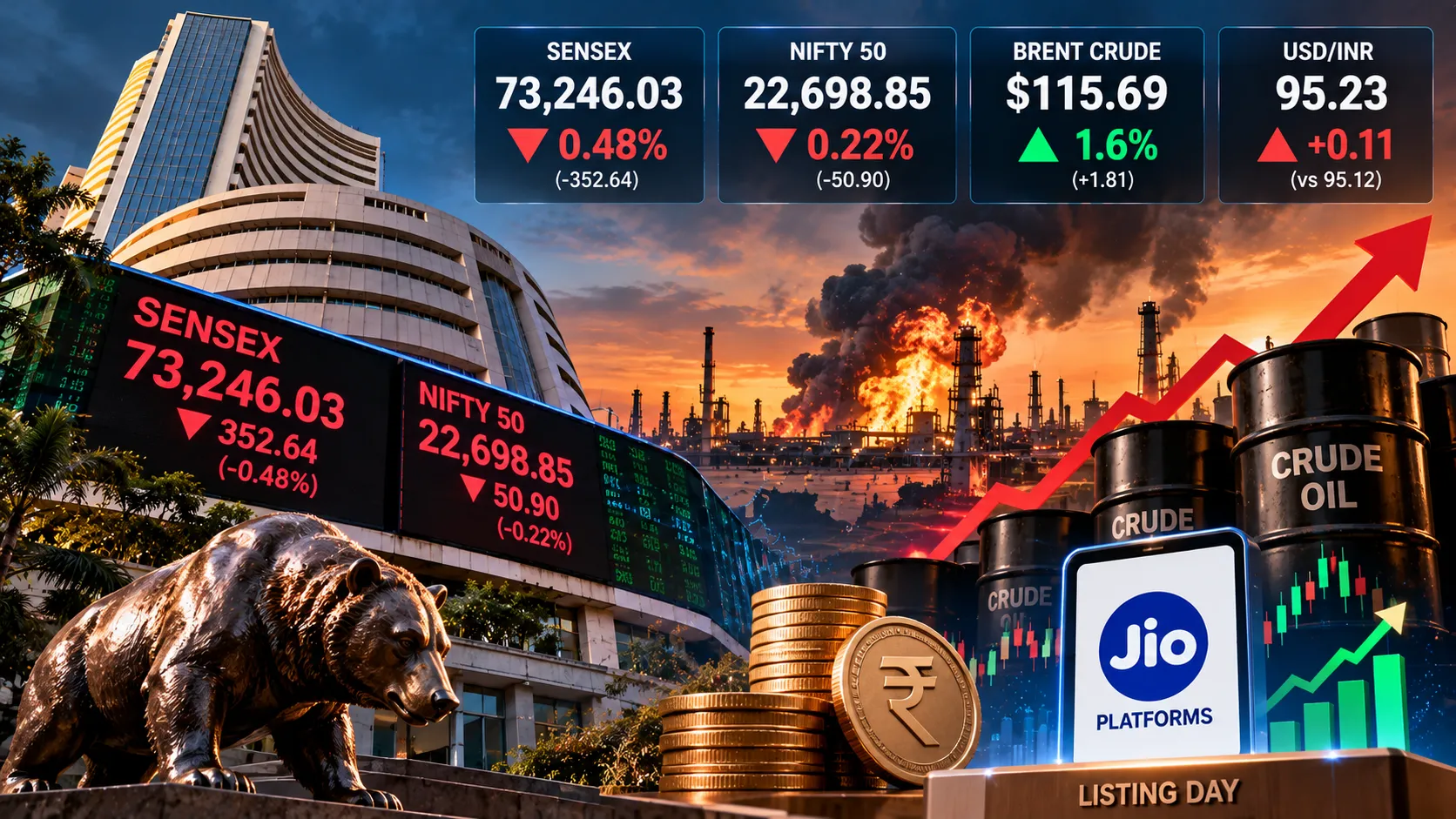
Indian equities lost ground on Wednesday as a fresh attack on Middle Eastern oil infrastructure sent crude prices higher, overshadowing a blockbuster stock market debut by Jio Platforms and caution ahead of the US Federal Reserve's policy decision.
The BSE Sensex closed down 352.64 points, or 0.48%, at 73,246.03 on October 28, while the NSE Nifty 50 fell 50.90 points, or 0.22%, to 22,698.85, according to HDFC Sky. The rupee weakened 11 paise to close at 95.23 per dollar from 95.12.
The oil shock returns
The main trigger was crude oil. Yemen's Houthi rebels said on Tuesday that they had hit Saudi Arabia's biggest oil refinery, which has a capacity of 550,000 barrels per day, with a missile. Saudi authorities had not immediately confirmed the strike, according to Reuters reports carried by Business Recorder.
Brent crude rose $1.81, or 1.6%, to $115.69 a barrel by mid-morning in New York, while US West Texas Intermediate gained $2.52, or 2.5%, to $102.42. The rise pushed Brent back into what technical analysts call overbought territory for the fourth time in five days.
Dennis Kissler, senior vice president of trading at BOK Financial, said crude futures were "once again pricing in nearer-term tighter supplies on news the US is likely to re-start military operations soon."
Supply worries were compounded by a surprise draw of 1.9 million barrels in US crude inventories for the week ended October 23, according to the Energy Information Administration, against forecasts of a small build.
Why oil matters so much to India
India imports most of the crude oil it consumes, making it one of the economies most exposed to higher prices. Every sustained increase in crude raises the country's import bill, widens the current account deficit, puts pressure on the rupee and feeds inflation through fuel, transport and manufacturing costs.
The rupee's slide to 95.23 per dollar, close to record lows, reflects that vulnerability. A weaker currency in turn raises the rupee cost of imported oil, creating a feedback loop that policymakers have struggled to break during the current crisis.
Sector scorecard
Information technology and oil and gas stocks were the biggest drags, with the Nifty IT and Nifty Oil & Gas indices each falling about 2%. Realty, energy and FMCG indices lost about 0.5% each.
Among the top laggards on the Nifty were Infosys, HCLTech, Reliance Industries, ONGC and Bharti Airtel, according to HDFC Sky. IT stocks remain under pressure after Infosys cut its full-year revenue growth guidance last week, raising concerns about demand for traditional technology services.
On the positive side, auto, consumer durables, media and pharmaceutical stocks each gained about 1%. Apollo Hospitals, Larsen & Toubro, Trent, SBI Life and InterGlobe Aviation were among the top gainers, while Bajaj Auto attracted buying after its results. HDFC Sky noted that its live stock ticker showed some conflicting moves, so individual figures should be checked against exchange data.
The broader market fared better than the benchmarks. The Nifty Midcap index rose 0.4% and the Nifty Smallcap index 0.9%. Market breadth was positive, with 2,178 stocks advancing against 1,957 declining.
The Jio debut
The session's highlight was the listing of Jio Platforms, which opened at ₹1,358 on the National Stock Exchange, about 21% above its issue price of ₹1,119. The ₹30,213 crore offering drew bids worth about $77 billion, and the listing valued the company at roughly $131.5 billion, making it India's second-most valuable listed company after its parent Reliance Industries.
Jio's strong debut showed that investors remain willing to back large, well-known companies even in a volatile market, but it did not prevent the benchmark indices from closing lower.
The Fed and global backdrop
Investors were also cautious ahead of the US Federal Reserve's decision, announced late on Wednesday night India time. The Fed held its benchmark rate at 3.75-4% in a 10-2 vote, with two officials favouring an increase, and described the US economy as growing at a "strong" pace, keeping alive expectations of a rate hike in December.
A hawkish Fed tends to strengthen the dollar and raise US bond yields, drawing capital away from emerging markets such as India. The 10-year US Treasury yield rose to about 5.04% after the decision.
The geopolitical overlay
The refinery attack is part of a wider conflict in West Asia that has disrupted energy supplies for months. Qatari mediators have presented Iran with a new draft deal to end the war, but a senior Iranian official said Doha had only put forward unacceptable ideas. Several analysts expect renewed US strikes on Iran after the US midterm elections on November 3.
OPEC+ is expected to keep its December output targets unchanged at a meeting on Sunday, with most core members already producing below their targets.
What it means for investors
For Indian investors, the session underlined how closely the market's direction is tied to oil. Sectors that benefit from a weak rupee, such as pharmaceuticals, and those with strong domestic demand, such as autos, have shown relative resilience, while oil-sensitive and export-dependent IT stocks remain under pressure.
Analysts generally expect volatility to persist until there is clarity on the conflict in West Asia and the path of global interest rates.
Foreign flows and the rupee
Foreign portfolio investors have been cautious sellers of Indian equities through much of the autumn, as a stronger dollar, high US yields and the oil shock reduce the appeal of emerging markets. Domestic institutions, backed by steady inflows into mutual funds through systematic investment plans, have largely absorbed that selling, which has helped limit the depth of market declines. A weaker rupee raises the cost of imported crude and other commodities, but it also supports exporters such as IT services and pharmaceutical companies, which earn much of their revenue in dollars. The Reserve Bank of India has intervened in currency markets at times to smooth sharp moves, and traders will watch its actions closely if oil prices climb further.
What comes next
Market participants will watch crude prices, the rupee and foreign fund flows in the coming sessions, as well as quarterly results from companies including Asian Paints, Coal India, Trent and IndiGo. A de-escalation in the Middle East would be the most powerful catalyst for a rebound, while further attacks on energy infrastructure could deepen the pressure on Indian assets.