Indian equities extended their November rally on Wednesday, with the benchmark indices posting strong gains as buying in automobile, banking and consumer stocks and a powerful wave of foreign inflows overwhelmed concerns about rising US interest rates.
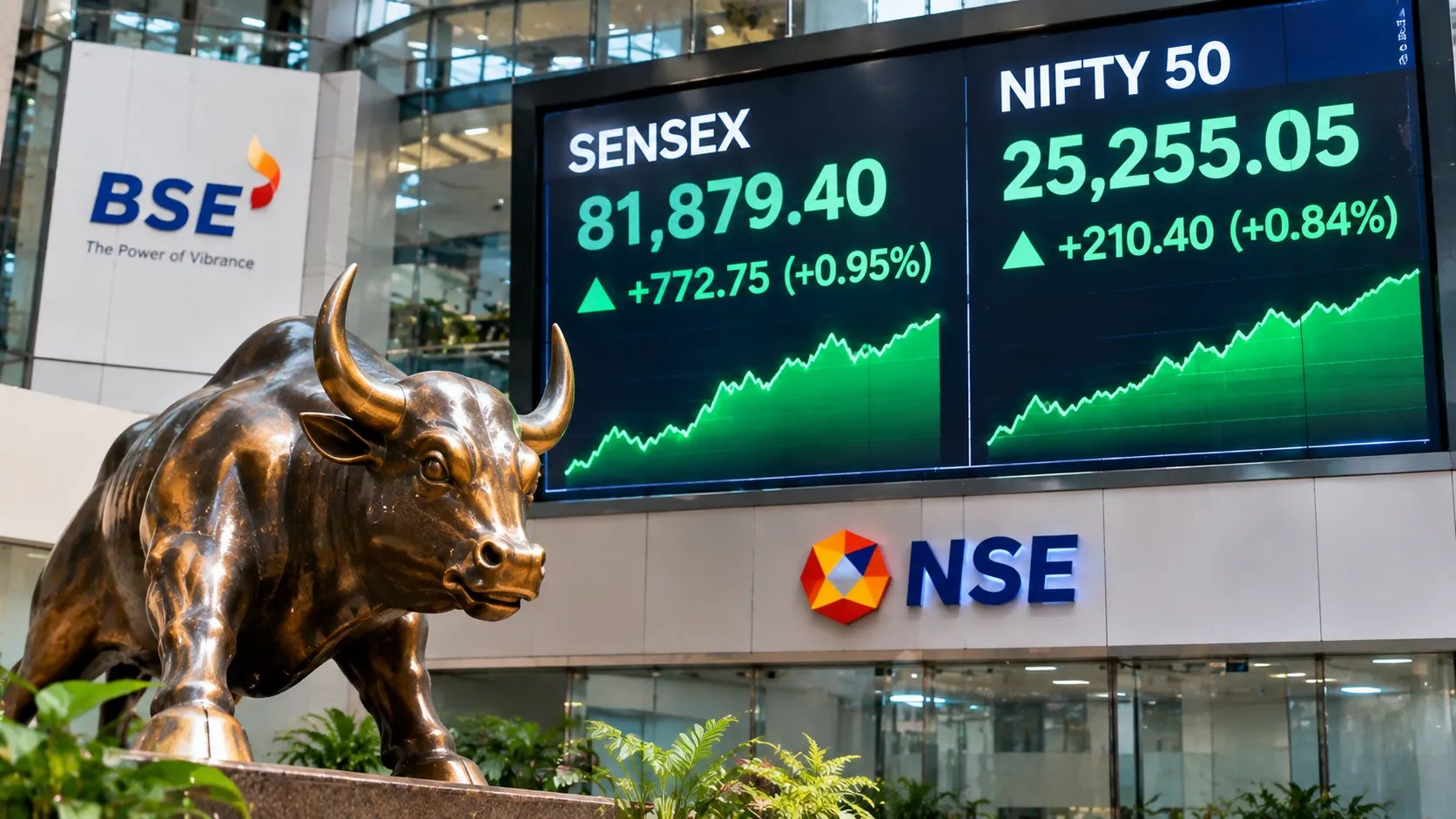
The BSE Sensex closed 772.75 points, or 0.95%, higher at 81,879.40 on November 11, according to HDFC Sky. The NSE Nifty 50 rose 210.40 points, or 0.84%, to 25,255.05. The indices pared some of their intraday gains, according to Business Standard, but still delivered one of the strongest sessions of the month as trading resumed after a market holiday.
The rally was broad. Advancing shares outnumbered decliners by 2,756 to 1,555 on the BSE, with 162 unchanged, according to HDFC Sky. The Nifty Smallcap index rose 1.6% and the Nifty Midcap index gained 0.8%, outperforming the large-cap benchmarks, while the PSU bank index rose about 3%, Business Standard reported.
Sectors in focus
Auto and banking stocks led the advance, with the Nifty Auto and Nifty Bank indices each gaining about 1% to 2%, according to HDFC Sky. FMCG stocks also posted strong gains. Information technology, pharmaceutical and realty stocks lagged, with their sectoral indices slipping between 0.5% and 1%.
Mahindra & Mahindra, InterGlobe Aviation, Eicher Motors, Trent and Tata Steel were among the leading gainers in the Nifty 50, according to HDFC Sky, while Tech Mahindra, Nestlé India, HCL Technologies and Titan were among the laggards. Price data on some trackers differed on individual stock moves, so investors should consult exchange data for final figures.
The foreign money wave
The most important driver of the rally has been the return of foreign investors. Foreign portfolio investors have bought $5.68 billion of Indian shares so far in November, their biggest monthly buying since September 2024, according to HDFC Sky. The Nifty and Sensex have gained nearly 10% this month.
The flows mark a sharp reversal from earlier in the year, when foreign investors sold Indian equities and redirected capital towards markets such as South Korea and Taiwan that were seen as direct beneficiaries of the AI boom. Now, with AI-linked technology stocks under pressure in the United States, analysts say investors are rotating towards markets with strong domestic growth stories and less exposure to the AI trade.
India fits that description. Its economy is driven primarily by domestic consumption and investment, its corporate earnings have proved resilient in the September quarter, and its valuations have become more reasonable after months of underperformance relative to other emerging markets.
Crude oil offers relief
Lower oil prices have also supported Indian stocks. Brent crude fell to a two-month low of $89.16 a barrel on Tuesday before recovering to about $92 on Wednesday, as concerns over the US-Iran conflict eased, according to HDFC Sky. Business Standard reported that oil fell after US President Donald Trump suggested the war with Iran could end soon.
India imports more than 85% of its crude oil, so lower prices reduce pressure on the import bill, inflation and the rupee. The rupee opened at 93.72 to the US dollar on Wednesday, 21 paise stronger than its previous close of 93.93, according to Business Standard.
The US rates headwind
Not all the global signals were positive. Wall Street fell on Tuesday after hotter-than-expected US inflation data pushed up Treasury yields and raised expectations of a more aggressive Federal Reserve rate increase in December, according to HDFC Sky. Higher US interest rates tend to draw capital away from emerging markets, as investors can earn more on safe American assets.