Indian equities extended their losses for a second straight session on Thursday, October 22, as a fresh flare-up of violence in the Gulf sent oil prices sharply higher and reignited fears about inflation, interest rates and India's import bill.
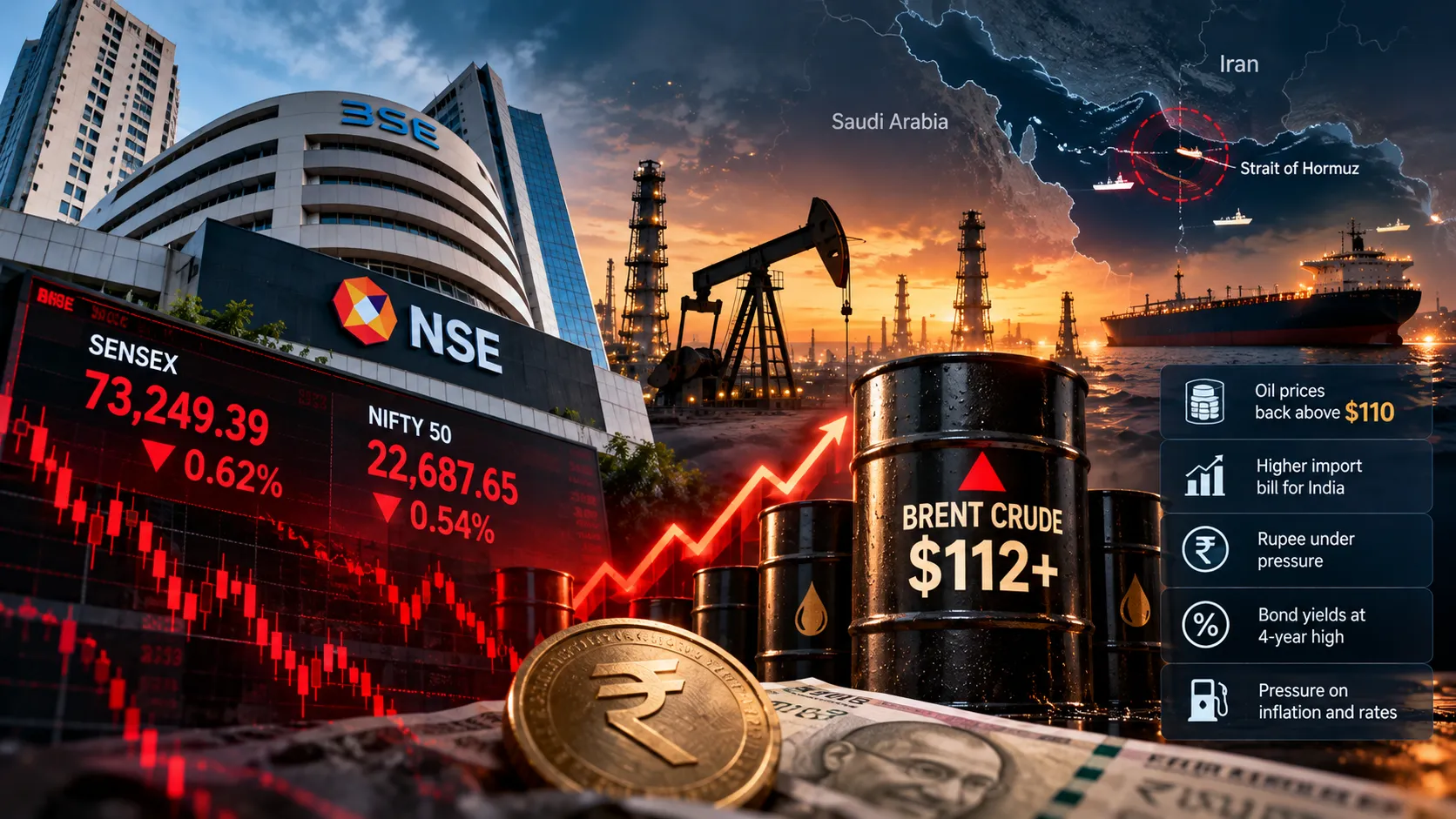
The BSE Sensex closed at 73,249.39, down more than 450 points or 0.62%, while the NSE Nifty 50 ended at 22,687.65, down more than 120 points or 0.54%, according to Kotak Neo market data. The broader market fared worse. The Nifty Midcap 100 fell 0.87% and the Nifty Smallcap 100 dropped 1.14%, as investors cut exposure to riskier stocks.
The selling was driven less by domestic news than by events more than 2,000 kilometres away. Houthi strikes on Saudi Arabia on Wednesday killed at least one person and wounded eight at a civilian airport in Dammam, while a drone attack on a Saudi oilfield killed two people, Reuters reported. Iran's Islamic Revolutionary Guard Corps separately claimed that it had struck four oil-carrying ships in the northern Persian Gulf and that three other vessels had hit mines in the western Strait of Hormuz.
Oil back above $110
Brent crude December futures traded at $111.71 a barrel in the afternoon, and later rose above $112, while US West Texas Intermediate traded around $99.32. Prices had already been near a five-month high earlier in the week after a drawdown in US crude inventories.
For India, which imports nearly 90% of its crude oil needs, the price of oil is one of the most important variables for the economy and the markets. Higher crude raises the cost of fuel, transport and manufacturing inputs, widens the current account deficit and puts pressure on the rupee. It also squeezes the margins of state-run fuel retailers. On the same day, Hindustan Petroleum Corporation reported a 9% fall in quarterly profit as higher crude prices and tax expenses weighed on its earnings.
The attacks added to a sense that the conflict in West Asia is spreading. Kpler data cited by Reuters showed at least 18 attacks on shipping in the past two weeks, and LSEG analysts warned that Iran was targeting tankers beyond the Strait of Hormuz, including in the Gulf of Oman. The United States ordered some diplomats and their families to leave its missions in Saudi Arabia.
Winners and losers
Among Nifty 50 stocks, Bajaj Finance, Cipla, UltraTech Cement, ICICI Bank and Bajaj Auto were the top gainers. Nestle India, Eternal, HDFC Life Insurance, Tata Motors Passenger Vehicles and Reliance Industries were among the biggest losers.
Stock-specific action remained intense as the second-quarter earnings season gathered pace, with dozens of companies, including Adani Energy Solutions, Havells, HPCL and Swiggy, scheduled to report results. Swiggy shares hit a record low during the session, falling about 6% to ₹209.65 ahead of its numbers, while Balkrishna Industries rose about 4% after announcing a strategic partnership with Italian tyre maker Pirelli.
India Cements was a notable outlier, rising about 22% over two days on heavy trading volumes despite the weak market.
Rupee ends its winning streak
The currency market reflected the same pressures. The rupee closed at 94.83 per dollar, weaker than its previous close of 94.47, ending an eight-session winning streak, Business Standard reported. It had touched an intraday high of 94.33 in early trade before giving up its gains as dollar demand emerged.
State-run banks were seen buying dollars around 94.32, possibly on behalf of oil companies or the Reserve Bank of India. The rupee has still gained 1.06% so far in October, helped by foreign inflows linked to the Jio Platforms IPO and RBI measures to curb dollar demand, but it remains about 4% weaker than before the start of the US-Iran conflict.
"The pullback suggests that dollar demand emerged at lower levels," said Dilip Parmar of HDFC Securities, adding that "elevated crude oil prices remain a key risk for the currency." He expects the rupee to trade between 94.50 and 95.25 in the near term.
Amit Pabari of CR Forex noted that the rupee "has taken support at 94.20 thrice before." He said a fall in Brent below $105 could prompt exporters to sell dollars and speed up the rupee's recovery.
Bond yields at a four-year high
In the bond market, the yield on India's benchmark 10-year government security settled at 7.46%, up from 7.44%, its highest level since November 3, 2022. Rising yields reflect expectations that inflation will stay elevated and that the RBI, which recently raised its policy rate, is in no hurry to cut.
Banking system liquidity has also tightened, with the surplus shrinking to just ₹542 crore as advance tax payments drained cash from the system, pushing short-term rates higher. Tighter liquidity and higher yields can weigh on equity valuations, particularly for rate-sensitive sectors such as banks, real estate and autos.
Gold and silver fell on the MCX as higher crude prices revived concerns about further interest rate increases. Gold December futures slipped 0.84% to ₹1,44,850 per 10 grams, while silver fell 2.7% to ₹2,03,527 per kilogram.
What is weighing on sentiment
Analysts say Indian markets are caught between supportive domestic factors and difficult global conditions. On the positive side, the record Jio Platforms IPO has drawn strong demand, second-quarter results have been broadly resilient, and planned private-sector capital investment rose 39% year on year to ₹99.7 lakh crore in September, according to market data.
On the negative side, the conflict in West Asia shows no sign of easing, US President Donald Trump said on Wednesday that Washington was not negotiating with Iran, and global bond yields remain high. Investors are also watching US jobs data ahead of the Federal Reserve's policy decision next week. The MSCI All Country World Index was on course for its biggest daily fall in two weeks.
Why oil matters so much for India
The sensitivity of Indian markets to oil prices has a structural explanation. Crude is India's single largest import, and every sustained $10 rise in prices adds billions of dollars to the annual import bill. Higher fuel costs feed into food and transport inflation, which affects household spending and corporate margins across sectors. Oil marketing companies, airlines, paint makers, chemical manufacturers and logistics businesses are particularly exposed.
At the same time, India's government has limited room to cushion consumers through tax cuts without straining its finances. That leaves the economy more exposed to prolonged price spikes than many other large emerging markets.
What comes next
Market participants expect cautious trading to continue until there is greater clarity on the situation in West Asia. The direction of crude prices, foreign investor flows and the outcome of the Jio Platforms IPO will be key factors in the coming sessions, along with results from major companies.
For long-term investors, analysts generally advise focusing on companies with strong balance sheets and pricing power, which are better placed to cope with higher input costs. For now, the message from Thursday's session is clear: as long as oil stays above $110, Indian markets will struggle to sustain a rally.