Indian equities recovered sharply on Tuesday, October 13. Technology shares led a broad advance that reversed the previous session's losses and added about ₹4.62 lakh crore to investor wealth in a single day.
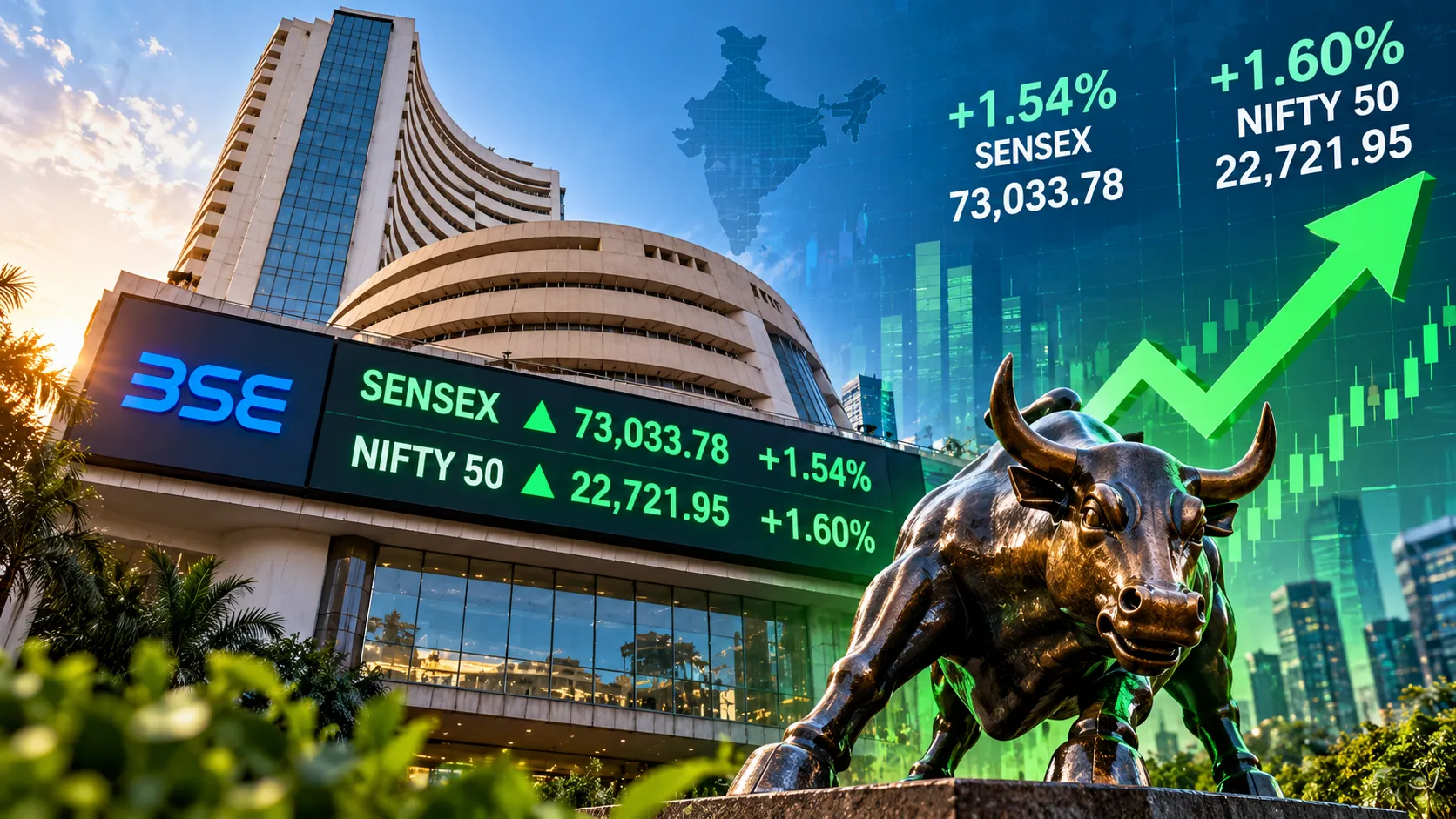
The 30-share BSE Sensex closed 1,109 points, or 1.54%, higher at 73,033.78. The NSE Nifty 50 rose 1.60% to 22,721.95, comfortably reclaiming the 22,700 mark. The day before, the Sensex had fallen 547.65 points to 71,924.68 and the Nifty had dropped 157.10 points to 22,363.35, as worries over crude oil, inflation and tighter monetary policy weighed on sentiment.
The turnaround came without a single dominant trigger. Market participants instead pointed to a combination of supportive signals: a sharp rebound in information technology stocks, comments from Finance Minister Nirmala Sitharaman hinting at a review of transaction taxes, a stronger rupee, and an upgrade to India's growth outlook from the International Monetary Fund.
IT stocks do the heavy lifting
The Nifty IT index jumped 5.22%, by far the strongest sectoral move of the day. Software exporters dominated the leaderboard: HCL Technologies, Tata Consultancy Services and Tech Mahindra were among the top gainers in the Nifty 50, along with non-bank lender Shriram Finance.
The size of the IT rally stood out against the global backdrop. On the same day, technology stocks elsewhere in Asia were under heavy pressure. South Korea's Kospi fell more than 7% intraday as a sell-off in memory-chip makers deepened. Indian IT companies, which mostly sell services and software rather than hardware, have little direct exposure to memory pricing. Investors appeared to treat them as a separate trade. India's large-cap technology names are also among the most liquid stocks for foreign funds, so sharp moves in the sector tend to lift the headline indices disproportionately.
Not every heavyweight joined in. Kotak Mahindra Bank, food-delivery and quick-commerce company Eternal, Maruti Suzuki India and Max Healthcare Institute were among the main laggards in the Nifty 50.
Broader market follows, but more cautiously
Gains extended beyond the large caps, though with less conviction. The Nifty Midcap 100 rose 1.06%, while the Nifty Smallcap 100 edged up just 0.11%. The Nifty Media index added 0.42%. The gap between large-cap and small-cap performance suggests the buying was concentrated in liquid, index-heavy stocks rather than spread across the market. Traders often read that pattern as institutional short-covering or tactical repositioning rather than a broad return of retail risk appetite.
The policy and macro signals
Several developments on the policy front helped the mood. Sitharaman's suggestion that transaction taxes could be reviewed was well received. Levies on securities transactions have been a sore point for active traders and foreign investors, and any easing would lower trading costs at a time when the market has struggled for direction.
The rupee also provided support. It opened 62 paise stronger at 95.16 to the dollar and later hit a one-month high, after the Reserve Bank of India introduced stricter foreign-exchange trading guidelines aimed at curbing speculation. A steadier currency reduces the pressure on foreign portfolio investors, whose dollar returns erode when the rupee weakens.
Separately, the IMF raised its forecast for India's growth to 7% from the 6.4% it projected in July, citing stronger momentum, resilient domestic consumption and robust services activity despite higher oil prices. The Fund also projected consumer inflation of 5% for the current fiscal year.
These positives arrived against a difficult backdrop. Data released on October 12 showed retail inflation rose to 5.54% in September, a 23-month high, from 4.83% in August. Food inflation climbed to 7.74%, and rural inflation, at 6.08%, ran well ahead of the urban rate. The Reserve Bank had already raised its policy repo rate by 25 basis points to 5.50% on October 7, its first increase since February 2023, and shifted to a stance of calibrated tightening. With inflation now above 5.5%, markets are bracing for the possibility of further tightening.
The transaction-tax comments struck a particular chord because of recent history. In the July 2024 Union Budget, the government raised the securities transaction tax on futures to 0.02% and on options to 0.1%, part of a broader effort, alongside tighter rules from market regulator SEBI, to cool a boom in speculative derivatives trading by retail investors. Trading volumes in the derivatives segment fell after those changes, and brokers and exchanges have since lobbied for relief. Any review that lowers costs for investors could revive activity, though officials are likely to weigh that against the risks the earlier measures were designed to contain.
Oil remains the key risk
Crude prices were the other major variable. Oil fell on Tuesday after a sharp rally the previous session, but remained elevated. In mid-afternoon trade, Brent crude futures for December delivery stood at about $104.42 a barrel, while US West Texas Intermediate futures for November were near $91.77. Traders were weighing possible supply disruptions from attacks on Saudi Arabia against expectations of higher diesel availability from Russia.
For India, which imports most of the crude it consumes, oil above $100 a barrel feeds directly into inflation, the trade deficit and the rupee. Every sustained rise in crude tests the resilience of corporate margins, especially in sectors such as aviation, paints, chemicals and consumer goods, where raw-material costs are closely linked to oil.
Precious metals were largely flat. On the Multi Commodity Exchange, gold futures for December delivery traded at about ₹1,49,533 per 10 grams and silver futures at about ₹2,22,800 per kilogram, both marginally lower in afternoon trade.
What comes next
Tuesday's session showed that buyers are willing to step in when valuations look reasonable and the macro news is less bad than feared. Whether the rebound lasts is another matter. Market participants expect stock-specific moves and sector rotation to drive the near term rather than a broad, sustained rally.
Several events will shape the next few sessions. US consumer price data due on October 14 could reset expectations for the Federal Reserve, with knock-on effects for emerging-market flows. The second-quarter earnings season is gathering pace, and IT companies' results and outlooks will test whether Tuesday's sector rally reflected a real change in fundamentals or simply a relief bounce. The path of crude prices and any follow-through on the transaction-tax review will be closely watched.
For now, Dalal Street has recovered the ground lost on Monday and then some. The challenge for investors is to tell a turning point from a pause in a market still navigating high oil prices, rising inflation and a central bank that has shifted firmly towards tightening.