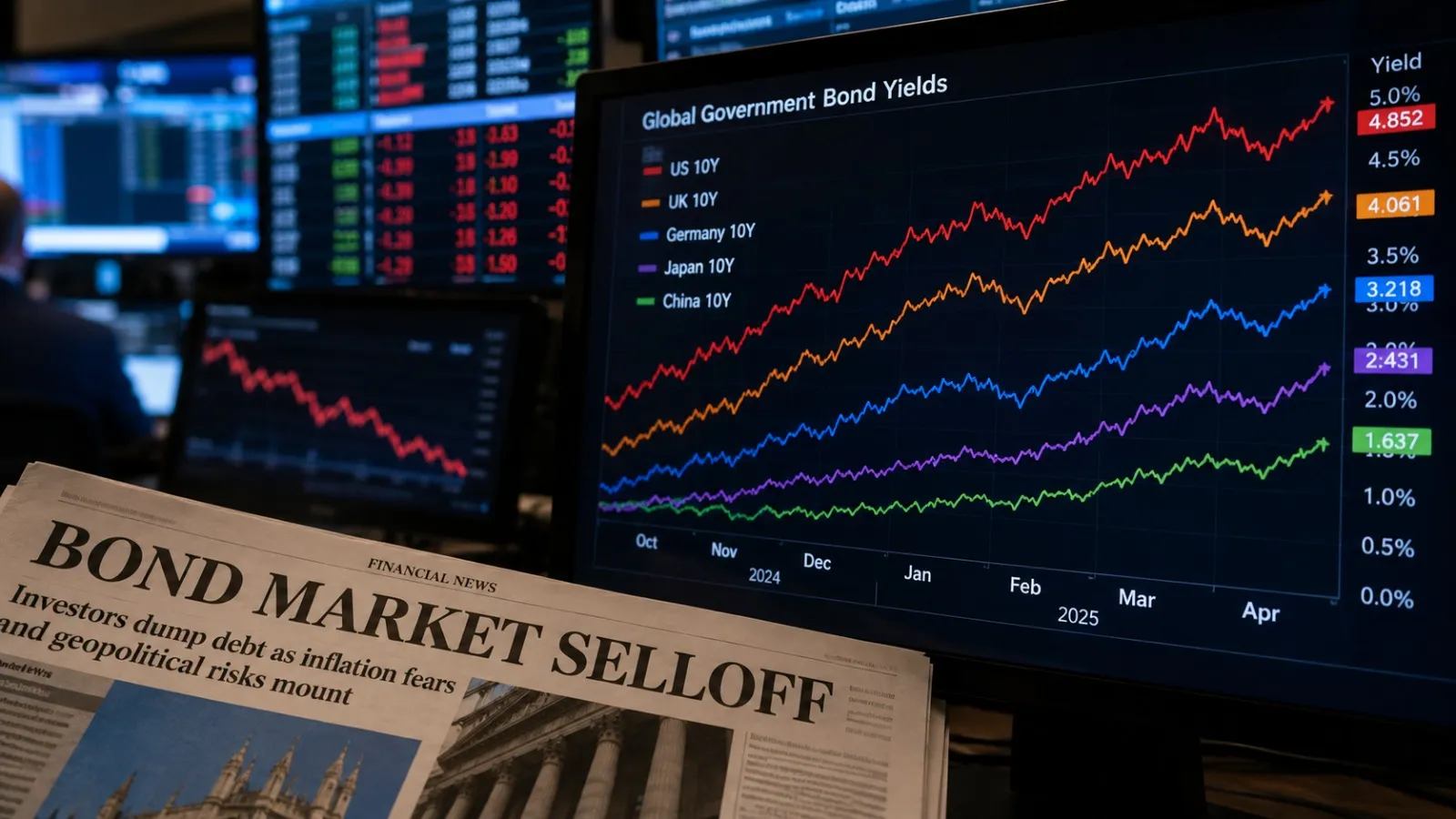
India's equity benchmarks ended the week lower for a seventh consecutive time, extending the longest weekly losing streak for the Nifty since the market collapse triggered by the Covid-19 pandemic. A modest recovery on Friday was not enough to offset the damage from a sharp sell-off on Thursday, as investors weighed record foreign outflows, US Treasury yields at their highest levels since 2007 and crude oil prices that remain above $100 a barrel.
The NSE Nifty 50 lost 205.90 points, or about 0.9%, over the week to close at 23,140.50 on Friday, September 25. The BSE Sensex fell 399.22 points, or 0.54%, to end at 73,895.74. Market reports put the Nifty's cumulative decline over the seven-week run at about 5.8%. Markets were closed on Saturday.
A rebound that could not rescue the week
Friday's session offered some relief. The Sensex rose 315.20 points, or 0.43%, and the Nifty gained 77.40 points, or 0.34%, as bank, auto and realty stocks recovered. Axis Bank led the Nifty's gainers, rising 3.03%, followed by Asian Paints at 2.14% and Mahindra & Mahindra at 1.75%. Max Healthcare was the biggest loser, falling 3.06%, while Tata Motors' passenger vehicle arm and Infosys dropped 1.54% and 1.41% respectively.
Market breadth was balanced. Thirty-four of the 50 Nifty stocks rose, and across the broader Nifty 500 advancing stocks narrowly outnumbered decliners, 249 to 247. Eight of ten sector indices closed higher, led by Nifty Realty, which rose 0.92%, while Nifty IT slipped 0.17%. The India VIX, a measure of expected volatility, fell 4% to 12.18.
The recovery followed a heavy fall on Thursday, when the Nifty dropped 1.64% and the Sensex 1.67% after the US 10-year Treasury yield climbed to its highest level since 2007. Investors lost about ₹3.54 lakh crore in market value in that single session.
Foreign investors keep selling
The most persistent pressure has come from foreign portfolio investors. On Friday alone, they were net sellers of ₹3,694 crore in the cash market, according to exchange data, while domestic institutional investors bought ₹2,838 crore, cushioning the fall.
Foreign investors had pulled ₹20,974 crore out of Indian equities in September up to the 18th, according to depository data, reversing inflows of ₹20,200 crore in July and ₹29,630 crore in August. The September selling took total foreign outflows from Indian equities in 2026 to about ₹2.45 lakh crore, already well above the ₹1.66 lakh crore withdrawn in the whole of 2025. Foreign investors have also sold Indian debt this month.
Analysts largely attribute the selling to global factors rather than to India's economic fundamentals. "September's FPI selling is a crude-and-dollar story, not an India story," Vedant Gupte, co-founder and chief executive of investment platform Trackk, said earlier this month. "When oil spikes and US yields firm up, money leaves every emerging market and India isn't being singled out; it's being caught in the tide."

Yields, oil and a hawkish Fed
Three forces have combined to make Indian assets less attractive to global investors. The first is US interest rates. The Federal Reserve has raised its policy rate to a range of 3.75–4.00%, its first increase in three years, and markets are pricing in the possibility of further hikes. The yield on the US 10-year Treasury note rose above 5.1% on Wednesday after strong business activity data and reached 5.20% on Thursday, levels last seen in 2007. Higher US yields narrow the gap between returns available in the United States and in emerging markets.
The second is crude oil. The conflict between the United States and Iran and the disruption to traffic through the Strait of Hormuz have kept Brent crude above $100 a barrel for much of September. India imports most of the oil it consumes, and higher prices feed into inflation, the current account deficit and corporate costs. Brent fell 2.14% on Friday to settle at $104.32 as reports emerged that Washington and Tehran were discussing a phased arrangement to reopen the strait, but the relief may prove temporary if talks stall.
The third is the currency. The rupee has come under pressure alongside the outflows, and India's foreign exchange reserves fell by $14.88 billion to $765.90 billion in the week ended September 18, according to Reserve Bank of India data released on Friday. It was the sharpest weekly drop in reserves since November 2024 and followed a period in which reserves had climbed to a record $785.7 billion in early September, boosted by inflows under special deposit and hedging schemes.
Winners and losers beneath the surface
Large-cap technology and telecom names, including Infosys and Bharti Airtel, were among the heaviest drags on the indices over the week. In the midcap space, Patanjali Foods, Mankind Pharma, ICICI Lombard General Insurance, Phoenix Mills and Steel Authority of India were the top five gainers, while PB Fintech, One 97 Communications, Oracle Financial Services Software, L&T Finance and Container Corporation of India were the biggest laggards.
PB Fintech, the parent of Policybazaar, was hit hardest after the Insurance Regulatory and Development Authority of India proposed caps on commissions paid to insurance distributors, a move analysts said could compress the revenue of online intermediaries.
What to watch next week
Technical analysts see the 23,000 level as immediate support for the Nifty, followed by 22,700. On the upside, 23,200–23,300 is the near-term resistance zone. "A sustained move above 23,300 could improve the technical setup, while a decisive break below 23,000 may resume the downtrend," said Rupak De, senior technical analyst at LKP Securities.
Beyond the charts, several events could influence direction. A three-day strike by public sector bank unions is scheduled from September 28 to 30, though stock market operations are not expected to be affected. The Moneyview IPO closes on September 28 and is scheduled to list on October 1. Investors will also track US economic data, commentary from Federal Reserve officials and any developments in the US–Iran talks that could move oil prices.
For long-term investors, including many in the global Indian diaspora who hold Indian equities, the key question is whether the selling reflects a temporary global shock or a more durable reassessment. India's domestic growth and earnings outlook remain relatively strong, and domestic institutions continue to buy on declines. But until oil prices ease and US yields stabilise, foreign flows are likely to remain the swing factor for Indian markets.