FundingMarket Data Women5 MIN READ

Sensex Tumbles 1,248 Points as Soaring US Bond Yields and $107 Oil Trigger a Broad Sell-Off on Dalal Street

The Sensex fell 1.67% to 73,580.54 and the Nifty closed at 23,063.10 on September 24 as the US 10-year Treasury yield hit its highest level since 2007. Investors lost about ₹3.54 lakh crore in a single session.

By Shaym Kumar · Author25 September 2026New
Sensex Tumbles 1,248 Points as Soaring US Bond Yields and $107 Oil Trigger a Broad Sell-Off on Dalal Street

Indian equities suffered one of their steepest sell-offs of the year on Thursday, September 24, as a surge in global bond yields and stubbornly high oil prices pushed investors away from riskier assets.

The BSE Sensex fell 1,247.71 points, or 1.67%, to close at 73,580.54. The NSE Nifty 50 dropped 383.70 points, or 1.64%, to end at 23,063.10. The decline was broad-based: the Nifty MidCap 100 lost 2.25% and the Nifty SmallCap 100 fell 1.54%.

Investors lost about ₹3.54 lakh crore in a single session, as the combined market capitalisation of BSE-listed companies fell from ₹485.01 lakh crore to ₹481.47 lakh crore.

Market fear rose sharply. The India VIX, which measures expected volatility over the near term, jumped 27.44% to 13.19.

The global trigger: bond yields at two-decade highs

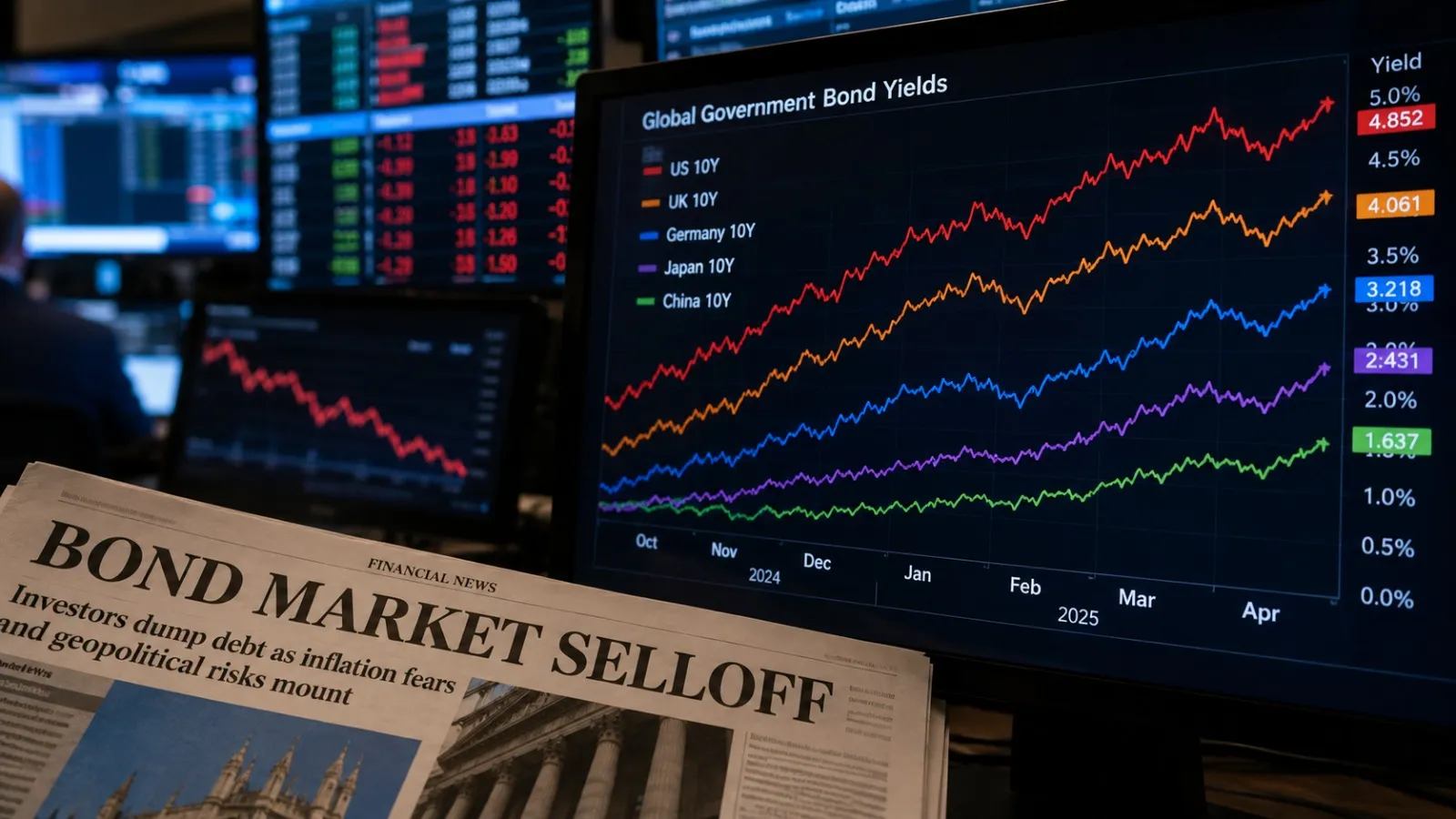
The main driver was outside India. In the United States, government bond yields continued their steady climb. The 10-year Treasury yield touched 5.15%, its highest level since July 2007, while the 30-year yield rose to about 5.44%, the highest in more than two decades.

Rising US yields matter for Indian markets for a simple reason. When investors can earn more than 5% on US government bonds, the relative appeal of riskier emerging-market equities falls. Higher yields also strengthen the US dollar, which can prompt foreign portfolio investors to pull money out of markets such as India.

Bond markets in the US have been under pressure for weeks. Strong business activity data, weak demand at government debt auctions, heavy federal borrowing and elevated oil prices have all fed concerns that inflation will stay high. Several Federal Reserve officials have openly discussed the possibility of further interest-rate increases, a sharp change from the rate-cut expectations that dominated markets earlier.

India's own bond market felt the pressure too. The yield on the benchmark 10-year government security rose 6 basis points to 7.09%.

Oil adds to the pain

Energy prices compounded the problem. Brent crude traded near $107 a barrel on Thursday, having briefly risen above $108 earlier in the session, amid continuing tensions between the United States and Iran over shipping through the Strait of Hormuz.

For India, which imports the vast majority of the crude oil it consumes, high oil prices are a direct economic risk. They widen the trade deficit, put pressure on the rupee, raise fuel and transport costs, and can push up inflation, which in turn limits the Reserve Bank of India's room to cut interest rates.

Later in the session, reports that the United States and Iran were exploring a phased deal to reopen the strait helped oil prices ease from their highs, but not enough to reverse the damage in equities.

Financials and Reliance lead the decline

Financial stocks were among the biggest drags on the benchmarks. Bajaj Finance, Axis Bank and Bajaj Finserv were the top losers among Sensex constituents.

Insurance-linked stocks were under particular pressure after the Insurance Regulatory and Development Authority of India proposed caps on the commissions paid to insurance intermediaries. Policybazaar parent PB Fintech fell as much as 36% in its worst day since listing, while Max Financial Services and HDFC Life Insurance also declined sharply.

Reliance Industries, the heaviest stock in the benchmark indices, fell about 2% to its lowest level in 17 months. Business Standard's market coverage attributed the weakness to concerns about risk across the conglomerate's core businesses.

“When the world's safest asset pays more than 5%, every other investment — including Indian equities — has to justify its price again.”
— TIGI Analysis

There were few bright spots. Shares of the National Stock Exchange, which made their market debut on the same day, rose 1.79% to about ₹1,817, closing above their issue price of ₹1,785 despite the weak broader market.

What the charts are saying

Technical analysts see the market in a fragile position. Shrikant Chouhan, head of equity research at Kotak Securities, said the current market texture was weak and that sentiment was likely to remain negative as long as the Nifty traded below 23,150 and the Sensex below 73,800.

He identified 23,000 on the Nifty and 73,500 on the Sensex as immediate support levels. A break below those could take the indices to 22,800–22,850 and 73,000–72,800 respectively. On the upside, a move above 23,150 and 73,800 could extend a pullback towards 23,250–23,300 on the Nifty and 74,300–74,500 on the Sensex.

A market commentary summarised the day bluntly, describing it as a "bloodbath" as global macroeconomic conditions worsened, with indices opening with a gap down and facing continued selling through the session.

ChatGPT Image Sep 25, 2026, 01_18_14 PM.png

Early signs on Friday

Friday morning brought tentative relief. GIFT Nifty futures pointed to a slightly higher open, and Asian markets were mixed as investors assessed the talks in Washington between US President Donald Trump and Chinese President Xi Jinping. Oil prices eased further, with Brent futures slipping below $106 a barrel on hopes of a diplomatic solution in the Gulf.

The primary market also remains busy. Friday marks the opening of several initial public offerings, including the ₹420-crore issue from Snapdeal parent AceVector, while Moneyview's IPO enters its second day of bidding.

What it means for investors

The sharper fall in mid-sized companies than in the Sensex was also telling. Mid-cap and small-cap stocks have attracted heavy retail participation in recent years, much of it through systematic investment plans and direct trading. These stocks tend to fall harder when risk appetite fades, because they are less liquid and their valuations rely more on expectations of future growth. The 2.25% drop in the Nifty MidCap 100 suggests that investors are becoming more selective about paying for growth when the risk-free rate in the world's largest economy is above 5%.

The jump in the India VIX tells a similar story. At 13.19, the index is still well below the levels seen during periods of genuine market stress, but a rise of more than a quarter in a single day shows how quickly traders moved to buy protection against further declines.

For long-term investors, Thursday's fall is a reminder that Indian equities do not trade in isolation. The domestic growth story remains intact in many respects, but global interest rates and energy prices set the price of capital everywhere.

Three indicators will be worth watching in the days ahead: the direction of the US 10-year Treasury yield, the price of Brent crude, and foreign portfolio flows into Indian equities. If US yields stabilise and oil continues to ease on diplomatic progress, the sell-off could prove short-lived. If yields keep rising, pressure on emerging-market assets, including India, is likely to persist.

For now, volatility has returned to Dalal Street, and investors are being asked to pay close attention to events thousands of miles away.

TagsSensexNiftyStock MarketDalal StreetBond YieldsUS TreasuryCrude OilBrentIndia VIXReliance IndustriesBajaj FinanceIndian Markets

Reader reviews

Sign in to rate and review this article.
Loading reviews…