When the world's largest paint company says demand will stay weak for more than a year, it offers a sobering signal about the state of the housing market and the broader economy.
Sherwin-Williams, the Cleveland-based paint and coatings maker, reported third-quarter results on Tuesday, October 27, and warned that soft demand would persist. "Customer sentiment and the leading indicators we track point to muted demand over the remainder of the year and into 2027," said chair, president and chief executive Heidi Petz.
Sherwin-Williams shares fell 2.7% on Tuesday, according to the Associated Press, which noted that high mortgage rates are weighing on housing demand.
The numbers
Consolidated net sales rose 7.9% to $6.86 billion, helped by all three of the company's segments, its acquisition of Brazilian paint company Suvinil and price increases in the mid-single-digit percentage range.
But profit growth was modest. Diluted earnings per share rose 0.9% to $3.38, and adjusted diluted earnings per share increased 1.1% to $3.63.
Petz described the quarter as being delivered "despite muted underlying market volumes," highlighting that sales growth came largely from pricing and acquisitions rather than higher volumes.
Segment performance
Sales in the Paint Stores Group, which sells to professional painters and contractors through Sherwin-Williams's own stores, rose 4.7% to $4.02 billion, with same-store sales up 3.9%.
The Consumer Brands Group, which sells through retailers, saw sales jump 21.7% to $937.4 million, driven mainly by Suvinil, favourable currency movements and product mix. The Performance Coatings Group, which serves industrial customers, grew 8.8% to $1.90 billion.
Margin pressure
Gross margin fell to 47.8% from 49.2%, partly because of dilution from Suvinil, which carries lower margins and higher selling and administrative costs. Excluding Suvinil, management said year-to-date gross margin was flat. Raw material and supply chain costs rose, and Consumer Brands segment profit declined.
The company said it took "disciplined pricing and cost actions" to offset inflation. Selling, general and administrative expenses fell to 30.2% of sales from 30.7%.
Guidance
Sherwin-Williams revised its full-year 2026 diluted earnings per share guidance to $10.92-11.22 and narrowed its adjusted guidance to $11.85-12.15. It maintained its forecast for full-year sales growth in the mid- to high-single-digit range, with fourth-quarter sales expected to rise by a mid-single-digit percentage.
The housing freeze
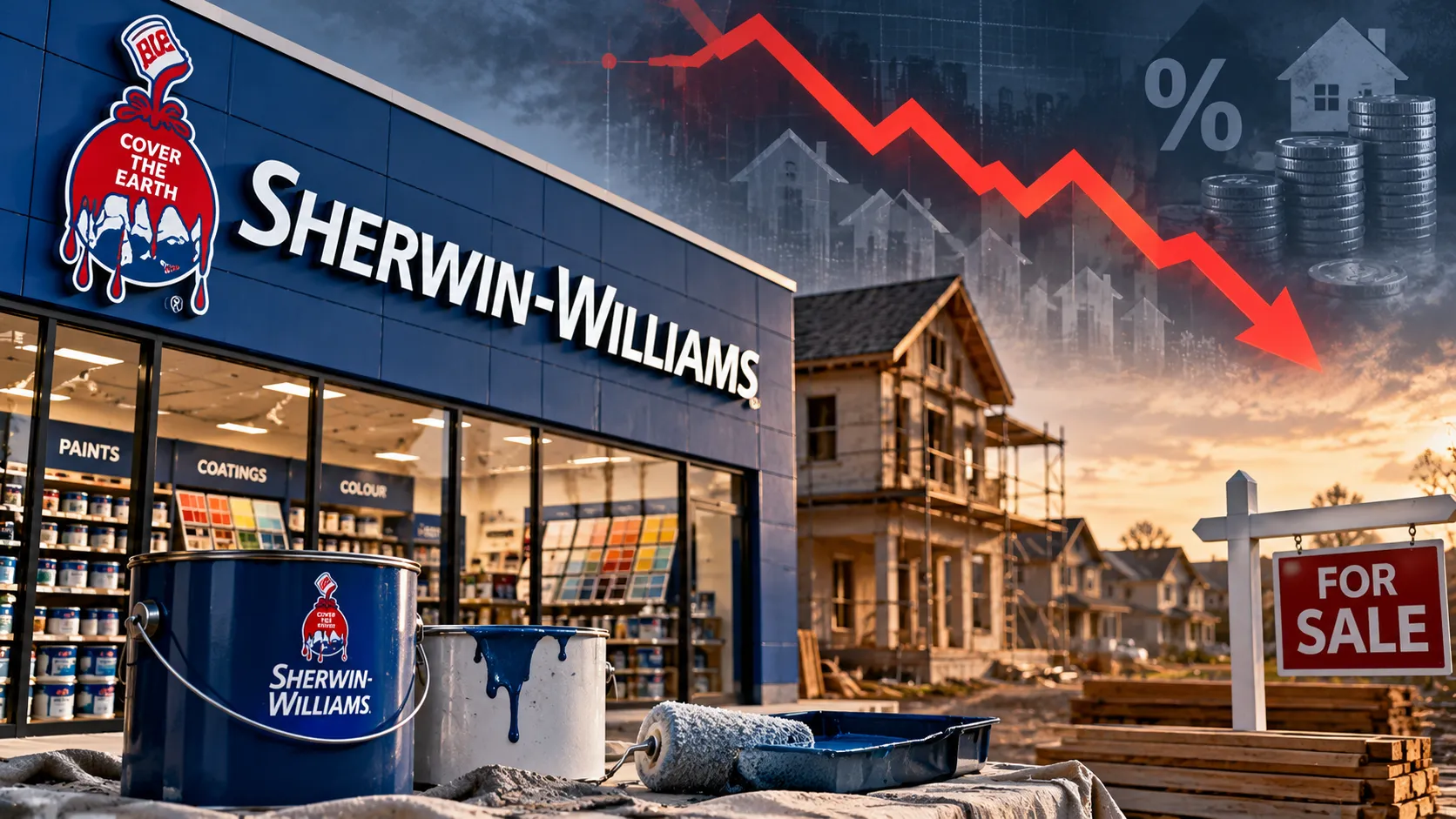
The paint maker's warning reflects the state of the US housing market. With the 10-year Treasury yield near 5% and the Federal Reserve having raised rates last month, mortgage rates remain high. That discourages homeowners from selling, since many have older mortgages at much lower rates, and makes buying a home less affordable.
Fewer home sales mean fewer people repainting houses before selling or after moving in. New construction is also affected by higher financing costs. Paint demand is closely tied to housing turnover, renovation activity and construction, making Sherwin-Williams a bellwether for the sector.
A broader signal
Sherwin-Williams's caution adds to a mixed picture of the US economy. Consumer confidence improved in October, and companies such as Visa and Royal Caribbean have reported strong consumer spending. But sectors sensitive to interest rates, such as housing and construction, are under strain.
The divergence suggests that higher rates are affecting parts of the economy unevenly, with spending on travel and services holding up better than big-ticket purchases tied to borrowing costs.
What it means for India
India's paint industry operates in a very different environment. Demand is driven by urbanisation, rising incomes, housing construction and repainting cycles. Major players include Asian Paints, Berger Paints, Kansai Nerolac and new entrants such as Grasim Industries' Birla Opus, which has intensified competition.
However, Indian paint makers face a common challenge with Sherwin-Williams: raw material costs. Many paint ingredients are derived from crude oil, so high oil prices raise costs and squeeze margins. Asian Paints was among the top losers on the Nifty on October 27, and its shares have been under pressure from high crude prices and competition.
The Suvinil acquisition
Sherwin-Williams acquired Suvinil, one of Brazil's leading architectural paint brands, in October 2025, expanding its presence in Latin America's largest economy. The acquisition has added significantly to the Consumer Brands Group's sales, though it has diluted margins in the short term as the company integrates the business.
Brazil's paint market is large and growing, and Suvinil gives Sherwin-Williams a strong brand and distribution network in the country. The company has said it expects the acquisition to contribute to growth over time.
Pricing power
Sherwin-Williams's ability to raise prices by a mid-single-digit percentage despite weak volumes reflects its strong market position, particularly among professional painters, who value product quality and service over price. That pricing power has helped the company maintain sales growth in a difficult market, though it may be harder to sustain if demand remains weak for an extended period.
The professional painter channel
Sherwin-Williams's Paint Stores Group, which sells primarily to professional painters and contractors through more than 4,000 company-operated stores in North America, is the core of its business. Professional painters value consistent product quality, quick availability and service, which allows Sherwin-Williams to charge premium prices. Same-store sales growth of 3.9% in the quarter, largely driven by pricing, shows the resilience of that channel even in a weak market.
Lessons for investors
The company's experience shows how even market leaders are affected by the interest rate cycle. Paint demand is tied to housing turnover and construction, which are sensitive to borrowing costs.
What comes next
Sherwin-Williams will provide more detail on its outlook for 2027 in the coming months. Investors will watch for signs of stabilisation in the housing market, which would depend on mortgage rates falling, and on the impact of cost-saving measures on margins.
For the broader economy, the company's warning is a reminder that higher interest rates continue to weigh on rate-sensitive sectors, even as other parts of the economy remain resilient. Analysts will also follow the company's pricing decisions for 2027, since its ability to raise prices again will depend on how competitors respond and on whether raw material costs continue to rise. A recovery in home sales, if mortgage rates ease, would be the most powerful catalyst for demand. Investors in India's paint sector will also note the company's warning, since global demand trends and raw material costs influence the outlook for Asian Paints, Berger and their rivals.