Shiprocket, the Indian platform that helps small businesses and direct-to-consumer brands sell and ship goods online, has reported its first-ever quarterly profit, a milestone for a company that went public just three months ago.
The Delhi-based company posted a consolidated net profit of ₹0.6 crore, or ₹60 lakh, for the July-September quarter, the second quarter of the 2026-27 financial year, compared with a net loss of ₹20.3 crore a year earlier, according to Inc42, which reported the results on Thursday, November 5. It had reported a net loss of ₹13.7 crore in the previous quarter.
Operating revenue rose 34.7% to ₹673.6 crore from ₹500.2 crore a year earlier, and increased 13.8% from ₹592.1 crore in the previous quarter.
The path to profit
The swing to profit was narrow but significant. Total expenses rose 29.6% to ₹692.9 crore from ₹534.8 crore, more slowly than revenue, according to Inc42. Other income, largely interest on cash reserves including proceeds from its IPO, rose to ₹19.9 crore from ₹14.3 crore. Total income of ₹693.5 crore was slightly above total expenses, enabling the company to report a small profit. The company reported no tax expense.
While the profit is modest, it represents a turning point for a company that has invested heavily in building its technology platform and network over several years. For listed new-age technology companies, the transition from losses to profits often marks a turning point in how investors value them.
A rapid improvement
Shiprocket's results show a clear trajectory of improvement. In the first quarter of the financial year, its first results as a listed company, it narrowed its loss by 24% to ₹13.7 crore, while revenue grew 34%, according to Inc42. The second quarter's swing to profit continues that trend.
What Shiprocket does
Founded in 2017 and headquartered in Delhi, Shiprocket started as a shipping aggregator, allowing small online sellers to compare and book courier services from multiple logistics companies through a single platform. Instead of negotiating separately with each courier, sellers could access discounted rates and manage shipments in one place.
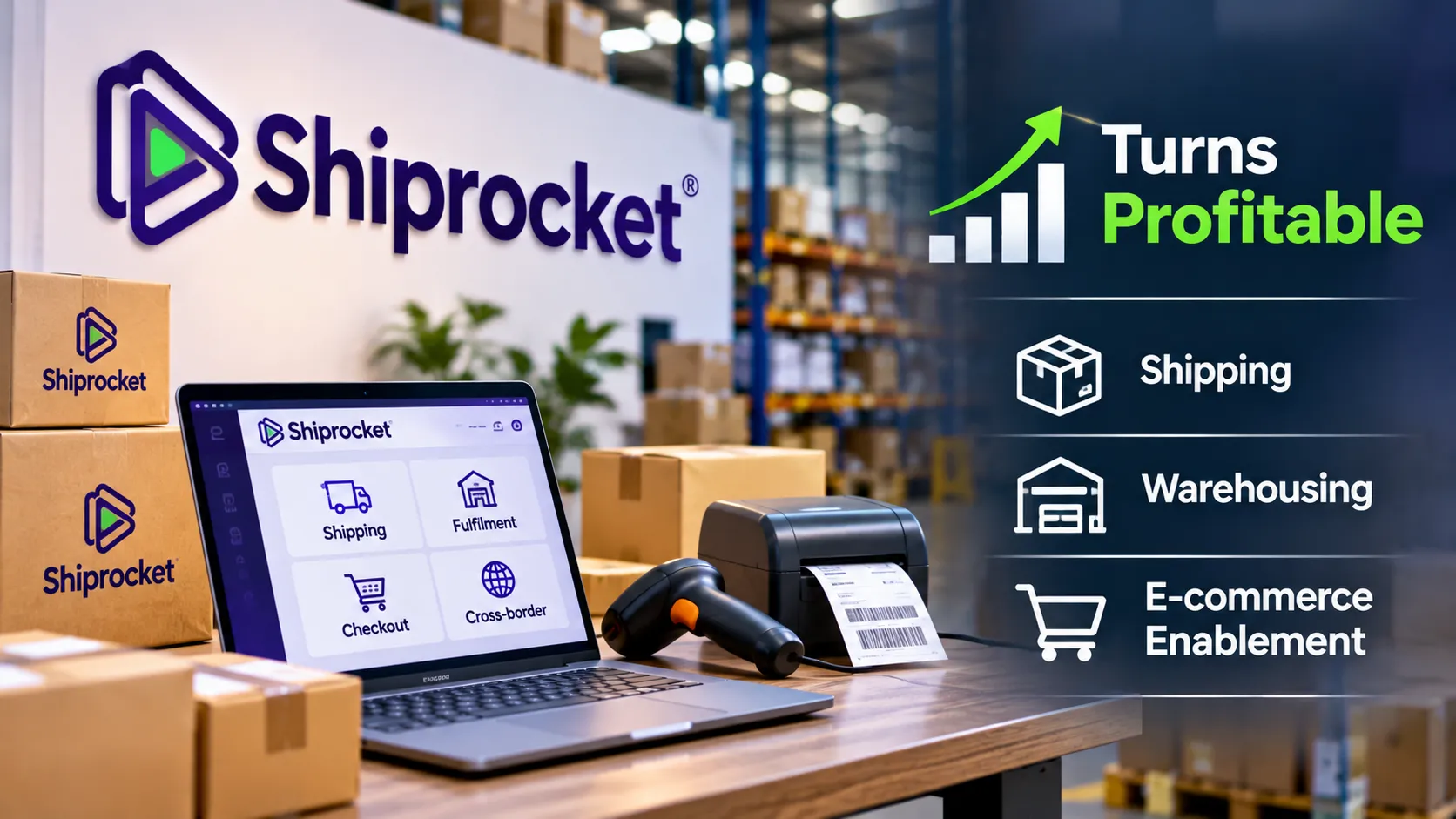
The company has since expanded into a broader e-commerce enablement platform, offering services such as fulfilment and warehousing, checkout solutions, marketing tools, cross-border shipping and working capital financing. Its customers include hundreds of thousands of small and medium-sized businesses, D2C brands and social media sellers across India.
The listing
Shiprocket listed on the National Stock Exchange and BSE in August 2026, according to Inc42. Its shares jumped after its first-quarter results, rising as much as 7% as investors welcomed its narrowing losses, and had traded well above the IPO price, according to reports.
The listing made Shiprocket one of a growing number of Indian startups to go public on domestic exchanges, as India's IPO market has become an important source of capital and exit opportunity for venture-backed companies.
The D2C and SME opportunity
Shiprocket's growth reflects the rapid expansion of online commerce among small businesses in India. Millions of small businesses and independent brands now sell online, through their own websites, social media platforms such as Instagram and WhatsApp, and marketplaces. These sellers need affordable logistics, payment and marketing solutions that were previously available mainly to large companies.
The rise of D2C brands, which sell directly to consumers rather than through traditional retail channels, has been a significant driver. India has seen an explosion of D2C brands in categories such as fashion, beauty, personal care and food, many of which rely on platforms such as Shiprocket for their operations.
Competition
Shiprocket competes with other logistics aggregators and e-commerce enablement platforms, as well as with logistics companies such as Delhivery that offer services directly to sellers. The growth of quick commerce, which offers delivery within minutes, and of the government-backed Open Network for Digital Commerce (ONDC) is also changing the landscape for small online sellers.
Delhivery, India's largest listed logistics company, recently reported a return to profit and revenue above ₹3,000 crore for the September quarter, underscoring the improving economics of the logistics sector.
The profitability trend
Shiprocket's turnaround is part of a broader shift among Indian startups towards profitability. After years of prioritising growth funded by venture capital, many startups have focused on reducing losses and achieving sustainable profits, particularly as they prepare for or follow public listings. Investors in Indian IPOs have increasingly rewarded companies with a clear path to profitability.
Recent examples include Ather Energy, which posted its first quarterly profit, and Nykaa, Lenskart and PhysicsWallah, which reported strong profit growth.
Challenges ahead
Sustaining profitability will require Shiprocket to continue growing revenue faster than costs, while managing competition and pricing pressure. Its customers, small businesses, can be vulnerable to economic slowdowns, and the logistics industry operates on thin margins. Expanding higher-margin services, such as software, payments and financing, will be important to improving profitability.
Building the full stack
Shiprocket's strategy is to become a one-stop platform for small online businesses, covering everything from building an online store and accepting payments to shipping orders, managing returns and accessing working capital. Each additional service increases the revenue it earns from each seller and makes it harder for sellers to switch to competitors.
Cross-border shipping is a particular opportunity. Indian D2C brands are increasingly selling to customers abroad, particularly to the Indian diaspora in the United States, the United Kingdom, the Middle East and other markets, and Shiprocket offers services to help them ship internationally.
The investor view
For investors, Shiprocket's first profit validates the company's business model and reduces concerns about its need for additional capital. However, the profit was narrow and partly supported by other income, so investors will want to see operating profitability improve in the coming quarters. The company's revenue growth of nearly 35% remains strong, suggesting that it has significant room to scale.
What comes next
Investors will watch whether Shiprocket can build on its first profit and expand margins in the coming quarters, particularly during the festive season, which drives a surge in e-commerce volumes. Its ability to expand its services and maintain growth will determine whether its first profit marks the beginning of a sustained period of profitability. For India's startup ecosystem, the milestone adds to the growing list of companies that have successfully made the journey from venture-backed startup to profitable listed company.