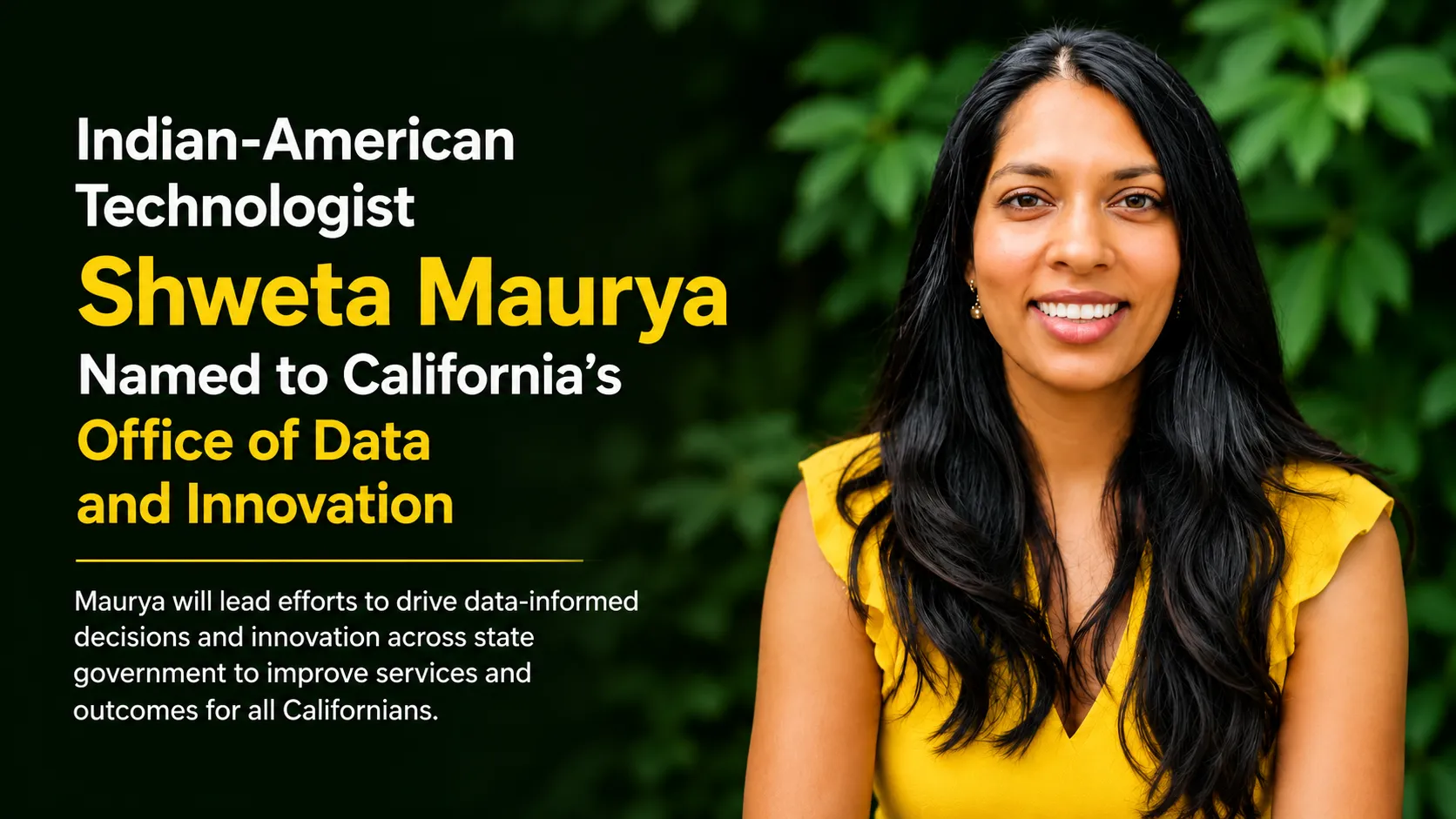
California Governor Gavin Newsom has appointed Shweta Maurya, an Indian-American mechanical engineer with a decade of experience across fintech and e-commerce, as senior product manager at the state's Office of Data and Innovation. The appointment, announced this week, places Maurya inside one of the more consequential — if lower-profile — arms of California's state government: an office tasked with using data, technology and human-centred design to make public services more accessible and effective for the state's nearly forty million residents.
For a diaspora accustomed to celebrating Indian-American achievement primarily through the lens of Silicon Valley chief executives or venture-backed founders, appointments like Maurya's represent a different but increasingly significant category of influence — one rooted not in building consumer products for private markets, but in applying private-sector product discipline to the machinery of American government itself. The Office of Data and Innovation occupies a specific niche within California's sprawling state bureaucracy: rather than owning services outright, it works alongside individual state departments as an internal consultancy of sorts, helping them redesign digital touchpoints, streamline application processes and apply evidence-based design principles to programmes that millions of Californians rely on for everything from unemployment benefits to public health services.
Maurya's own career trajectory reads as a fairly representative arc for the current generation of Indian-American technologists entering public-sector roles after building their early careers inside high-growth private companies. A resident of Campbell in the heart of Silicon Valley, she most recently served as senior manager of strategy and operations at Chime, the financial technology company that has built one of the largest challenger-bank customer bases in the United States. During her tenure at Chime between 2019 and 2025, Maurya held a series of escalating roles within the company's program management office, including stints as staff program manager and senior program manager, giving her direct exposure to the operational complexity of scaling a regulated financial services product to tens of millions of customers.
Before joining Chime, Maurya spent two years at Amazon, from 2017 to 2019, as a program manager working on the company's Books and Kindle division. In that role, she led product initiatives spanning reward experimentation programmes, oversaw the design and analysis of A/B tests involving machine learning models, and built out customer feedback mechanisms intended to guide iterative product improvements — a set of responsibilities that gave her direct, hands-on experience with the kind of data-driven product methodology that state governments have historically struggled to replicate internally, given civil service hiring structures that were not originally designed to compete for private-sector product talent.
Maurya's professional background also includes an earlier chapter outside the technology sector entirely. Between 2013 and 2015, she worked as a mechanical engineer at Randall Lamb, an engineering consultancy, before making the transition into product management roles that would ultimately define the remainder of her career. That earlier engineering training — grounded in the more traditional, physical-systems discipline of mechanical engineering rather than software — is not uncommon among a certain cohort of Indian-American technologists who entered the American workforce through engineering pathways before pivoting toward product and strategy roles as the technology industry's centre of gravity shifted toward software and data-driven decision-making over the following decade.
In January 2025, Maurya co-founded Scoot Closer, an independent venture whose specific focus has not been widely publicised, before stepping back from full-time operating roles to take what she has described as a personal sabbatical beginning in January 2026. Her appointment to the California data innovation post therefore arrives at a distinct inflection point in her career — a return to structured institutional work, but within the public rather than the private sector, and with a mandate explicitly oriented toward improving the lived experience Californians have with their own state government.
Maurya holds a Master of Business Administration from George Washington University and a Bachelor of Science in Mechanical Engineering from the University of Colorado, an academic profile that combines rigorous technical training with formal business education — a combination that has become increasingly common among Indian-American professionals moving into senior product and strategy roles across both the private and public sectors in the United States. Her appointment does not require confirmation by the California State Senate, a structural feature of many senior product and design roles within the Office of Data and Innovation that allows the office to move more nimbly in recruiting talent directly from the private sector, where competing offers and shorter decision cycles are the norm. The position carries an annual salary of one hundred fifty-four thousand, eight hundred and sixty dollars, reflecting the state's ongoing effort to offer compensation packages competitive enough to attract experienced technologists away from higher-paying private-sector roles into public service.
The broader significance of appointments such as Maurya's lies less in any single individual's résumé than in what they collectively signal about the evolving relationship between Indian-American technology talent and American civic institutions. For much of the past two decades, the dominant narrative of Indian-American professional achievement in the United States centred overwhelmingly on the private technology sector — venture-backed startups, publicly listed technology giants, and the executive suites of Fortune 500 companies. That narrative remains powerful and largely accurate as far as it goes, but it has increasingly been joined by a parallel and less visible trend: Indian-American professionals moving deliberately into public-sector technology roles, state and municipal government innovation offices, and civic technology non-profits, applying the same product rigor that built some of Silicon Valley's most successful consumer businesses to the comparatively unglamorous but consequential work of government service delivery.
California's Office of Data and Innovation has itself become something of a proving ground for this pattern, having recruited a number of technologists with private-sector pedigrees into product and design roles over the past several years as the state has sought to modernise services ranging from unemployment insurance processing to public benefits enrolment. Maurya's arrival adds another data point to that trend, and her specific combination of fintech operational experience and e-commerce product discipline is likely to be viewed within the office as directly transferable to problems around benefits access, application friction and the kind of iterative, feedback-driven design processes that private companies like Chime and Amazon have refined at scale but that government agencies have historically found harder to institutionalise.
California's Office of Data and Innovation itself occupies a distinctive place within the broader landscape of American state government technology reform efforts. Established as part of a wider push by the Newsom administration to modernise how California's state agencies design and deliver digital services, the office operates with a mandate that deliberately blurs conventional lines between policy, design and engineering functions, embedding small, cross-functional teams directly within partner departments rather than functioning as a centralised technology unit that dictates requirements from a distance. That embedded model has become increasingly influential as a template for other state and municipal government innovation offices around the country, several of which have sent delegations to study California's approach as they consider establishing comparable units within their own governments.
The broader movement toward embedding private-sector product and design talent within American government has accelerated considerably over the past decade, driven substantially by a series of high-profile digital service failures — most notably the troubled initial rollout of the federal government's healthcare enrolment website in 2013 — that exposed how poorly equipped many government agencies were to manage large-scale digital projects using traditional government IT procurement and staffing models. In response, a range of institutions emerged specifically to recruit private-sector technologists into government service, including the federal United States Digital Service and a growing number of state-level equivalents modelled on California's own office. Indian-American technologists have participated in this movement in numbers that some observers argue exceed their proportional representation within the broader American technology workforce, a pattern some attribute to a comparatively strong tradition of public service orientation within segments of the diaspora community, alongside the practical reality that many Indian-American technologists working in Silicon Valley are geographically well positioned to take on California state government roles without relocating.
Maurya's specific fintech background is also likely to prove directly relevant to a number of the Office of Data and Innovation's current priority areas. State benefits programmes — including unemployment insurance, food assistance and a range of public health enrolment systems — increasingly require the kind of rigorous identity verification, fraud prevention and payment processing infrastructure that fintech companies such as Chime have spent years refining for commercial banking products. The transferability of these skills from consumer fintech into public benefits administration has become an increasingly explicit recruiting pitch used by government innovation offices seeking to attract private-sector product talent, on the theory that many of the underlying technical and design challenges — verifying identity reliably at scale, minimising friction in enrolment processes, detecting and preventing fraudulent claims — are functionally similar regardless of whether the end product is a consumer banking app or a state unemployment benefits portal.
Broader labour market data on Indian-American participation in American public-sector technology roles remains relatively limited compared with the extensive tracking available for private-sector employment patterns, but anecdotal evidence from professional networks and civic technology organisations suggests the trend Maurya's appointment exemplifies has accelerated notably over the past five years, coinciding with both the broader maturation of the civic technology movement and a generational shift among Indian-American technologists now reaching the decade-plus career mark at which many professionals across industries begin more actively considering how to apply accumulated expertise toward broader public benefit. Several civic technology organisations focused specifically on connecting private-sector technologists with public-sector opportunities report that Indian-American applicants now represent a meaningfully higher share of their candidate pipelines than several years ago, a pattern several such organisations attribute partly to increased visibility of successful public-sector transitions by earlier cohorts of diaspora technologists, creating a demonstration effect that appears to be encouraging further transitions of the kind Maurya has now made.
It is also worth situating this appointment within the specific institutional history of the Office of Data and Innovation itself, which was established in the years following California's difficult experience managing digital service delivery during the early phase of the pandemic, when a range of state systems — most notably the state's unemployment insurance infrastructure — buckled under unprecedented application volumes and exposed significant weaknesses in the state's legacy technology architecture. That formative crisis shaped the office's founding mandate considerably, embedding a strong institutional emphasis on resilience, user-centred design and rapid iterative improvement that continues to inform how the office recruits and deploys staff across its various department partnerships today, and which provides important context for understanding precisely what kind of practical, execution-focused product experience the office tends to prioritise when evaluating candidates for roles such as the one Maurya now holds.
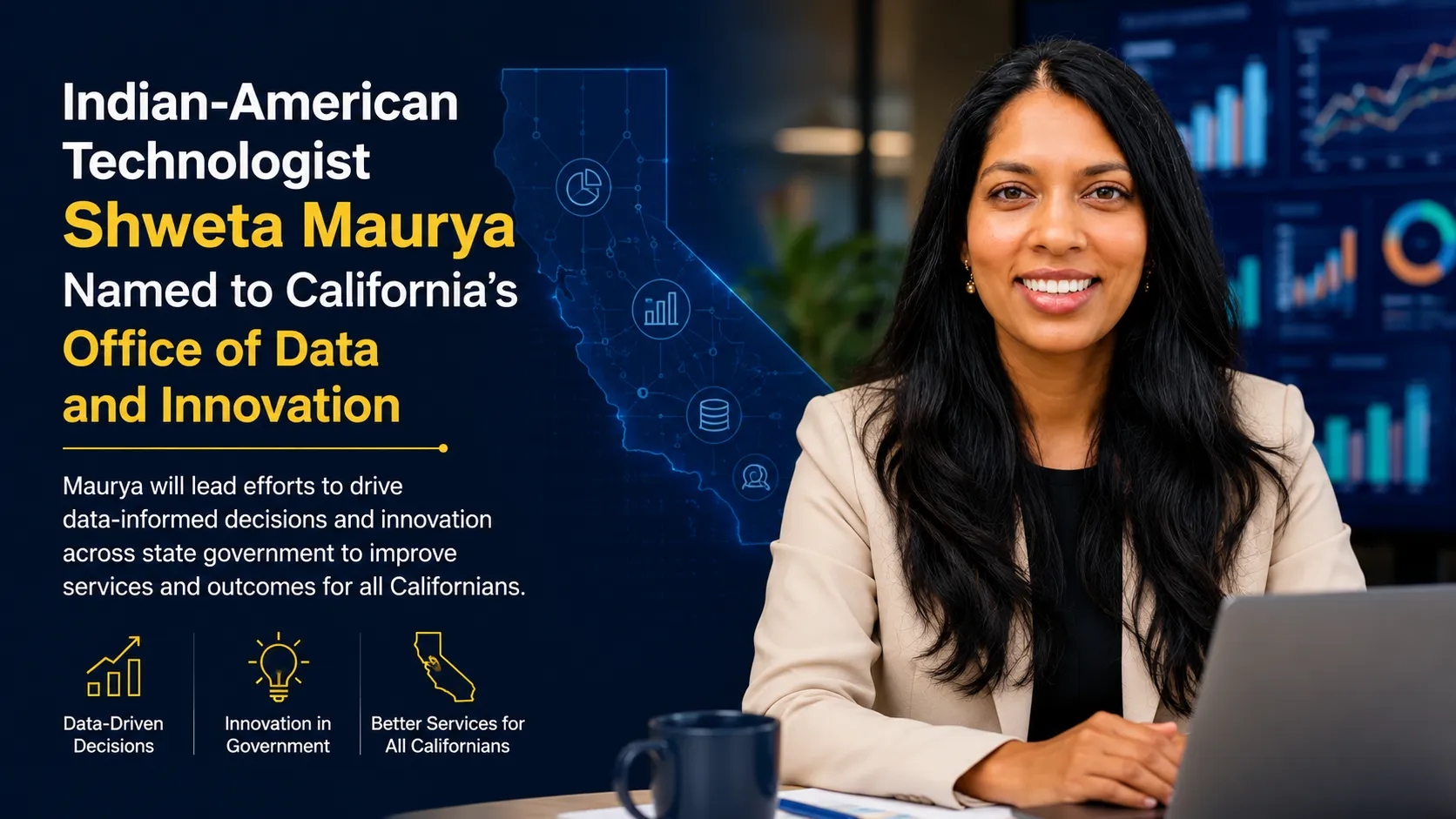
Maurya's move also illustrates a broader life-stage pattern increasingly visible among mid-career Indian-American technologists in the Bay Area: a deliberate pause from full-time private-sector operating roles — in her case, the sabbatical she began in January 2026 following her venture co-founding effort — followed by a considered pivot toward public-sector or mission-driven work rather than an immediate return to another high-growth private company. Career coaches and professional networks serving the Bay Area's Indian-American technology community report growing interest in this kind of pivot among professionals roughly a decade into their careers, often motivated by a combination of financial stability accumulated through earlier private-sector compensation, genuine interest in applying accumulated skills toward public benefit, and a desire for the kind of mission clarity that government and public-interest roles can offer relative to the more purely commercial objectives that dominate most private-sector product management positions.
Whether Maurya's tenure ultimately produces measurable improvements in how Californians interact with state services will depend on factors well beyond any individual appointment — funding continuity, departmental cooperation, and the perennial challenge of sustaining innovation initiatives across changing political administrations chief among them. But for a broader diaspora community increasingly attentive to where Indian-American talent is choosing to direct its energy, the appointment offers a useful reminder that influence within American public life is no longer confined to the boardroom or the venture capital term sheet. Increasingly, it is also being exercised inside the state agencies that determine how efficiently, and how humanely, government itself actually functions for the people it serves.