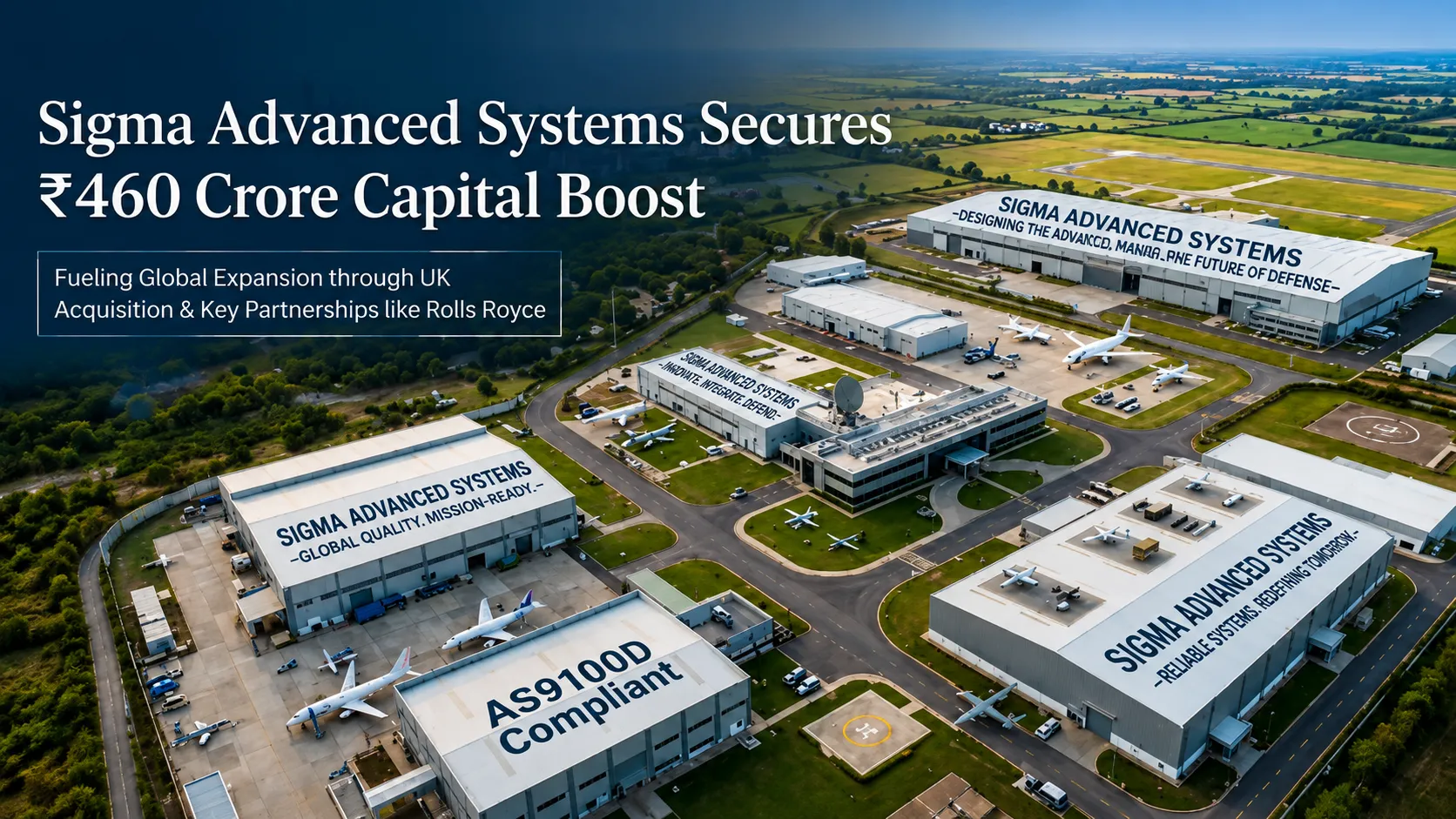
Hyderabad-based aerospace and defence manufacturer Sigma Advanced Systems has raised approximately ₹460 crore through a preferential allotment of shares, with the company earmarking the proceeds for growth initiatives spanning capacity expansion, strategic acquisitions and further investment across its manufacturing footprint. The transaction adds to a string of significant capital raises across India's private defence-manufacturing sector this year, reflecting sustained investor confidence in the country's push toward greater self-reliance in critical aerospace and defence technologies.
The fundraise places Sigma Advanced Systems among a growing cohort of Indian aerospace and defence manufacturers attracting significant private capital, a trend closely tied to the government's sustained push toward domestic defence self-reliance. Policy initiatives aimed at reducing dependence on imported defence equipment, alongside production-linked incentive schemes and easier foreign direct investment norms in the defence sector, have combined to make India's defence-manufacturing ecosystem an increasingly attractive destination for growth capital over the past several years. The company's positioning within this landscape also reflects a broader shift in how Indian defence procurement itself has evolved, with public-sector buyers increasingly favouring domestic private manufacturers capable of meeting rigorous quality and delivery-timeline standards previously associated primarily with larger, established defence-sector incumbents. This shift has created meaningful new opportunities for specialised mid-sized manufacturers like Sigma to compete for contracts that would, a decade earlier, have been the near-exclusive preserve of public-sector undertakings or a small number of long-established private conglomerates. The structuring of the round as a preferential allotment — rather than a conventional venture round — is itself notable, reflecting Sigma's positioning as a more mature, revenue-generating industrial enterprise rather than an early-stage technology startup in the traditional venture sense. Preferential allotments typically involve the direct issuance of new shares to a select group of investors at a negotiated price, a mechanism more commonly associated with established manufacturing and industrial companies seeking growth capital without the extended due-diligence and structuring timelines typical of multi-stage venture financing. Company disclosures indicate that a portion of the newly raised capital is intended to support acquisitions, suggesting Sigma may be positioning itself for inorganic growth within India's increasingly consolidated aerospace and precision-components supply chain. Industry observers note that as India's defence-manufacturing base matures, mid-sized specialised manufacturers are increasingly looking to acquire complementary capabilities — whether in materials engineering, systems integration or testing infrastructure — rather than build every capability organically, a pattern well established in more mature aerospace-manufacturing markets globally.
The broader context for Sigma's fundraise is India's accelerating defence-indigenisation programme, which has set ambitious targets for domestic production value and defence exports over the coming years. Hyderabad, where Sigma is headquartered, has emerged as one of India's key aerospace and defence manufacturing clusters, benefiting from a concentration of skilled engineering talent, established supply-chain relationships with public-sector defence undertakings, and state-level industrial policy support specifically targeted at the sector. For investors, the appeal of businesses like Sigma lies in the combination of policy tailwinds, long product-development cycles that create durable revenue visibility once contracts are secured, and relatively limited direct competition given the specialised regulatory and technical barriers to entry in defence manufacturing. These characteristics have made the sector increasingly attractive to growth-equity and strategic investors seeking exposure to India's broader industrial and manufacturing renaissance, distinct from the software- and consumer-internet-heavy profile that has historically dominated the country's startup funding narrative. Sigma's dual focus on aerospace and defence components also positions the company to benefit from parallel growth trends in India's civil aviation and space sectors, both of which are experiencing their own periods of expansion driven by rising domestic air travel demand and an increasingly active private space-technology ecosystem. Manufacturers capable of serving both defence and adjacent commercial aerospace customers often benefit from more diversified revenue streams and greater manufacturing-capacity utilisation than pure-play defence contractors dependent solely on government procurement cycles, which can be subject to budgetary and political timing variability. The involvement of private capital in a preferential allotment of this scale also reflects a broader evolution in how India's defence-manufacturing ecosystem is being financed. Where large-scale defence production was historically the near-exclusive domain of public-sector undertakings and a small number of established private conglomerates, the past several years have seen a proliferation of specialised, mid-sized private manufacturers gaining direct access to growth capital markets — a shift that industry observers attribute to both regulatory liberalisation and growing investor confidence in the sector's long-term revenue visibility.
As Sigma Advanced Systems deploys its newly raised capital toward expansion and potential acquisitions, the transaction adds to a growing body of evidence that India's defence and aerospace manufacturing sector is emerging as a distinct and increasingly well-capitalised category within the country's broader private investment landscape — one likely to attract continued attention from both domestic and international investors as New Delhi's defence self-reliance ambitions gather further momentum. Looking further ahead, Sigma's acquisition strategy, once executed, will offer a useful test case for how successfully India's emerging tier of specialised private defence manufacturers can consolidate capabilities and scale toward the kind of integrated systems expertise historically associated with larger, more established global aerospace and defence contractors — a trajectory that, if successful, could reshape the competitive landscape of India's defence-manufacturing base over the remainder of the decade. Investors across India's growing defence-manufacturing investment community will likely track Sigma's post-fundraise execution closely, given the read-through implications for valuation benchmarks and capital availability across the wider specialised aerospace and defence supplier base. The transaction is also likely to encourage other mid-sized Indian defence and aerospace manufacturers to explore similar preferential allotment structures as a faster, less dilutive alternative to traditional multi-round venture financing when raising growth capital. As India's defence-manufacturing base continues to mature, transactions of this kind are likely to become an increasingly familiar feature of the sector's evolving capital-formation landscape. Sigma's next reporting cycle will offer investors an early opportunity to assess how effectively the newly raised capital is being deployed against its stated growth and acquisition objectives, providing a useful checkpoint for the broader thesis underpinning the fundraise. The transaction's ultimate significance will likely be measured over several years rather than a single reporting cycle, given the long-gestation nature of defence-manufacturing capacity expansion and acquisition integration.