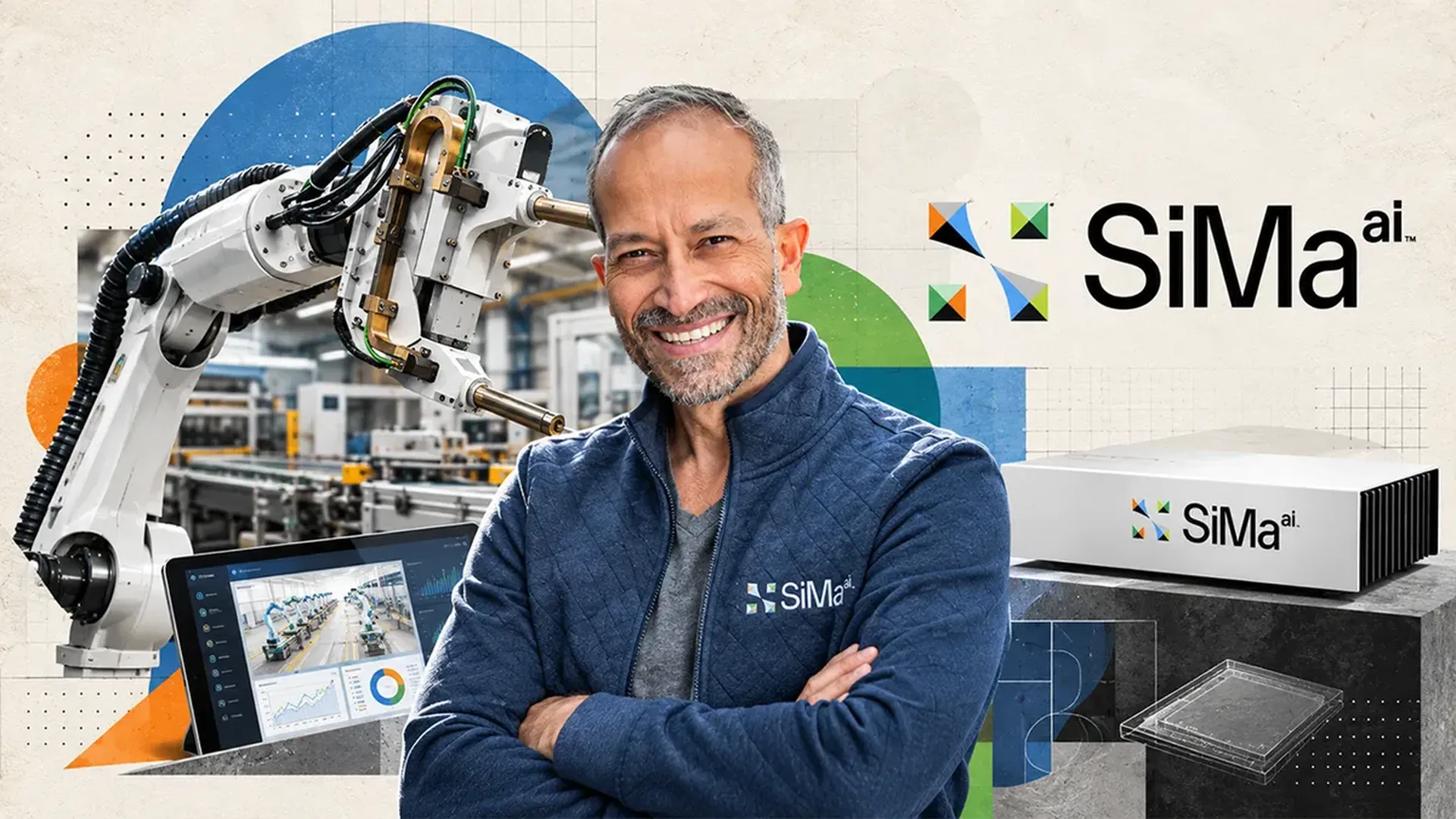
SiMa.ai, a Silicon Valley semiconductor company building chips that let robots, drones and cars run artificial intelligence on the device itself, has raised $150 million in an oversubscribed Series C round that values it at $1.45 billion. The round was co-led by Fidelity Management & Research Company and Amplify, and was announced on 28 September 2026.
The financing takes the San Jose-based company's total funding to $500 million. Its valuation has risen from $960 million at the time of its $85 million Series B in July 2025, according to reports of the round.
Participants in the Series C include Alter Venture Partners, Dell Technologies Capital, StepStone Group, AllianceBernstein and Baron Capital. J.P. Morgan and the State of Michigan joined as new investors.
A founder with a big claim
SiMa.ai was founded in 2018 by Krishna Rangasayee, an Indian-origin semiconductor veteran who serves as its chief executive. He frames the company's opportunity in sweeping terms.
"Physical AI in humanoids, automotive, and drones is the gateway to a $50 trillion market that has remained largely untouched by modern innovation," he said.
He is equally direct about the competition. "It's a $5 trillion Nvidia and then it's us," Rangasayee told Forbes ahead of the announcement, presenting SiMa.ai as the leading challenger in its niche to the world's most valuable chipmaker.
What 'physical AI' means
Physical AI refers to machines that sense, reason and act in the real world, from humanoid robots and warehouse automation to drones, advanced driver-assistance systems and in-car AI assistants. These machines cannot always depend on a connection to a cloud data centre. They need to make decisions in milliseconds, often in places with limited connectivity, and within strict limits on power consumption and heat.
That is the market SiMa.ai targets. Its chips perform AI computation at the "edge", on the device itself, rather than sending data to remote servers. The company positions its technology as a cheaper and more power-efficient alternative to Nvidia's graphics processors for these workloads.
Products today and tomorrow
SiMa.ai's second-generation chip, Modalix, is built on Taiwan Semiconductor Manufacturing Company's 6-nanometre process and is in production. The company has also developed Palette Neat, which it describes as the industry's first agentic software environment for physical AI, designed to simplify how developers build and deploy AI models on its hardware.
The new capital will fund the expansion of Palette Neat and the development of next-generation hardware due in the first half of 2028. SiMa.ai says the new architecture will deliver 1,000 dense tera-operations per second (TOPS) of compute while keeping power consumption to around 80 watts.
The company plans to target medium- and high-end drones, humanoid robots, driver-assistance systems and AI-powered vehicle cockpits.
Its current customers and partners include ARK Electronics, AverMedia Technologies, Robert Bosch, Emerson Electric, Micron Technology and Synopsys.

The Nvidia question
Competing with Nvidia is the defining challenge for every AI chip start-up. In edge AI, Nvidia's Jetson platform is the default choice for many robotics developers. Its current top-end Jetson AGX Thor module delivers around 2,000 FP4 TOPS, according to analysis by AI Weekly, twice the headline figure SiMa.ai is targeting for 2028.
SiMa.ai's argument is not about raw throughput. It is about performance per watt and cost. A humanoid robot or drone runs on batteries, and every watt consumed by the processor reduces operating time. For a car, heat and power budgets are equally tight. The company claims its technology offers up to ten times the efficiency of existing industry standards, a claim it will need to prove at mass-market scale.
Software is the other battleground. Nvidia's CUDA ecosystem and robotics tools are deeply entrenched, and developers are reluctant to rewrite code for a new chip. That is why SiMa.ai has invested heavily in Palette Neat. Rangasayee has argued that Nvidia sells complete system-on-module boards, not just chips, and that SiMa.ai had to build an equivalent replacement to compete.
An Indian engineering story
SiMa.ai has a significant engineering presence in India, particularly in Bengaluru, which has become one of the world's largest centres for semiconductor design. Most global chip companies run large design centres in the city, and a growing number of start-ups are building core intellectual property there.
For India, companies like SiMa.ai demonstrate the depth of the country's chip design talent even as it works to build domestic fabrication capacity. The government's semiconductor mission has focused on attracting manufacturing and packaging plants, but design remains the area where India's human capital is already globally competitive.
Rangasayee is also part of a broader pattern. Founders who grew up in India have built a large number of the world's most valuable technology companies abroad, particularly in the United States. SiMa.ai adds to that list in one of the most strategically important sectors of the global economy.
Why investors are backing edge AI now
The timing of the round reflects a shift in how the robotics industry uses AI. Much of the past decade's effort went into training models in the cloud. As companies move from training to deployment, the focus is turning to the chips that will run those models inside millions of machines.
The participation of Fidelity, AllianceBernstein, Baron Capital and J.P. Morgan, investors with deep public-market experience, suggests a view that SiMa.ai could eventually become a listed company. The involvement of the State of Michigan points to the company's automotive ambitions, given the state's role as the centre of the US auto industry.
Risks to watch
Chip development is expensive and slow. SiMa.ai's next architecture will not arrive until 2028, and in that time Nvidia and other competitors will release their own new products. Winning designs in cars can take years because of long qualification cycles, and robotics markets, while promising, remain small compared with data-centre AI.
The company's claims on efficiency and ease of use will face real-world testing as customers move from evaluation to volume production. Securing manufacturing capacity at leading foundries, where AI demand has strained supply, is another consideration.
The bigger picture
The AI hardware market has so far been dominated by the data centre. SiMa.ai's funding round is a bet that the next large wave of demand will come from machines operating in the physical world, where power efficiency, cost and real-time performance matter as much as raw speed.
If that bet is right, the edge could become the next great battleground for AI chips, and a company founded by an Indian-origin engineer, with deep roots in Bengaluru's design ecosystem, is positioning itself to be one of the leading contenders.