SK hynix, the world's leading supplier of memory chips for artificial intelligence, is considering returning a huge windfall to shareholders, a move that could help restore confidence in South Korea's battered stock market.
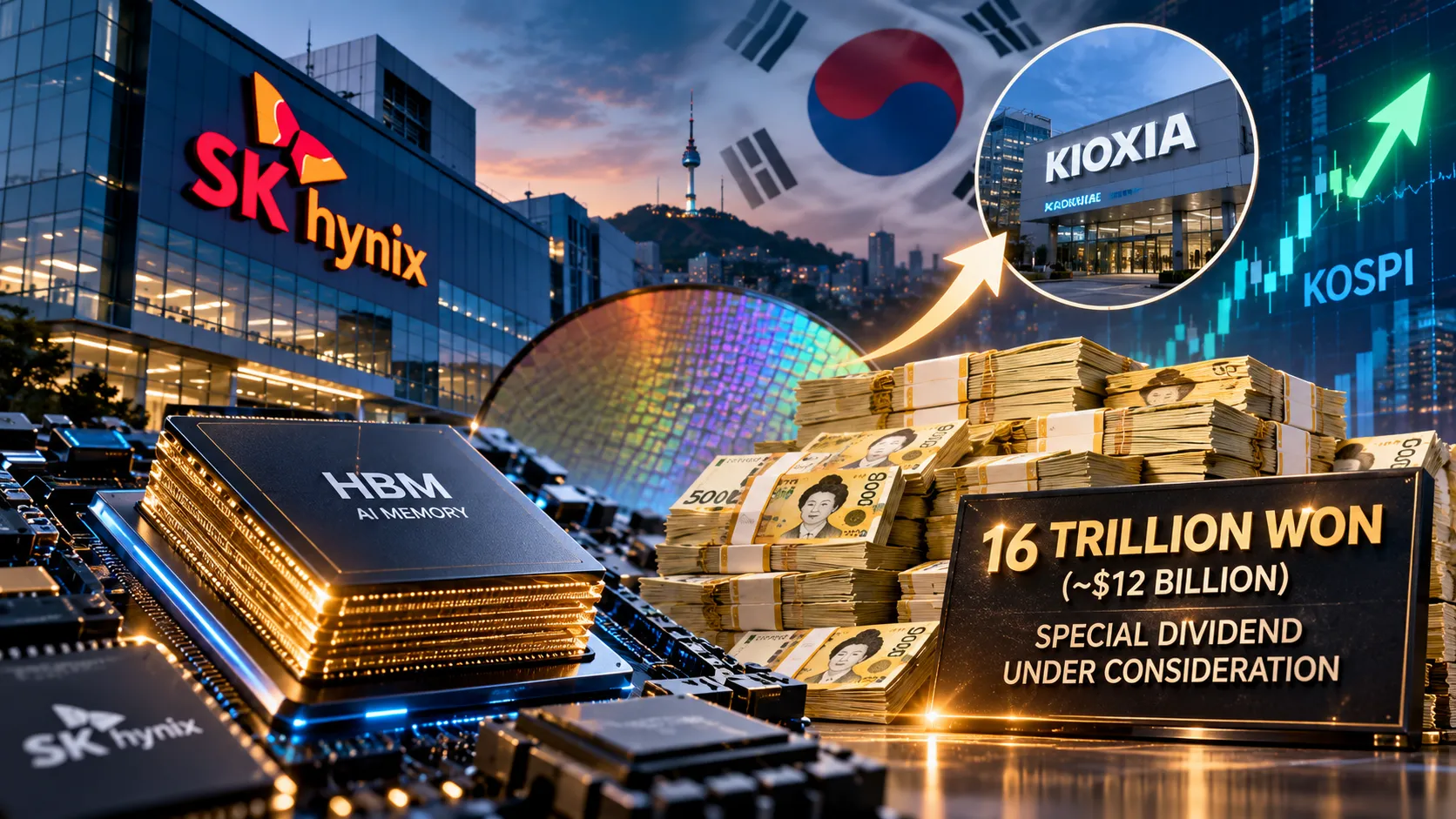
The company is weighing a special dividend of about 16 trillion won, roughly $12 billion, according to a report by the Korean newspaper Dong-A Ilbo on Monday, October 26, cited by Reuters. The payout would be funded by gains from the sale of its stake in Kioxia, the Japanese memory chip maker.
The newspaper said the plan could be unveiled alongside SK hynix's third-quarter earnings on Wednesday, October 28.
SK hynix responds
In a regulatory disclosure on October 26, SK hynix said it is reviewing a range of measures to return value to shareholders, but that nothing has been finalised. The company's board will decide on additional shareholder return measures, which will be announced at its third-quarter earnings presentation on October 28.
The company has not confirmed the reported figures.
The Kioxia windfall
SK hynix invested about 4 trillion won in Kioxia in 2018 as part of a consortium led by private equity firm Bain Capital, which acquired Toshiba's memory chip business. Kioxia, which makes NAND flash memory used in smartphones, computers and data centres, later listed on the Tokyo Stock Exchange.
According to reports, the planned special dividend would represent about 80% of roughly 20 trillion won in gains from the sale of the Kioxia stake, gains equal to about five times the original investment. Bain sold its stake this year, and SK hynix now holds convertible bonds linked to its Kioxia stake.
A 16 trillion won payout would be more than seven times the total dividends SK hynix paid last year.
Why a special dividend now
The timing is significant. South Korea's Kospi has fallen more than 35% from its June peak and nearly 20% in October alone, driven by concerns that AI spending may slow and that memory chip profits will decline. SK hynix's shares have fallen sharply from their highs.
A large special dividend would signal confidence in the company's financial strength and reward shareholders who have suffered losses. It would also align with the Korean government's "Value-up" programme, which encourages companies to improve shareholder returns and address the "Korea discount," the tendency for Korean stocks to trade at lower valuations than global peers.
The AI memory leader
SK hynix has been one of the biggest beneficiaries of the AI boom. It is the leading supplier of high-bandwidth memory (HBM), a specialised type of memory chip stacked vertically and used alongside graphics processors in AI servers. Nvidia is its most important HBM customer.
The company reported record profits as AI demand surged, overtaking Samsung Electronics in some memory segments. But investors now worry that AI infrastructure spending could slow, and that increased HBM production by Samsung and Micron could reduce prices and margins.
Goldman Sachs, which cut its Kospi target to 9,000 from 12,000, said chip stock prices imply a 65% drop in sector earnings in 2027, a scenario it considers overly pessimistic.
Solidigm IPO shelved
In a separate disclosure on October 23, SK hynix said its overseas subsidiary Solidigm "has been reviewing various financing options" and that it had suspended its review of a pre-IPO investment and an initial public offering in US markets. Solidigm, formed from SK hynix's acquisition of Intel's NAND business, makes solid-state drives used in data centres.
Capital allocation choices
A special dividend of this size raises questions about capital allocation. Memory chip making requires enormous investment in new factories and technology, and SK hynix is building new fabrication plants in South Korea and an advanced packaging facility in the United States.
Investors will want to see that the company can fund its expansion while returning cash to shareholders. The Kioxia gains represent a one-off windfall rather than recurring income, which makes a special dividend a natural way to distribute them without committing to permanently higher payouts.
What it means for investors
For shareholders, including Korea's National Pension Service and foreign institutional investors, a large special dividend would provide a significant cash return. For the Korean market, it could set a precedent for other companies holding non-core assets or excess cash.
SK Square, the holding company that owns about 20% of SK hynix, would receive a large share of any payout, which could benefit the broader SK Group.
The value of the Kioxia bet
SK hynix's investment in Kioxia was originally a strategic move. When Toshiba sold its memory chip business in 2018 to raise money after losses at its US nuclear unit, the Bain-led consortium beat rival bidders, and SK hynix joined to gain exposure to the NAND flash market, where Kioxia was one of the world's largest producers. Japanese government concerns about technology leakage limited SK hynix's direct stake and influence.
The investment has since become a significant financial windfall, as demand for flash storage in AI data centres has boosted the value of memory companies. Kioxia's shares have risen strongly since its listing, as AI-driven demand for data storage has grown.
Korea's dividend culture
Korean companies have historically paid lower dividends than peers in other developed markets, preferring to retain cash for investment or, critics say, to serve the interests of controlling families. Government reforms, including tax incentives for higher dividends and pressure from institutional investors, have aimed to change that. A large special dividend from one of Korea's most valuable companies would be a high-profile example of the shift towards greater shareholder returns.
What comes next
All eyes will be on SK hynix's third-quarter results and shareholder return announcement on October 28. Beyond the dividend, investors will scrutinise the company's outlook for HBM demand, memory prices and capital spending, which will shape sentiment for the entire Korean market.
The decision will also be watched as a test of how Korean companies respond to government pressure to improve shareholder returns, and whether such measures can help lift valuations from historically depressed levels. The decision will also be watched by Samsung Electronics shareholders, who have pressed for higher returns, and by other Korean conglomerates that hold stakes in listed affiliates or overseas companies. A generous payout from SK hynix could raise expectations across the market and add momentum to the Value-up programme.