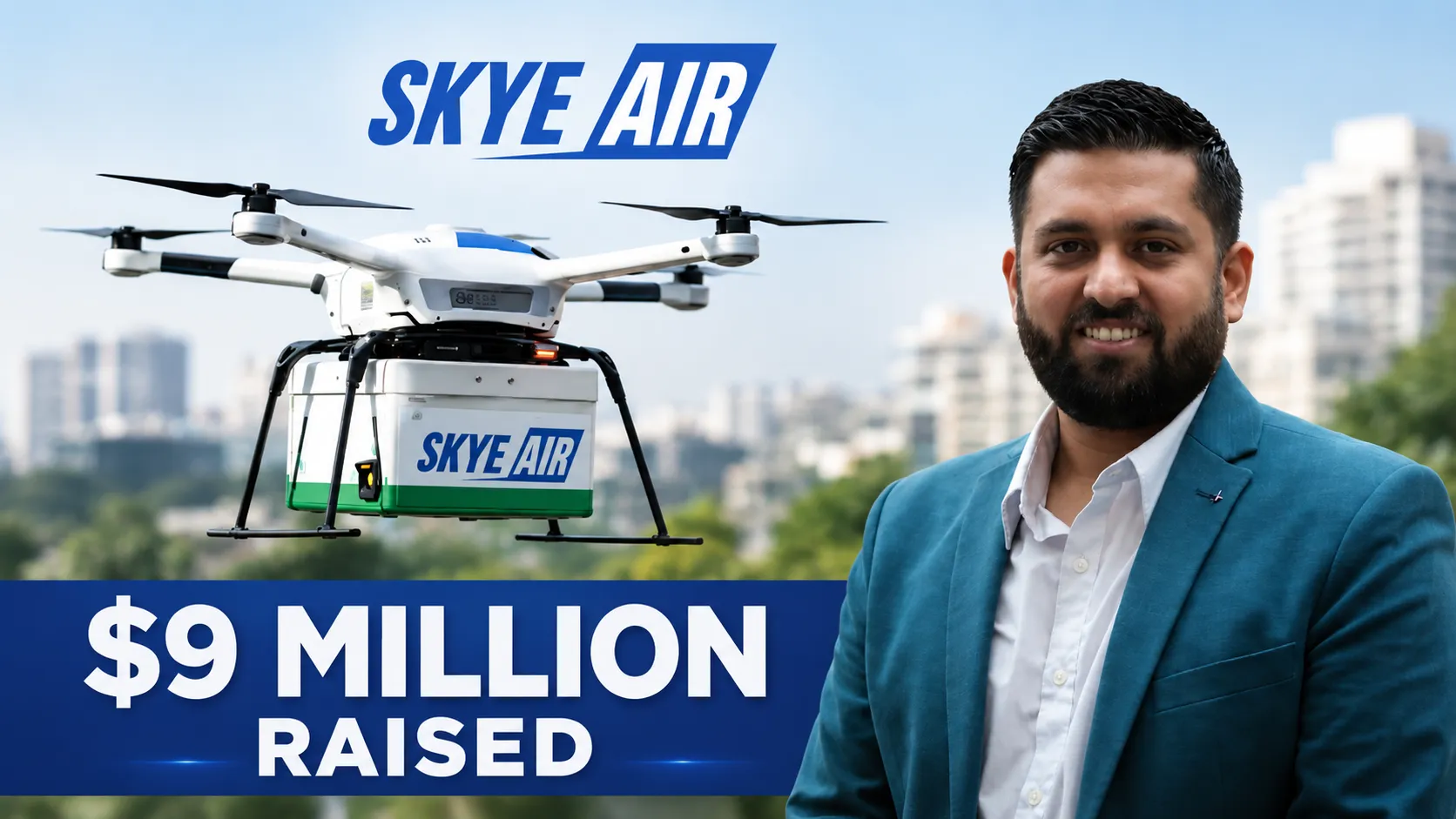
Drone delivery startup Skye Air Mobility is raising $9 million, or approximately ₹83 crore, in an ongoing Series B funding round led by IAN Alpha Fund, with participation from AVNM Ventures, Faad Capital and Bajaj Capital alongside existing investors including Chiratae Ventures and Mount Judi Ventures, as well as a host of undisclosed high-net-worth individuals. The round adds to a steady stream of capital flowing into India's emerging commercial drone-logistics sector, as operators across the category increasingly transition from regulatory pilot programmes toward sustained, revenue-generating operations.
The round places Skye Air Mobility among a small but growing cohort of Indian startups building commercial drone-logistics capabilities, a category that has moved gradually from pilot programmes and regulatory sandboxes toward more operationally mature, revenue-generating deployments over the past two years. India's drone sector has benefited from a series of supportive regulatory reforms, including simplified airspace-clearance processes and production-linked incentive schemes aimed at building domestic drone-manufacturing capacity, both of which have lowered the barriers for logistics-focused drone operators to scale commercial operations. The timing of the round is notable, arriving as several Indian states have begun piloting expanded drone-delivery corridors for both healthcare logistics and, in select cases, e-commerce fulfilment, creating a broader base of real-world operational data that companies like Skye Air Mobility can draw on to refine their commercial and regulatory positioning. This gradual accumulation of operational track record has increasingly become a prerequisite for securing meaningful institutional capital in a category still working to demonstrate defensible, at-scale unit economics. Skye Air Mobility's investor roster for this round is notable for its blend of institutional venture capital and family-office-style investment vehicles, a combination increasingly common among Indian startups operating in capital-intensive, hardware-adjacent categories where traditional software-focused venture funds may be less represented. The participation of Bajaj Capital, a wealth-management and financial-services group, alongside more specialised early-stage investors such as Faad Capital and AVNM Ventures, suggests a broadening of the investor base willing to underwrite India's still-nascent drone-logistics category. The continued backing from Chiratae Ventures and Mount Judi Ventures, both of which are understood to have supported Skye Air Mobility in earlier funding rounds, also signals a degree of investor conviction in the company's execution to date — a meaningful marker in a hardware-and-logistics category where operational complexity and regulatory dependency have historically made follow-on investment decisions more scrutinised than in pure software businesses.
India's broader drone-logistics opportunity spans use cases including medical-supply delivery to remote and hard-to-access regions, e-commerce last-mile delivery in congestion-heavy urban corridors, and agricultural applications such as crop monitoring and precision spraying. For companies like Skye Air Mobility, the ability to demonstrate reliable, regulatory-compliant operations across even a subset of these use cases has become an increasingly important differentiator as the category matures beyond its early pilot-project phase. The fresh capital is expected to support Skye Air Mobility's continued fleet expansion, route-network scaling and further investment in the operational and regulatory infrastructure required to run commercial drone logistics at scale — including ground-control systems, pilot training and coordination with India's civil aviation authorities as airspace rules for commercial drone operations continue to evolve. The economics of drone-based last-mile delivery remain an area of active experimentation across the global logistics industry, with operators weighing the higher per-delivery cost of drone operations against the potential for dramatically reduced delivery times and access to locations poorly served by conventional road-based logistics networks. In the Indian context, this trade-off has proven particularly relevant for use cases involving time-sensitive medical deliveries to hilly, remote or otherwise hard-to-reach terrain, where conventional road transport can involve delays measured in hours rather than the minutes drone delivery can potentially offer. Skye Air Mobility's positioning within this landscape reflects a broader strategic choice made by several Indian drone-logistics startups to prioritise defensible, high-value use cases — such as medical and healthcare logistics — over more commoditised e-commerce delivery applications where drone economics remain less clearly proven at scale. This focus has allowed early movers in the category to build operational track records and regulatory trust with aviation authorities in lower-risk, higher-value corridors before pursuing broader commercial expansion into more contested delivery categories.
As India's drone-logistics sector transitions from proof-of-concept deployments toward more sustained commercial operations, Skye Air Mobility's Series B round offers an early indicator of investor appetite for the category — one that will likely be tested further as more operators seek to scale beyond pilot programmes into full-fledged, revenue-generating logistics networks over the coming year. The continued evolution of India's drone regulatory framework, including further airspace liberalisation and streamlined approval processes for beyond-visual-line-of-sight operations, will likely play a decisive role in determining how quickly companies like Skye Air Mobility can scale from targeted regional deployments toward the kind of nationwide logistics network that would be required to fully realise the sector's commercial potential. For India's broader drone-technology ecosystem, Skye Air Mobility's round adds further evidence that investor patience for hardware-and-logistics categories requiring extended regulatory and operational maturation is beginning to be rewarded, potentially encouraging a fresh wave of capital toward adjacent drone-enabled logistics and infrastructure-inspection startups. As more Indian states expand regulatory pilot zones for commercial drone operations, companies with an established operational track record, such as Skye Air Mobility, are likely to be among the primary beneficiaries of any subsequent liberalisation of airspace rules governing beyond-visual-line-of-sight logistics flights. The sector's next phase of growth will likely hinge on how quickly regulatory frameworks can keep pace with the operational ambitions of well-capitalised operators seeking to scale beyond their current regional footprints. Investors and founders across India's broader logistics-technology ecosystem will be watching Skye Air Mobility's continued execution closely as an indicator of how quickly the drone-delivery category can move from promising pilot programme to durable, revenue-generating business, a transition that remains an open question across most markets currently experimenting with commercial drone logistics at scale, and one that this fresh round of capital, together with continued regulatory support, should help the company begin to answer decisively and conclusively over the course of the coming year ahead.