One of Ola Electric's most important early backers is continuing to reduce its exposure, just as the electric scooter maker asks shareholders for fresh capital.
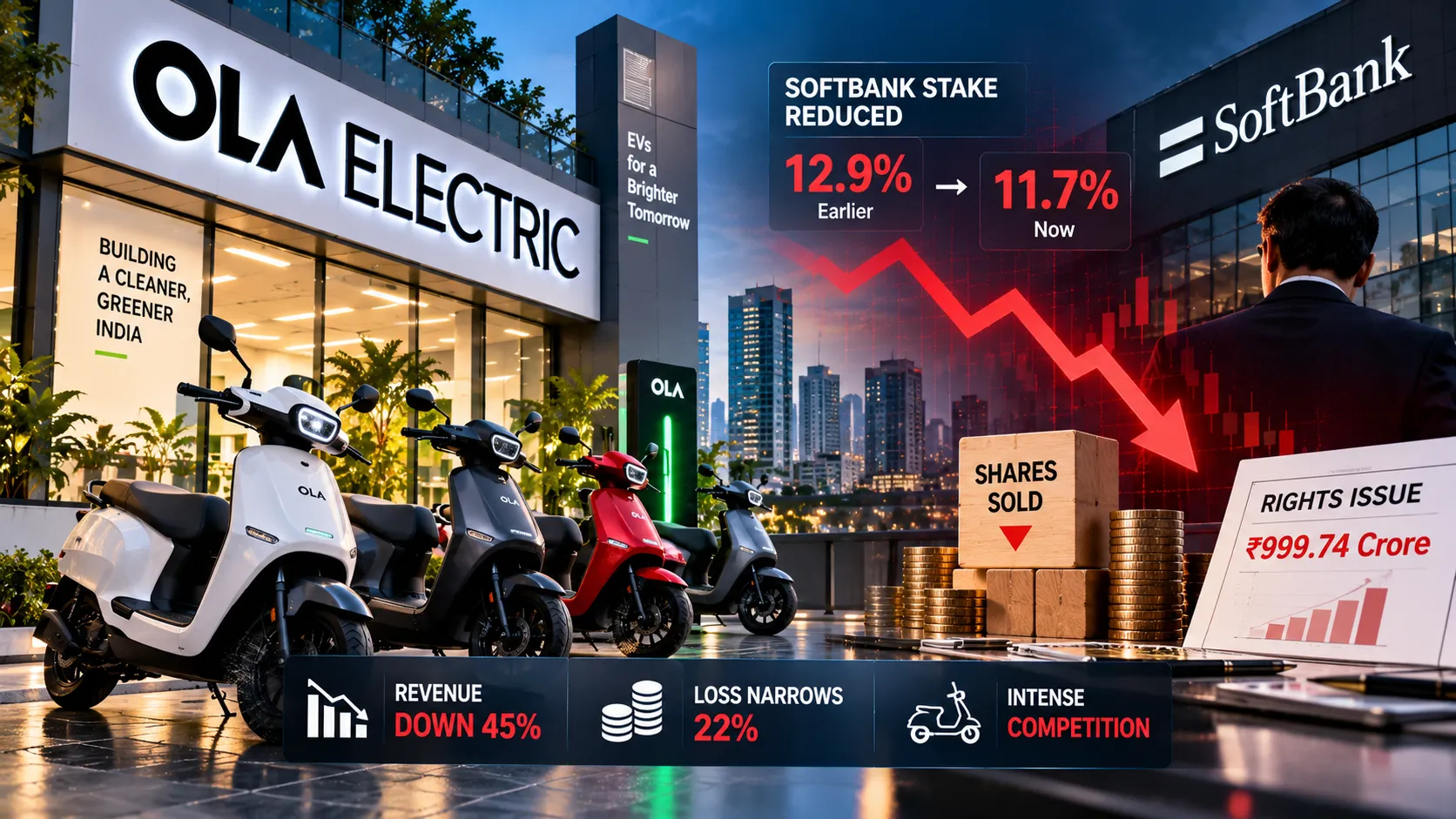
SoftBank, through its investment vehicle SVF II Ostrich (DE) LLC, sold about 5.55 crore Ola Electric shares between January 6 and October 22, 2026, reducing its stake from 12.9% to 11.7%, according to a regulatory disclosure reported on October 27. SoftBank also sold about 25.9% of its rights entitlements, the rights to buy new shares in the company's rights issue.
Ola Electric's ₹999.74 crore rights issue closes on October 30.
A steady retreat
The latest sale continues a pattern. SoftBank cut its stake from 17.83% to 15.68% between July and September 2025, and then to 13.53% by early January 2026, through open-market transactions, according to earlier disclosures reported by Entrackr. The cumulative reduction means SoftBank has sold roughly a third of its holding over about 15 months.
SoftBank was one of Ola Electric's largest investors before its initial public offering in August 2024, and its continued selling has weighed on investor sentiment.
The rights issue
Ola Electric's board approved a rights issue of about ₹1,000 crore, priced at ₹27 per share, earlier this month. In a rights issue, existing shareholders are offered the right to buy new shares in proportion to their holdings, typically at a discount to the market price.
Rights issues allow companies to raise money from existing investors, but they can signal financial strain if a company needs capital to fund operations. Shareholders who do not participate see their stakes diluted.
SoftBank's decision to sell part of its rights entitlements rather than take them up suggests that it does not intend to increase its investment in the company.
A tough year for Ola
Ola Electric has faced a difficult period. Its revenue for the April-June quarter fell 45% from a year earlier to ₹455 crore, while its loss narrowed 22% to ₹336 crore, according to earlier reports. The company has lost market share to rivals in the electric two-wheeler market, including Ather Energy, TVS Motor and Bajaj Auto.
Goldman Sachs has downgraded the stock to Sell, and the shares have traded near record lows in recent months. The company has also faced customer complaints about service quality and scrutiny from regulators.
The competitive landscape
India's electric two-wheeler market has grown rapidly, but competition has intensified. Established manufacturers with large dealer networks and strong after-sales service, such as TVS and Bajaj, have gained ground, while Ather Energy has grown steadily and recently reported its first quarterly profit.
Ola Electric was once the market leader, building a large factory in Tamil Nadu and launching scooters at aggressive prices. But service problems, quality concerns and the strength of rivals have eroded its position.
Bhavish Aggarwal's bet
Founder and chief executive Bhavish Aggarwal has pursued an ambitious strategy, including building a battery cell manufacturing facility, developing motorcycles and investing in artificial intelligence through a separate venture, Krutrim. Aggarwal has committed part of his own stake to help fund his participation in the rights issue, according to earlier reports.
The company's ability to execute on its plans, improve service and regain market share will determine whether it can turn around its performance.
What it means for new-age stocks
Ola Electric's struggles are a cautionary tale for investors in India's new-age companies. Several startups that listed during the IPO boom of recent years have seen their shares fall significantly below their listing prices as growth slowed and losses persisted.
At the same time, other companies, such as Ather Energy, have shown that EV makers can improve their finances. Investors have become more discerning, rewarding companies with strong execution and penalising those that miss expectations.
The investor exit question
SoftBank's selling reflects a broader trend of early investors reducing stakes in listed Indian startups as lock-in periods expire. Venture capital and private equity firms need to return capital to their own investors, and public listings provide a route to do so.
For retail investors, heavy selling by large early backers can create downward pressure on share prices, particularly when the company's fundamentals are under strain.
The rights issue mechanics
At ₹27 per share, Ola's rights issue price represents an opportunity for existing shareholders to buy more shares at a fixed price. Shareholders who do not wish to participate can sell their rights entitlements on the stock exchange during the trading window, which is what SoftBank has done with part of its entitlements. Those who neither subscribe nor sell their rights see their ownership diluted when new shares are issued.
The amount raised will help fund Ola's operations, including its cell manufacturing ambitions and working capital needs. The level of subscription by promoters and large shareholders will be closely watched as a signal of confidence.
Ather's contrasting path
Ather Energy, which reported its first quarterly profit recently, has become the benchmark against which Ola Electric is measured. Ather has grown steadily by focusing on product quality, service and a disciplined expansion of its retail network, gaining market share from Ola. The contrast has become a key theme in how investors assess India's listed electric two-wheeler makers.
Lessons for investors
Ola Electric's journey from one of the most anticipated IPOs of 2024 to a stock trading near record lows illustrates the risks of investing in fast-growing companies whose execution falls short of expectations. Strong brand recognition and ambitious plans did not protect the company from competition and operational challenges. For investors in India's new-age companies, the episode reinforces the importance of evaluating service quality, unit economics and competitive positioning alongside growth narratives.
What comes next
Attention now turns to the outcome of Ola Electric's rights issue, which closes on October 30. The level of participation will indicate how much confidence existing shareholders have in the company's turnaround plans.
Investors will also watch Ola's September-quarter results for signs of improvement in sales, market share and losses. For SoftBank, the question is whether it continues to reduce its stake further, or whether it holds its remaining shares in the hope of a recovery. Market participants will also track whether other large pre-IPO investors follow SoftBank in reducing their holdings, which could add further pressure on the stock, or whether improving results draw new long-term investors to the company's shares.