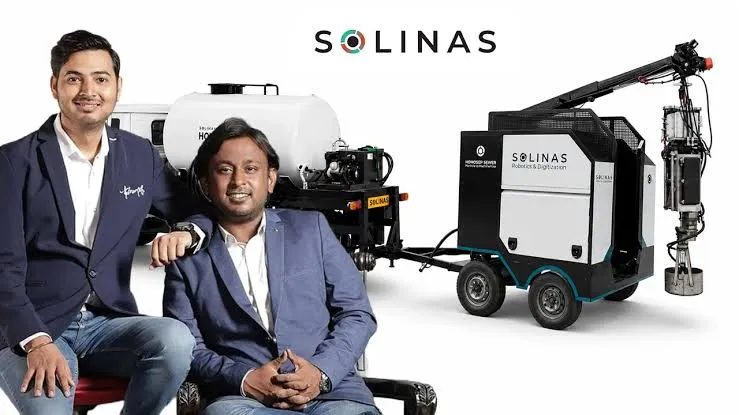
Indian cities lose roughly 38 per cent of treated water before it reaches a paying customer, a crisis rendered largely invisible by the fact that it happens entirely underground. Solinas Integrity, a Chennai-based robotics company incubated at IIT Madras, has raised $5.5 million in a Series A1 funding round to scale the robots designed to find and fix exactly that problem.
The round was co-led by Hero Enterprise Partner Ventures and Mela Ventures, with participation from Luthra Group. Existing investors SBI Ventures, through its climate-focused Neev II SVL-SME Fund, Rainmatter Capital and 8X Ventures Fund I all made follow-on investments, with SBI Ventures doubling its earlier position. The round follows Solinas's original Series A, led by SBI Ventures in May 2024, underscoring what the company describes as deepening alignment between India's climate-tech innovation ecosystem and global sustainability-focused capital.
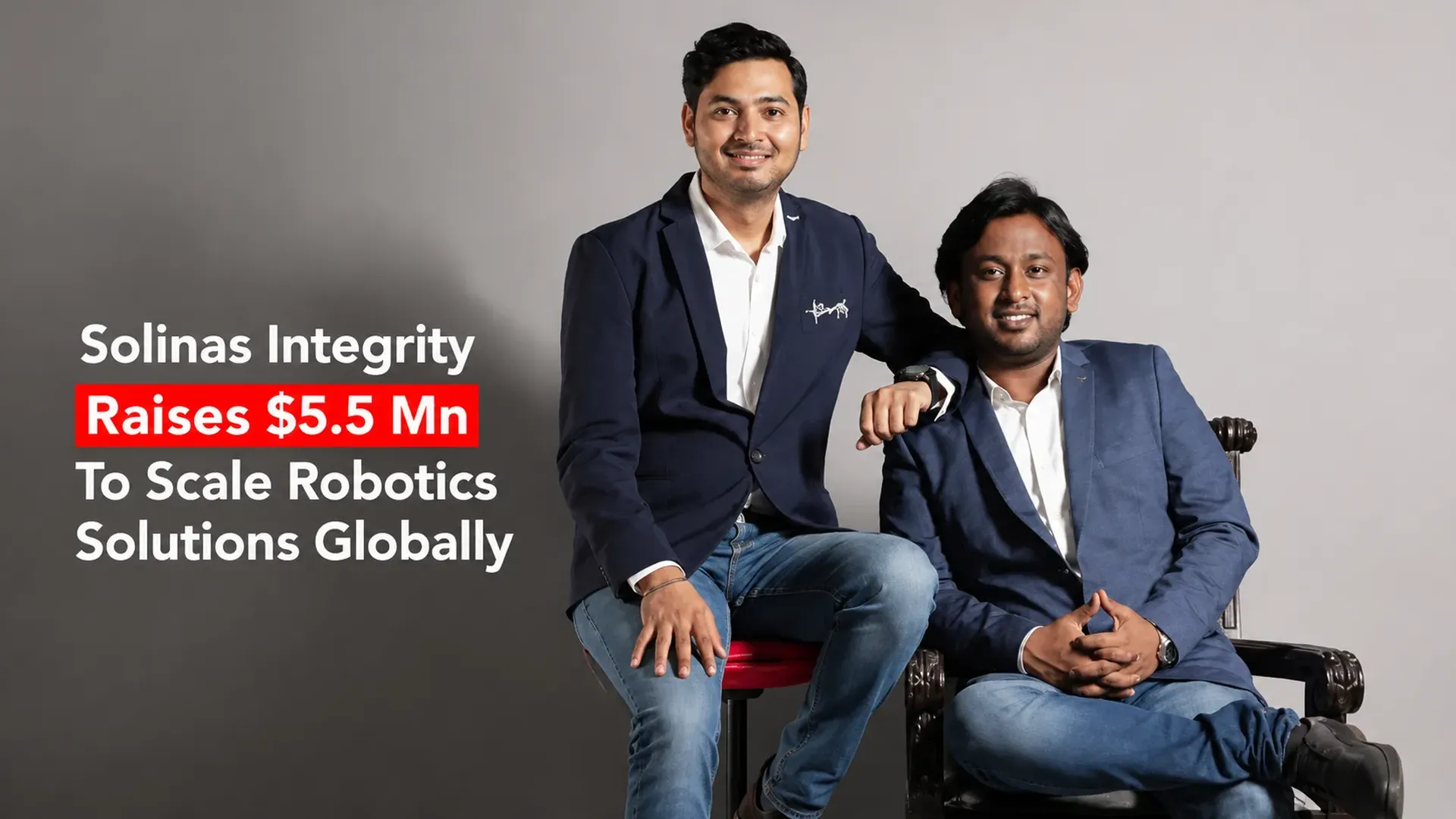
Founded in 2018 by Divanshu Kumar and Moinak Banerjee alongside co-founders Krishnan Balasubramanian, Prabhu Rajagopal and Bhavesh Narayani, Solinas has built an integrated full-stack robotics platform spanning inspection, sanitation and AI-powered infrastructure intelligence for underground water and wastewater networks. Its EndoBot crawlers, capable of navigating pipes as narrow as 90 millimetres, are equipped with high-definition cameras for visual inspection, laser profilers that measure pipe cross-section deformation to identify structural failure or sediment accumulation, and inertial measurement units that track the robot's precise position through the network, mapping defects in around 30 minutes at roughly one-fifth the cost of conventional inspection methods.
The company's broader product suite includes HomoSEP, which supports mechanised operations in sewers and septic tanks in place of manual scavenging, and SWASTH AI, an infrastructure intelligence platform that converts inspection data into asset-management and predictive-analytics tools for utilities and municipalities. Solinas says its technologies have already been deployed across more than 30 cities in 15 Indian states, and its solutions are also in use by Dubai Municipality, giving the company an operating footprint beyond India even at this relatively early stage of its growth.
"Current methods of maintaining India's water infrastructure are manual, hazardous, time-consuming, and costly, with virtually no visibility into what lies beneath," said Krishnakumar Natarajan, Managing Partner at Mela Ventures. "Solinas is changing that through a vertically integrated robotics platform that maps underground infrastructure, diagnoses issues, and delivers end-to-end solutions. At Mela Ventures, we have followed Divanshu and the team's journey for four years, and their growth has been remarkable. Backing fearless founders solving globally hard problems from India is core to our investment philosophy, and Solinas is one of the best examples of that."
The fresh capital will fund an increase in manufacturing capacity, new product development, strengthened software infrastructure and working-capital requirements as Solinas scales both government and enterprise contracts. Alongside continued domestic expansion into new Indian states and municipal areas, the company plans to deepen its international sales footprint with a strategic focus on the Middle East and Southeast Asia, building on its existing relationship with Dubai Municipality. Solinas is also investing in new product development to widen its technology portfolio into adjacent categories including WASH applications, industrial asset inspection and defence, where it already works with automotive, pharmaceutical and manufacturing companies on asset inspection and management.
The funding round arrives as water scarcity and ageing urban infrastructure become increasingly urgent policy concerns across India's rapidly growing cities, where non-revenue water losses, the technical term for treated water that never reaches a paying customer through leaks, theft or metering failures, represent both a significant economic cost to municipal utilities and a growing constraint on water availability for expanding urban populations. By combining robotics hardware with AI-powered data intelligence, Solinas is positioning itself not merely as an inspection contractor but as a long-term infrastructure-intelligence partner for the utilities and municipal bodies increasingly under pressure to modernise systems that, in many Indian cities, have gone decades without comprehensive underground assessment.
The manual scavenging problem that Solinas's HomoSEP robot directly targets carries particular social and legal weight in India, where the practice, despite being formally outlawed under the Prohibition of Employment as Manual Scavengers and their Rehabilitation Act of 2013, has persisted in many municipalities due to a chronic shortage of safer mechanised alternatives, resulting in preventable deaths and severe health consequences for sanitation workers who continue to enter sewers and septic systems manually. By offering a commercially viable, technically robust robotic alternative, Solinas positions its technology as directly relevant not only to infrastructure efficiency but to a specific, well-documented public health and labour-rights crisis that government policy alone has struggled to eliminate through legislation without adequate technological substitutes at scale.
Solinas's expansion into the Middle East, anchored by its existing relationship with Dubai Municipality, also illustrates a broader pattern among Indian deep-tech and climate-tech startups: building and proving a technology within India's demanding, cost-sensitive domestic infrastructure market before exporting that same technology, often at a meaningful cost advantage relative to Western competitors, into other geographies facing comparable water-infrastructure challenges. Gulf municipalities in particular, managing extensive underground water networks in arid, resource-constrained environments, represent a natural adjacent market for infrastructure-intelligence platforms proven in India, and Solinas's continued expansion into Southeast Asia alongside the Middle East suggests the company sees its underlying robotics and AI platform as broadly exportable well beyond the specific regulatory and infrastructure context in which it was originally built.
The company's expansion into industrial applications, working with automotive, pharmaceutical and manufacturing clients on asset inspection and management, also diversifies Solinas's revenue base beyond its founding public-utility and municipal focus, a diversification that matters both commercially, since government and municipal contracts frequently carry longer sales cycles and payment timelines than private enterprise deals, and strategically, since it positions the company's core robotics and AI-inspection technology as a broadly applicable infrastructure-intelligence platform rather than a narrowly scoped water-and-sanitation product, opening a considerably larger addressable market as Solinas looks to convert its Series A1 funding into sustained, multi-sector growth. With its investor base now spanning climate-focused institutional funds, strategic family offices and returning early backers, Solinas enters its next growth phase with both the capital and the credibility to test whether India-proven underground robotics can become a genuinely global infrastructure-intelligence category rather than a domestically confined solution to a domestically specific problem.