South Korea's export machine has rarely run this hot. Driven by an extraordinary surge in demand for the memory chips that power artificial intelligence, the country's exports nearly doubled in October to the highest monthly total in its history.
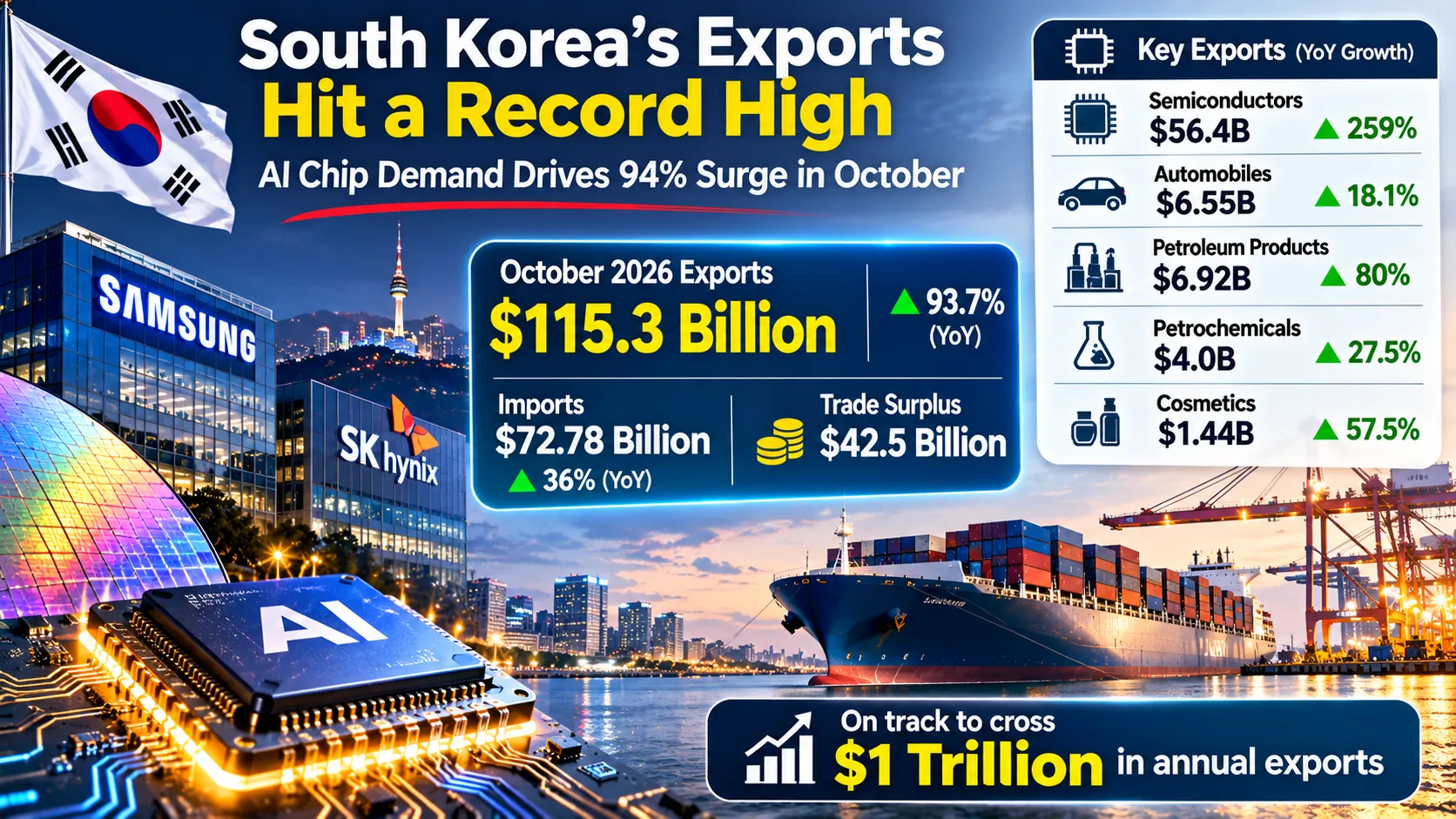
Exports rose 93.7% from a year earlier to a record $115.3 billion, according to data released on Sunday, November 1, and reported by Korea JoongAng Daily. Imports rose 36% to $72.78 billion, producing a trade surplus of $42.5 billion.
The growth was "driven largely by a sharp increase in semiconductor shipments," according to the report.
Chips dominate
Semiconductor exports rose 259% to $56.4 billion, accounting for roughly half of the country's total exports in the month. The surge reflects the global race to build AI data centres, which require vast quantities of high-bandwidth memory (HBM), conventional DRAM and NAND flash storage.
South Korea is home to SK hynix and Samsung Electronics, the world's two largest memory chipmakers. Both have reported record profits as memory prices have soared. Samsung said last week that it expects memory demand to exceed supply in 2027, while SK hynix has said it plans to return about $75 billion to shareholders.
Memory has traditionally been a cyclical industry, with booms followed by busts. The current upswing, driven by AI, has proven unusually powerful and prolonged, and the scale of October's export figures suggests no sign of a slowdown yet.
Exports to the US and China
Exports to China rose 133.6% to $26.98 billion, driven by semiconductors and wireless communications equipment. Exports to China have topped $20 billion for five consecutive months, according to the report.
Exports to the United States rose 185.8% to $24.9 billion, supported by demand for semiconductors, computers and electrical equipment used in AI infrastructure. American technology companies, including Microsoft, Alphabet, Amazon and Meta, are investing hundreds of billions of dollars a year in data centres, much of which flows to suppliers of chips and equipment in Asia.
Beyond chips
While semiconductors dominated, other sectors also grew. Auto exports rose 18.1% to $6.55 billion, driven by overseas demand for gasoline hybrid models. Hyundai Motor and Kia have benefited from strong demand for hybrids in the United States and Europe as some buyers hesitate to switch fully to electric vehicles.
Petroleum product exports rose 80% to $6.92 billion, reflecting higher fuel prices caused by the Middle East conflict and strong refining margins. South Korea's refiners, including SK Innovation, GS Caltex and S-Oil, import crude and export refined products. Petrochemical exports rose 27.5% to $4 billion, and cosmetics, reflecting the global popularity of Korean beauty products, rose 57.5% to $1.44 billion.
The trillion-dollar milestone
South Korea is expected to become the fourth country to record $1 trillion in annual exports, after China, the United States and Germany, with the milestone expected later in November, according to Korea JoongAng Daily. Cumulative exports for January to September had already reached $814.5 billion, surpassing $800 billion for the first time.
The milestone would be a remarkable achievement for a country of about 51 million people, highlighting the extent to which South Korea has become central to global technology supply chains.
Base effects
Part of the enormous year-on-year growth rate reflects a low base. October 2025 included a long holiday period in South Korea, which reduced working days and exports in that month. Even so, the absolute value of $115.3 billion is far above any previous month, confirming genuine strength.
Risks to the boom
The concentration of exports in a single product category creates risks. If AI investment slows, or if memory prices fall as new production capacity comes online, South Korea's exports could decline sharply. Investors have recently shown nervousness about the scale of AI spending, with technology stocks falling in the United States last week after mixed earnings.
Trade policy is another risk. The United States has imposed tariffs on many imports and has restricted exports of advanced chips and chipmaking equipment to China. South Korean chipmakers operate factories in China and must navigate these restrictions carefully.
The Kospi rally
South Korea's stock market has been one of the world's best performers this year, driven by the soaring valuations of Samsung and SK hynix. Foreign investors have poured money into Korean chip stocks, and the Kospi has reached record highs, although it has been volatile as sentiment towards AI fluctuates.
What it means for India
South Korea's export boom illustrates the enormous economic value being created by the AI hardware supply chain. India is seeking a share of this value through its semiconductor mission, which supports chip assembly and testing plants, including Micron's facility in Gujarat, and the Tata Electronics fab at Dholera. Indian policymakers see the success of countries such as South Korea and Taiwan as a model, although building a competitive chip industry takes decades.
Korean companies, including Samsung and Hyundai, have large operations in India, and India-Korea trade and investment ties are growing. India also competes with South Korea in some export markets, including automobiles, steel and petrochemicals.
The global trade picture
South Korea's export data is often seen as a bellwether for global trade, because it is released early each month and covers a wide range of products. October's figures suggest that global demand for technology products remains extremely strong, even as trade in some other categories faces headwinds from tariffs and the energy shock.
The memory makers' windfall
The export surge is mirrored in the financial results of South Korea's chip giants. Samsung Electronics reported record quarterly operating profit last week, driven by its memory business, and forecast that memory demand would exceed supply in 2027. SK hynix, the leading supplier of high-bandwidth memory to Nvidia, has reported a series of record quarters. Both companies are expanding production capacity rapidly, investing tens of billions of dollars in new factories and equipment.
What comes next
Investors will watch whether the export boom continues in November and whether South Korea crosses the $1 trillion mark. The earnings of chipmakers and the investment plans of major technology companies will provide further signals about the durability of AI-driven demand. For now, October's record numbers underline that the AI boom is reshaping global trade flows, with South Korea among its biggest beneficiaries.
For global investors and policymakers alike, Korea's monthly trade figures will remain one of the most important early signals of whether the AI investment cycle is accelerating, levelling off or beginning to turn, with consequences that reach far beyond the Korean peninsula.