Shares in Elon Musk's two publicly traded companies, SpaceX and Tesla, fell sharply on Wednesday, November 4. The declines came even as the wider US stock market posted one of its biggest gains in more than a year, after Democrats swept the midterm elections, including high-profile races in Texas, where both companies are headquartered.
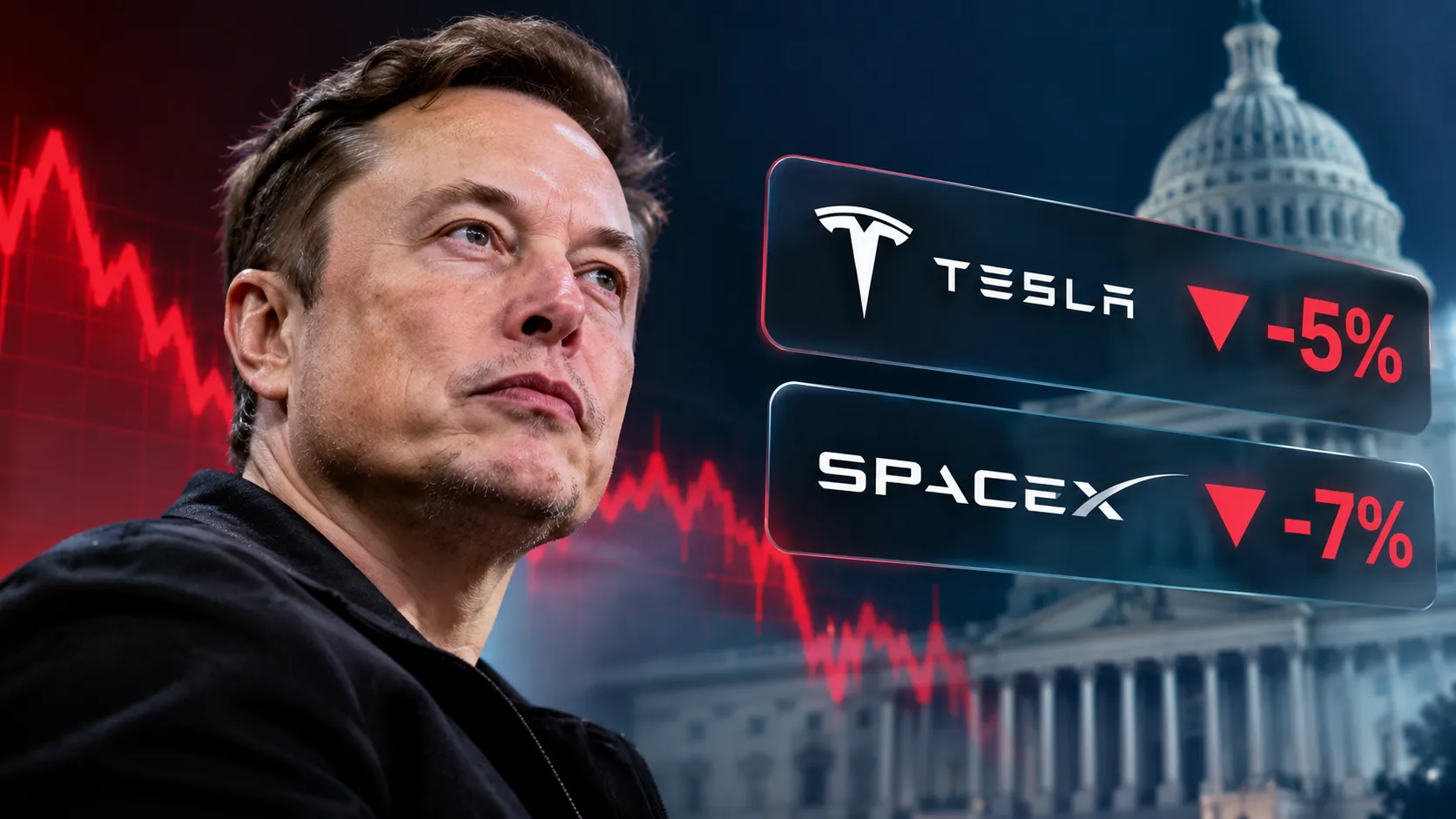
According to The New York Times, Tesla's stock fell more than 5% and SpaceX more than 7% when markets opened, before recovering some of those losses. Other reports put the declines during the session at about 5% for SpaceX and between 3% and 5.6% for Tesla, depending on the time of measurement.
The early fall in the two stocks wiped more than $100 billion off their combined market value at the open, according to estimates reported on the day.
A costly political bet
Musk spent at least $474 million supporting Republican candidates in the midterm elections, more than any other individual donor in the cycle. About $224 million of that went to races in Texas, where both SpaceX and Tesla are based and where Musk lives.
In Texas, Democrats won both the Senate race and the governor's race. Governor-elect Gina Hinojosa campaigned against corporate subsidies and criticised Musk directly. She will now have influence over regulatory decisions affecting his companies in the state.
Musk responded to the results on his social media platform X. "Data centers in space looking pretty appealing right now," he wrote, referring to SpaceX's plans to build computing infrastructure in orbit. In another post he joked that his "election-interfering space lasers" had not worked this time.
Why investors reacted
The declines reflected investor concern that the election result could create new political and regulatory risks for Musk's companies.
A Democratic-controlled Congress could launch investigations into Musk and his businesses. Some Democratic lawmakers have already said they want to examine his companies' government contracts, regulatory treatment and political activity. Congressional investigations can be time-consuming and distracting for management, and can lead to changes in policy.
Dan Ives, a Wedbush analyst who is generally bullish on both companies, said in a note that Musk needed to find a path forward in Texas following the Democratic wins in the Senate and governor's races.
The merger question
One of the biggest uncertainties concerns a possible merger between Tesla and SpaceX. The two companies have been exploring a combination that could leave Musk controlling most of the votes in the merged business.
A merger of that size would face scrutiny from regulators and shareholders under any circumstances. A Democratic-controlled Congress could add political pressure, with lawmakers potentially questioning the governance arrangements and Musk's control.
The election result has therefore introduced a new element of uncertainty into one of the most closely watched corporate stories of the year.
Data centres under pressure
The election also raised questions about Musk's plans for AI infrastructure. SpaceX is building several gigawatts of data-centre capacity, including projects in Texas. Tesla and SpaceX are also reported to be working on plans for a $100 billion chip manufacturing facility in the state.
Data centres became a political issue during the midterm campaigns, with concerns about their energy and water use, their effect on electricity prices and the subsidies they receive. A data-centre moratorium has been discussed in Texas.
AI data-centre stocks more broadly came under pressure on Wednesday. Dan Ives said in a separate note that the midterm results would slow the pace of data-centre construction across the US.
The political shift may help explain Musk's renewed emphasis on orbital data centres. SpaceX has argued that placing computing infrastructure in space could take advantage of continuous solar power and avoid many of the constraints that face data centres on Earth.
A Qualcomm deal cushions SpaceX
SpaceX's fall was partly cushioned by an announcement on the same morning. The company said it had signed a multiyear agreement with Qualcomm to build the ground network for Starlink Mobile, SpaceX's planned wireless carrier service.
The deal highlights SpaceX's push to expand Starlink beyond satellite broadband for homes and businesses into mobile communications. Partnering with Qualcomm, one of the world's leading chip and wireless technology companies, gives SpaceX access to established expertise in mobile networks.
Qualcomm's shares rose more than 5% on the day, ahead of its quarterly results after the market closed.
SpaceX's short life as a public company
SpaceX went public in June 2026 in one of the largest IPOs in history. Its shares rose strongly on the first day of trading but then fell sharply over the following weeks, dropping about 50% from their peak by late July.
The volatility reflects the challenge of valuing a company with such a wide range of businesses, from rocket launches and satellite broadband to AI and space-based computing. Investors have been weighing the strong growth of Starlink against the high costs and long timelines of SpaceX's more speculative projects.
Despite Wednesday's fall, some analysts remain optimistic about SpaceX's long-term prospects. Morgan Stanley published a more bullish forecast for the company this week, reflecting confidence in the growth of Starlink and its other businesses.
Tesla's exposure
For Tesla, the election result adds to a list of uncertainties. The company has faced pressure on its core electric vehicle business from competition, particularly from Chinese manufacturers, and from changes in US policy on EV incentives.
Much of Tesla's recent share price strength has been driven by Musk's ambitions in AI, robotics and autonomous driving, and by merger speculation. Political developments that affect those ambitions can therefore have a significant effect on the stock.
Tesla's Texas operations, including its large factory in Austin, could be affected by changes in state policy under the new governor.
Lessons on political risk
The market's reaction highlights how closely investors now link Musk's political activity to the prospects of his companies. Musk's prominent role in politics has made his businesses more exposed to political outcomes than most large companies.
For global investors, including members of the Indian diaspora who hold Tesla or SpaceX shares, Wednesday's session was a reminder that political risk can affect individual stocks even when the broader market is rising strongly.
What comes next
In the coming months, investors will watch how Musk responds to the new political landscape. That includes how he handles relations with the incoming Texas governor and whether congressional investigations begin. Progress on the proposed Tesla-SpaceX merger and on Starlink and AI projects will also be closely watched.
For now, the results have added a new layer of uncertainty to Musk's business empire, at a time when both SpaceX and Tesla are pursuing some of the most ambitious and capital-intensive projects in the technology industry.


