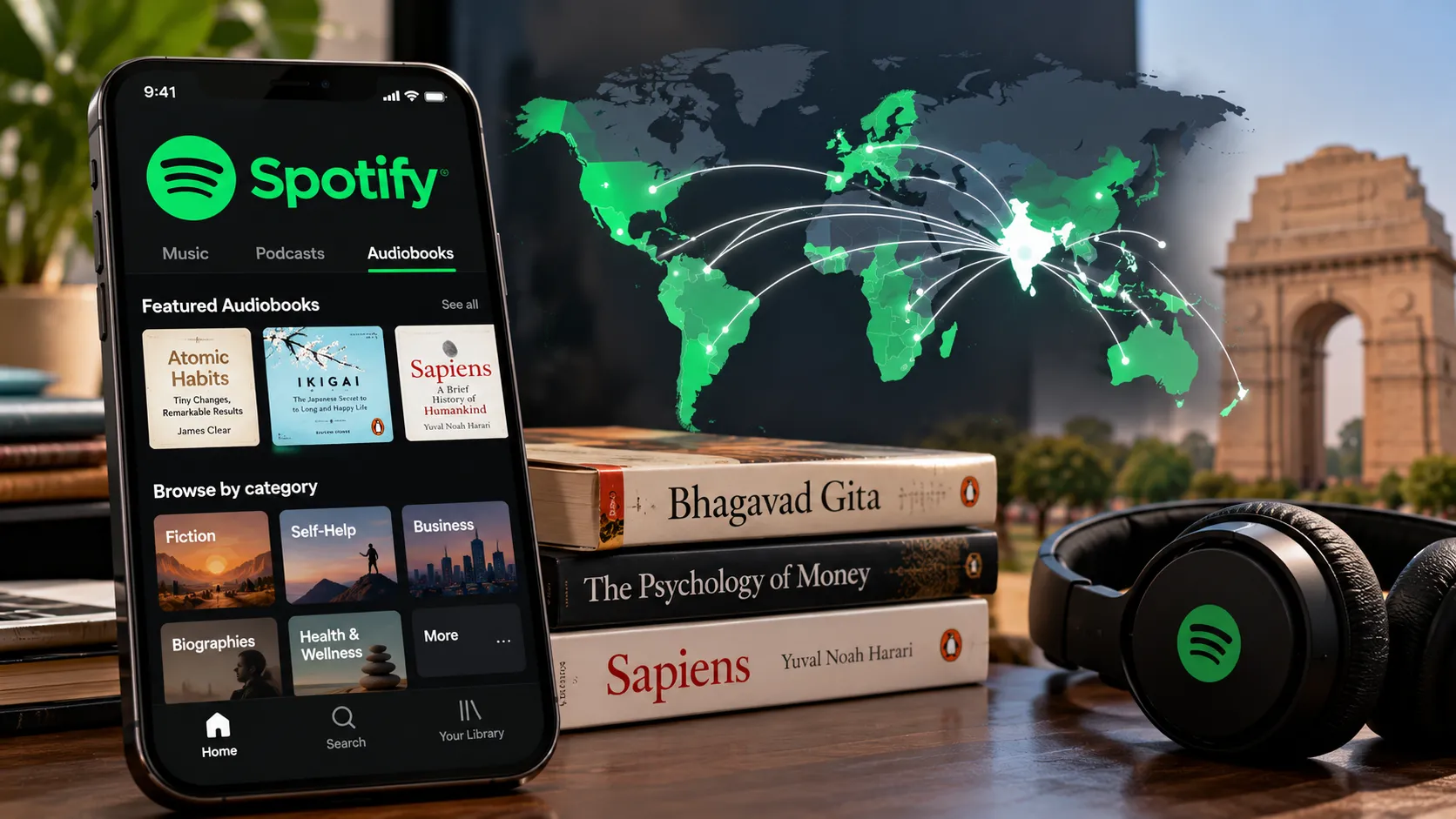
Spotify is taking its audiobook service to more than 180 markets, India among them, in an expansion that will put a catalogue of over 350,000 titles in front of more than 750 million users and considerably widen its challenge to Amazon's Audible.
The Swedish streaming company announced the plan on 7 October at the Frankfurt Book Fair. Audiobooks had until now been offered in 22 markets; the rollout began on the day of the announcement and is due to cover more than 180 by the end of 2026, Spotify said. India appears by name in the list of markets the company published, alongside its South Asian neighbours Pakistan, Bangladesh, Sri Lanka, Nepal, Bhutan and the Maldives.
The new markets span Europe, the Americas, the Caribbean, the Middle East, Africa and Asia. Spotify said titles will be available in more than 120 languages, including new catalogues in Spanish, Portuguese, Italian and Polish, and that all of its publishing partnerships are non-exclusive.
How Indian listeners will get access
The model will differ from country to country. Spotify offers audiobooks in three main ways. In some markets, eligible Premium subscribers get 12 hours of listening a month included in their plan; that version is coming to Italy, Spain, Portugal, Brazil, Mexico, Colombia, Poland, Chile, Norway and Peru, among others.
In Africa, Asia and Argentina, the main route will instead be Audiobooks+, a paid add-on that gives any listener extra monthly hours. Spotify said Premium Family and Duo members can get 15 hours a month through a recurring add-on. Listeners can also buy individual titles to keep.
For India, that means audiobooks are expected to arrive mainly as an add-on rather than as part of the standard Premium plan. Spotify said pricing and access models vary by market, and its announcement did not include Indian prices or a specific India launch date beyond the end-of-2026 target for the full rollout.
Spotify has operated in India since 2019. The audiobook segment there already includes Audible, which Amazon runs locally, as well as home-grown audio-series apps such as Pocket FM and Kuku FM. The announcement did not say how many Hindi or other Indian-language audiobooks would be available at launch; the language catalogues it highlighted were European.
The expansion also covers countries with large Indian diaspora communities, including the United Arab Emirates, Saudi Arabia, Qatar, Kuwait, Oman, Bahrain, Singapore, Malaysia, Kenya, South Africa and Mauritius. The published list also includes the United States, the United Kingdom, Canada and Australia.
Elsewhere in Asia, the list takes in Japan, South Korea, Indonesia, the Philippines, Vietnam, Thailand, Taiwan, Hong Kong and Kazakhstan, while Africa's largest economies, including Nigeria, Egypt and South Africa, are also covered. Taken together, the rollout would move audiobooks from a feature found mainly in rich, English-speaking countries to one available across much of the developing world, where price sensitivity is higher and local-language catalogues matter more.
Student plans are part of the push. In November, Audiobooks+ will come to Student plans in Ireland, Belgium, Austria and Finland, and Spotify said it intends to extend student availability to more markets over the coming year.
From a narrow launch to a global business
Spotify added audiobooks to Premium in the autumn of 2023. For most of the period since, the service has been concentrated in a handful of countries; TechCrunch noted it was mainly available in the US, the UK, Ireland, Australia, New Zealand and Germany. According to Spotify's newsroom, France, Belgium, the Netherlands and Luxembourg followed in October 2024, and Premium access reached Sweden, Denmark, Finland, Iceland and Monaco in November 2025.
The company now has figures suggesting the bet is paying off. Audiobooks+, launched just over a year ago, has more than one million subscribers and exceeds $100 million in annual recurring revenue, Spotify said. Monthly audiobook listeners grew nearly 40% over the past year, while listening hours rose more than 30%.
Those numbers give Spotify a story to tell publishers. TechCrunch reported that it works with more than 300 publishers worldwide, including Planeta and Mondadori, and that Spain will launch with more than 45,000 Spanish-language titles.
"Books change how we see the world, and the people in it," said Owen Smith, Spotify's vice-president of audiobooks. Smith said audiobooks are often the way people come back to reading, and that the expansion would let authors and publishers reach readers who had been out of their reach.
Spotify has also been building features around books. Page Match, introduced in February, lets readers move between a print book, an e-book and the audiobook; more than one million readers have used it, according to the company. A new option lets users scan a book's ISBN barcode to find their place, and the feature works in more than 30 languages.
Spotify chose a book-industry stage for the announcement rather than a technology event. Frankfurt is the world's leading meeting point for rights deals between publishers, and making the case there signals that Spotify sees itself as a distribution partner for publishers seeking new territories, not only as a streaming app adding a format.
Other additions this year include Audiobook Charts for discovering popular titles, an AI-powered tool built on ElevenLabs models to help authors produce audiobooks, and experimental sales of printed books in markets such as the US and UK.
The Audible question
The expansion is aimed squarely at rivals. TechCrunch described it as a way for Spotify to compete both with other music streaming services and with dedicated audiobook apps such as Audible. Spotify's advantage is distribution: rather than persuading people to install a separate app, it can put books in front of listeners who already open Spotify daily for music and podcasts.
The harder part is the economics. Audiobooks are costly to license, and bundling listening hours into a subscription means Spotify pays publishers for content that many users treat as a perk. Leading with the Audiobooks+ add-on in Africa, Asia and Argentina points to a more cautious approach in those regions, asking listeners to pay separately for their audiobook time.
For Indian readers, the near-term questions are price and catalogue. Streaming subscriptions in India are generally sold at far lower prices than in the US or Europe, so an add-on priced for Western markets would struggle, and the depth of Hindi and regional-language titles will decide whether the service appeals beyond English-language readers. Spotify has not yet answered either question.
The rollout will continue over the coming months, with Spotify aiming to finish by the end of 2026. What began three years ago as a feature for a small group of mostly English-speaking markets is set to become a standard part of the Spotify app across most of the world.