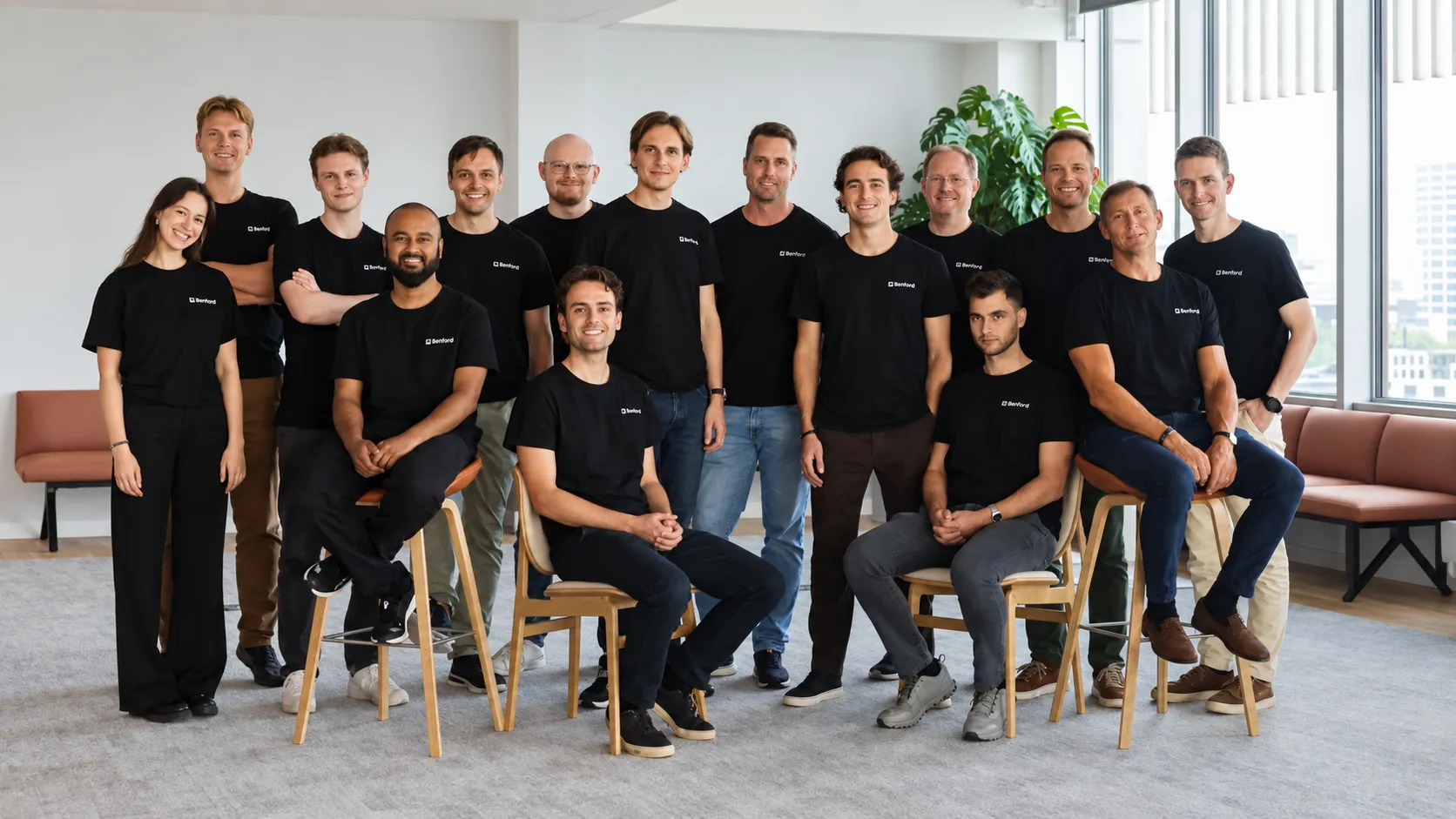
Spott, a Belgian startup building AI-native software for recruitment agencies, has raised €18.3 million ($21 million) in a Series A round led by Balderton Capital, as investors continue to back companies seeking to rebuild established enterprise software categories around artificial intelligence.
The round, announced on 22 September 2026, also included Base10 Partners, Y Combinator and Fortino Capital. It follows a €2.8 million seed round completed in March 2025 and brings Spott's disclosed funding to approximately €21.1 million.
One system instead of many
Recruitment agencies typically rely on a patchwork of tools: an applicant tracking system (ATS) to manage candidates, a customer relationship management (CRM) system to manage client relationships, email and calendar tools, sourcing databases and a variety of note-taking and scheduling applications. Information about candidates and clients is often scattered across these systems, making it difficult to search and use effectively.
Spott combines the ATS and CRM functions used by recruitment agencies with candidate search, outreach, note-taking, scheduling and automation in a single platform. It converts information from emails, CVs, calls and hiring pipelines into structured, searchable data rather than leaving it spread across disconnected tools.
That approach strengthens the AI proposition. Recruitment firms accumulate years of candidate conversations, placement histories, notes and client relationships. Once that information is structured and searchable by context rather than keywords, a firm's historical database can become significantly more valuable, allowing recruiters to rediscover candidates and identify matches they might otherwise miss.
Rapid growth and global reach
Founded in 2024, Spott says its revenue has increased more than tenfold since the beginning of 2026 and that hundreds of agencies now use its product. More than 80% of its new business arrives through inbound demand, suggesting strong word-of-mouth within the recruitment industry.
Customers include H.W. Anderson and CGP Group, a 200-person firm that uses Spott across 12 countries. Although Spott is based in Leuven, its customer base is already international: roughly 20% of current revenue comes from the Asia-Pacific region and 15% from the United States, according to the company.
Spott plans to open offices in Sydney and New York and expects to increase its headcount from 44 to around 60 by the end of the year.
Humans stay in the loop
One of Spott's most notable product decisions is its approach to automation. The platform does not allow its AI to autonomously advance candidates or present them to clients without human approval. Consequential decisions remain in the hands of recruiters.
That boundary may prove to be a competitive advantage. Employment decisions are among the most sensitive applications of AI, raising concerns about accuracy, bias and accountability. Under the European Union's AI Act, AI systems used in recruitment and employment decisions are classified as high-risk, subjecting them to strict requirements around transparency, human oversight and risk management. Other jurisdictions have introduced or are considering rules on the use of automated tools in hiring.
By designing human oversight into its product from the start, Spott may be better positioned to meet regulatory requirements and to earn the trust of agencies and their clients.
Why investors are backing AI-native SaaS
The round reflects a broader shift in enterprise software investing. Capital is increasingly flowing to startups that argue existing software categories can be rebuilt around AI and autonomous workflows, rather than simply enhanced with copilots bolted onto legacy systems.
Recruitment is an attractive target for this thesis. The industry involves large volumes of repetitive communication, candidate data, scheduling, CRM updates and document processing, all tasks where AI can reduce manual effort. At the same time, the recruitment software market has long been fragmented, with many agencies using older systems that are difficult to integrate and search.
Balderton Capital, one of Europe's most established venture firms, has backed a range of European software companies. Its decision to lead the round signals confidence that Spott can become a significant player in a global market. The participation of Y Combinator, which backed the company earlier, and Base10 Partners, a US-based firm focused on automation and the real economy, adds transatlantic support.

The competitive challenge
Spott faces competition from established ATS and CRM providers serving recruitment agencies, many of which are adding AI features to their platforms, as well as from a new generation of AI-first startups. Switching costs in recruitment software can be significant, since agencies must migrate large databases and retrain staff.
Spott's rapid growth suggests it has found ways to overcome those barriers, possibly by offering a compelling experience that reduces the manual work recruiters dislike most. Sustaining that growth will require continued product innovation, reliable data migration and strong customer support as it scales internationally.
What the funding will build
With the new capital, Spott is expected to deepen its product capabilities, expand its presence in the Asia-Pacific region and the United States, and build the go-to-market teams needed to serve larger agencies. The company's international revenue mix suggests that recruitment agencies face similar problems regardless of geography, and that a well-designed product can travel across markets with relatively limited localisation.
Larger agencies, however, bring more complex requirements, including integrations with payroll and compliance systems, multi-office permissions and detailed reporting. Meeting those needs while preserving the simplicity that attracted early customers will be a key product challenge as Spott moves upmarket.
The broader recruitment industry is also under pressure to become more efficient. Agencies face competition from in-house talent teams, professional networking platforms and new AI-driven hiring tools, and their clients increasingly demand faster, more data-driven service. Software that allows recruiters to spend less time on administration and more time building relationships with candidates and clients could help agencies defend their value in a changing market.
For Balderton and its co-investors, Spott represents a bet that the next generation of vertical software leaders will be built by teams that treat AI as the foundation of the product rather than a feature, and that combine that technical approach with a clear understanding of the professional workflows they are automating.
A European software success story in the making
Spott's progress also highlights the strength of Europe's emerging AI software ecosystem. Belgium, while smaller than the UK, Germany or France as a startup hub, has produced a number of successful software companies, and Leuven benefits from a strong university and research base.
With fresh capital, an international customer base and a product philosophy that combines automation with human judgment, Spott is positioned to capitalise on the transformation of recruitment software. If it continues to grow at its recent pace, it could become one of the more prominent European examples of how AI-native companies can challenge established software categories, while showing that responsible design and commercial success can go hand in hand.