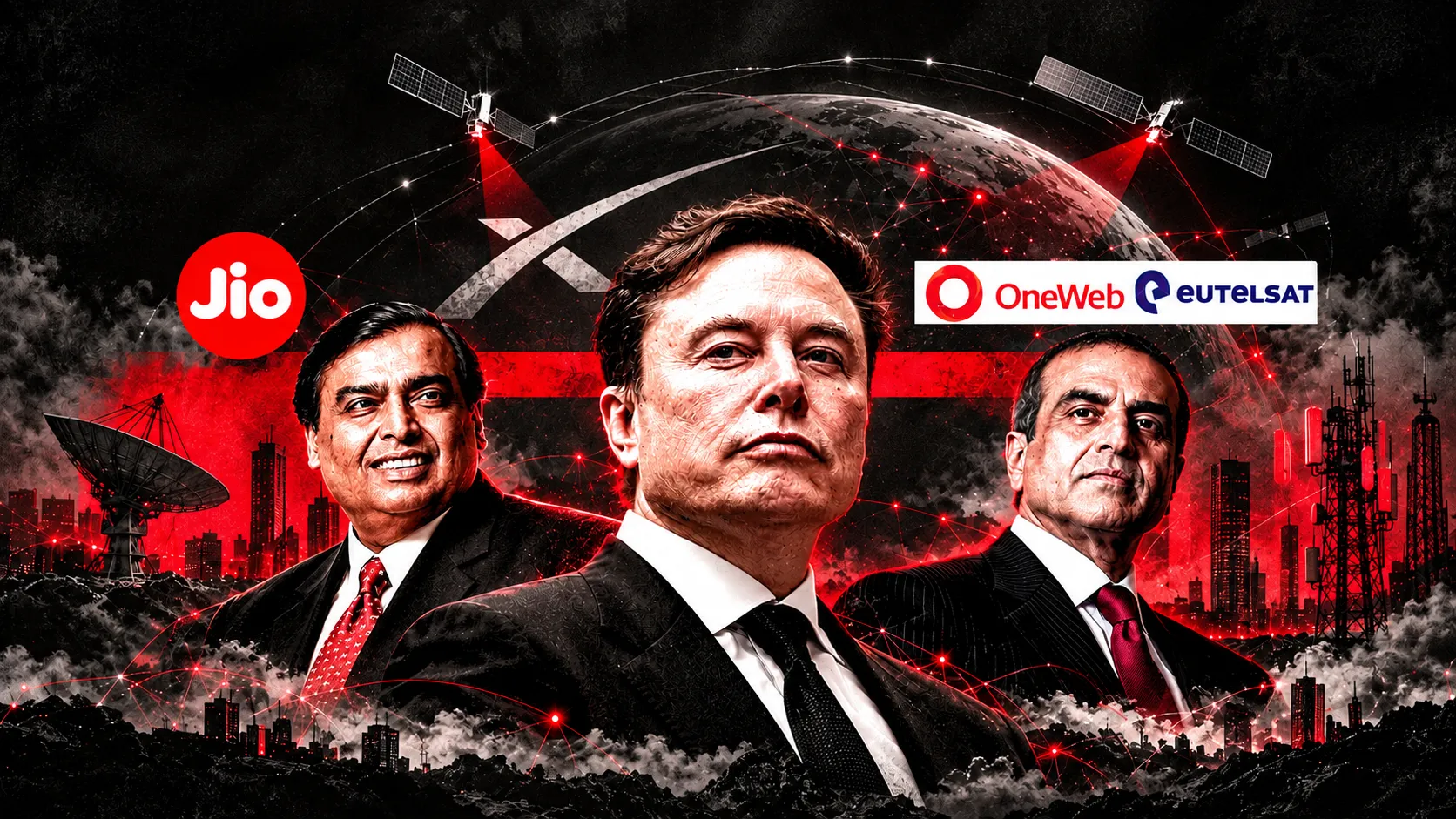
India has three licensed satellite broadband providers and not a single customer. Elon Musk's Starlink, Reliance Industries' Jio Satellite Communications and Bharti-backed Eutelsat OneWeb have each cleared important regulatory hurdles, built ground infrastructure and, in some cases, waited for years. Yet none can sell satellite internet services to Indian consumers or businesses.
The reason, as an in-depth Inc42 analysis published on October 18 lays out, is that a licence alone does not authorise commercial service. India's approval process for satellite communications has four steps, and all three companies are stuck on the final two: a security assessment and the assignment of spectrum.
The delay has become a flashpoint. Musk has publicly asked why Starlink remains unable to operate in India when it is "licensed in over 165 countries." Sunil Bharti Mittal, the founder of Bharti Enterprises, has joked that OneWeb would be happy to receive approval "at least a few days before" Musk. And the government insists that its framework is fair and non-discriminatory.
The four steps to launch
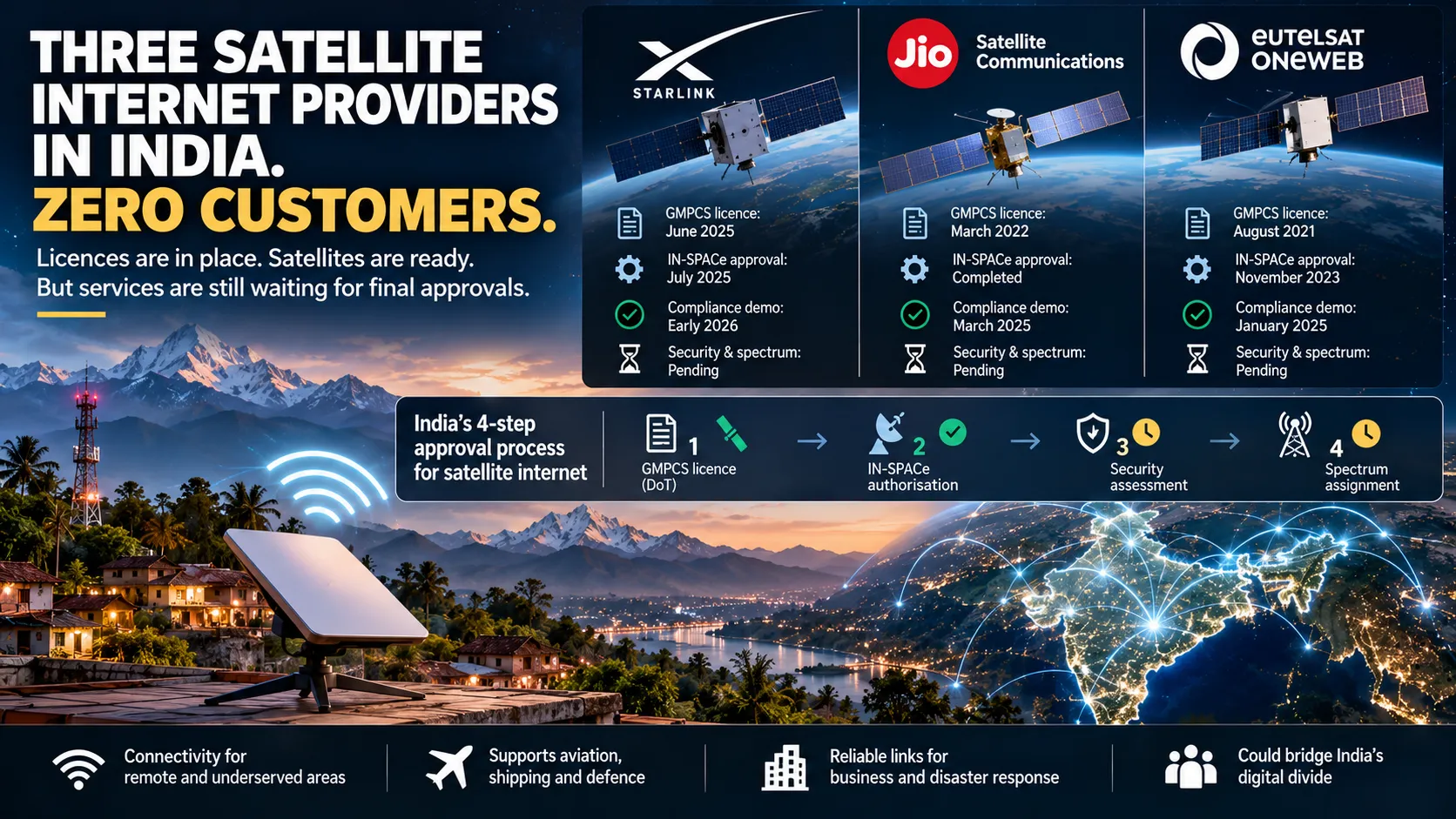
To offer satellite broadband in India, an operator needs a Global Mobile Personal Communication by Satellite (GMPCS) licence from the Department of Telecommunications (DoT), authorisation from IN-SPACe, the national space regulator, a successful security assessment and, finally, an assignment of satellite spectrum.
OneWeb was the earliest mover. It received its GMPCS licence in August 2021 and IN-SPACe authorisation in November 2023, and completed a security and technical compliance demonstration in January 2025. Mittal has said that OneWeb applied about five years ago, that its ground network has been ready for about three years and that its satellites have been passing over India for about five years.
Jio Satellite Communications, a wholly owned subsidiary of Jio Platforms incorporated in October 2021, obtained its GMPCS licence in March 2022 and carried out its compliance demonstration on March 20, 2025. The subsidiary reported revenue of ₹34.3 crore in the 2025-26 financial year, up from ₹10.7 crore the previous year, although its satellite broadband service has not launched. Reliance says those services remain pending.
Starlink arrived later but moved quickly through the early stages. It received its GMPCS licence in June 2025 and IN-SPACe authorisation in July 2025, followed by its compliance demonstration in early 2026. The company says it has built "a network of dedicated systems, gateways, and other infrastructure all in-country," with "all the requisite government approvals."
Security and spectrum are the bottlenecks
According to the DoT, security assessments for all three operators are underway, and spectrum will be assigned afterwards. The Ministry of Communications has said the three companies are at "broadly the same regulatory stage."
Experts say security reviews for satellite networks can cover a wide range of issues: how user terminals are activated, how traffic is routed, whether coverage can be changed remotely, access to sensitive data, the ability to suspend service when required, domestic control of key network functions and incident reporting. Tarun Wig of cybersecurity company Innefu Labs said foreign-controlled satellite networks can create risks around data sovereignty, service continuity and external control. He suggested measures including data localisation, encryption, lawful interception under Indian law and regular network audits.
Spectrum has been an equally contested issue. India decided to allocate satellite spectrum administratively rather than through auctions, a position supported by global satellite operators but initially opposed by Reliance Jio. Jio has argued that administrative allocation could give satellite companies a different cost structure from mobile operators, which pay billions of dollars for spectrum at auction. The Telecom Regulatory Authority of India (TRAI) has suggested a 30-day window for spectrum assignment and objections once in-principle network clearances are granted.


