One of Lenskart's earliest institutional backers has taken more money off the table, as the eyewear retailer's strong stock market performance continues to give investors attractive exit opportunities.
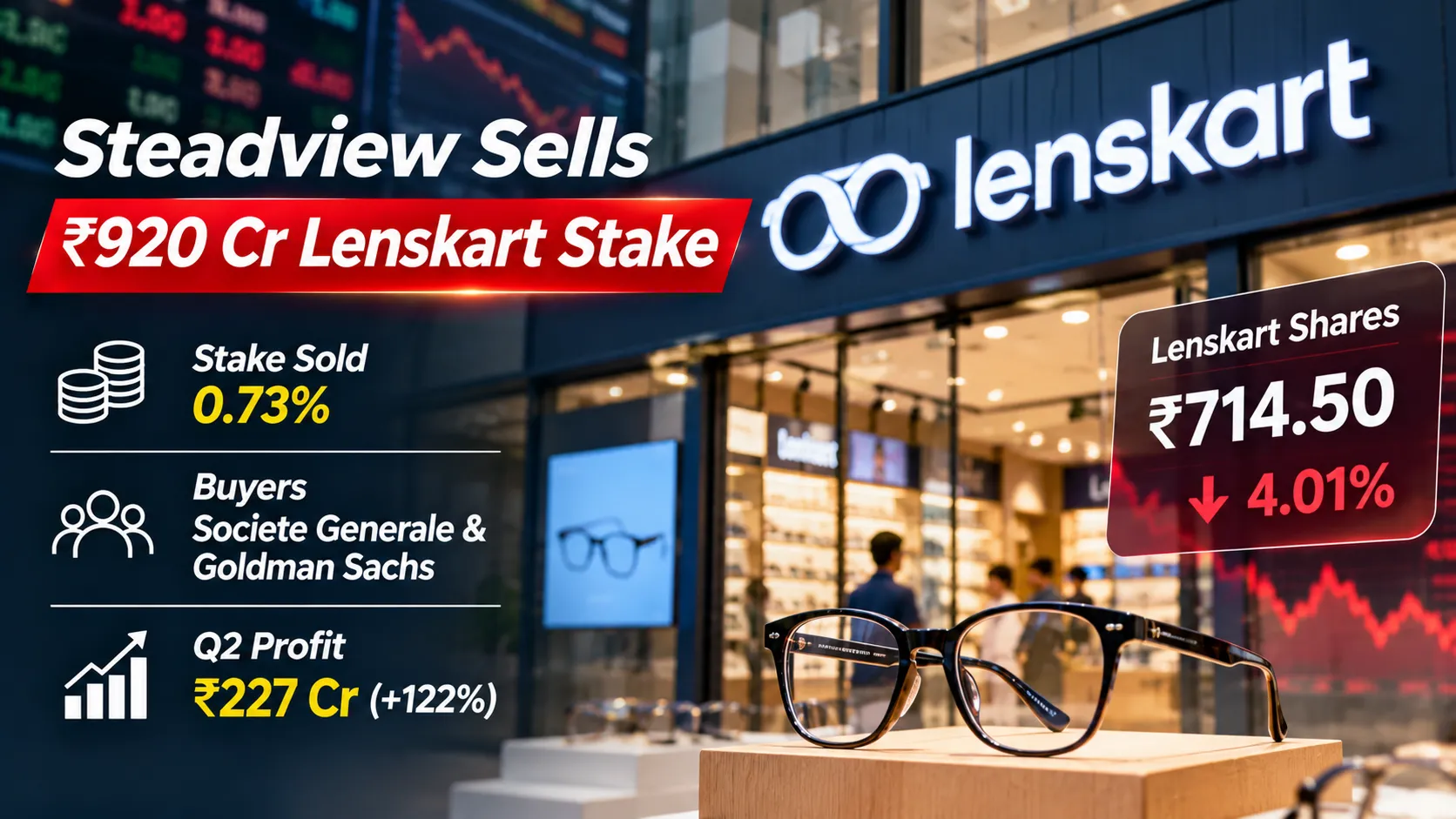
Steadview Capital sold about 1.27 crore shares of Lenskart Solutions, representing roughly 0.73% of the company, for about ₹920.58 crore through a block deal on Monday, November 23, Entrackr reported. The shares were sold at ₹725 each, a 2.6% discount to the previous closing price of ₹744.35.
The sale was made through Steadview Capital Mauritius Ltd-FDI and LTR Focus Fund, according to Entrackr.
The buyers
Societe Generale's offshore derivative instrument entity bought about 61.76 lakh shares for roughly ₹447.8 crore, while two Goldman Sachs entities together bought about 65.21 lakh shares worth roughly ₹473 crore, according to Entrackr.
The participation of large global financial institutions indicates continued demand for Lenskart shares among institutional investors, even as early backers reduce their holdings.
Steadview's stake
Steadview held about 3.31% of Lenskart as of September 2026, according to Entrackr. After the sale, its stake would fall to roughly 2.6%, meaning the transaction represents a partial exit rather than a complete one.
Steadview Capital, founded by Ravi Mehta, is a Hong Kong-based investment firm that has backed several Indian technology companies, including Ola, Zomato and PolicyBazaar. It was one of the investors that supported Lenskart's growth before its public listing.
Share price reaction
Lenskart shares closed 4.01% lower at ₹714.50 on the National Stock Exchange on Monday, according to Kotak Neo. The stock opened at ₹752 and traded between ₹711.35 and ₹752 during the session. The decline came on a day when the broader market fell sharply, with the Sensex down 1,483.72 points.
Despite the fall, Lenskart shares were up about 63.5% in 2026, compared with a decline of 2.8% in the Nifty 50 over the same period, according to Kotak Neo. The company's market capitalisation stood at about ₹1.25 lakh crore, or roughly $13 billion.
A wave of investor exits
Steadview's sale is the latest in a series of large block deals in Lenskart since the expiry of the lock-in period that followed its initial public offering.
Earlier in November, SoftBank's affiliate SVF II Lightbulb (Cayman) sold a 1.56% stake, or 2.72 crore shares, at ₹697.15 each for about ₹1,896.2 crore, according to Kotak Neo. Thirteen domestic and global institutional investors bought the stake.
In October, Alpha Wave Ventures sold about 2.64 crore shares, or 1.51% of the company, at an average of ₹645.31, for about ₹1,705 crore. Lenskart investors have sold more than $1 billion worth of shares in a three-month period, according to Entrepreneur India.
Strong results support demand
The steady demand for Lenskart shares has been supported by strong financial results. For the second quarter of the 2027 financial year, the company reported net profit of ₹227.08 crore, up 122.1% from a year earlier, according to Kotak Neo. Revenue from operations rose 35.7% to ₹2,845.03 crore, and EBITDA increased 50.5% to ₹362 crore, with the margin improving to 21.7% from 19.5%.
These numbers demonstrate the company's ability to grow rapidly while improving profitability, a combination that has attracted long-term institutional investors.
Lenskart's journey
Lenskart was founded in 2010 by Peyush Bansal, along with Amit Chaudhary and Sumeet Kapahi, as an online eyewear retailer. It has since grown into India's largest eyewear company, with an omnichannel model combining online sales with a large network of physical stores across India and international markets, including Southeast Asia and the Middle East.
The company manufactures much of its own eyewear, which helps it control costs and quality. Bansal has also become well known as one of the judges on the television show Shark Tank India.
Why early investors are selling
Block deals by early investors after an IPO are a normal part of the lifecycle of venture-backed companies. Venture capital and growth funds have limited lifespans and must eventually return capital to their own investors. Selling shares after a strong share price performance allows them to lock in returns.
Large block deals can create short-term pressure on the share price, as the market absorbs additional supply. However, when demand from institutional investors is strong, as in Lenskart's case, the impact tends to be limited.
What it means for retail investors
For retail shareholders, block deals can be a signal to watch rather than a reason to panic. The key question is whether the buyers are long-term institutional investors, which suggests confidence in the company's prospects. In Lenskart's case, global financial institutions and domestic funds have been active buyers.
Valuation questions
With its share price up sharply this year, Lenskart trades at a premium valuation compared with many retail companies. Investors are paying for its growth, profitability improvement and market leadership. Sustaining the valuation will depend on continued strong execution, including store expansion, international growth and margin improvement.
The new-age listing story
Lenskart's performance stands out among India's new-age technology and consumer companies that have listed in recent years. Several have struggled after their IPOs, while others, like Lenskart, have rewarded investors. Its success may encourage other consumer companies preparing for listings.
Why global institutions are buying
The buyers of Lenskart shares in recent block deals have included global banks, foreign portfolio investors and domestic mutual funds and insurers. Their interest reflects Lenskart's position as a market leader in a large, underpenetrated category, with a significant share of Indians who need vision correction still not wearing glasses.
Institutional investors also value the company's vertically integrated model, which combines manufacturing, technology and retail, and its demonstrated ability to expand margins as it scales.
The eyewear opportunity
India has one of the largest populations requiring vision correction in the world, driven by rising screen time, ageing and increased awareness of eye health. Yet the eyewear market has historically been fragmented, dominated by small independent opticians with limited product range and inconsistent quality.
Organised players like Lenskart have expanded access by offering affordable, standardised products, free eye tests and home services, helping to grow the overall market while gaining share from unorganised retailers.
What comes next
Investors will watch for further block deals by remaining early backers, as well as Lenskart's next quarterly results. Trading resumes on Wednesday, November 25, after the Guru Nanak Jayanti holiday, when the market will have its first opportunity to respond to the global rebound in equities.