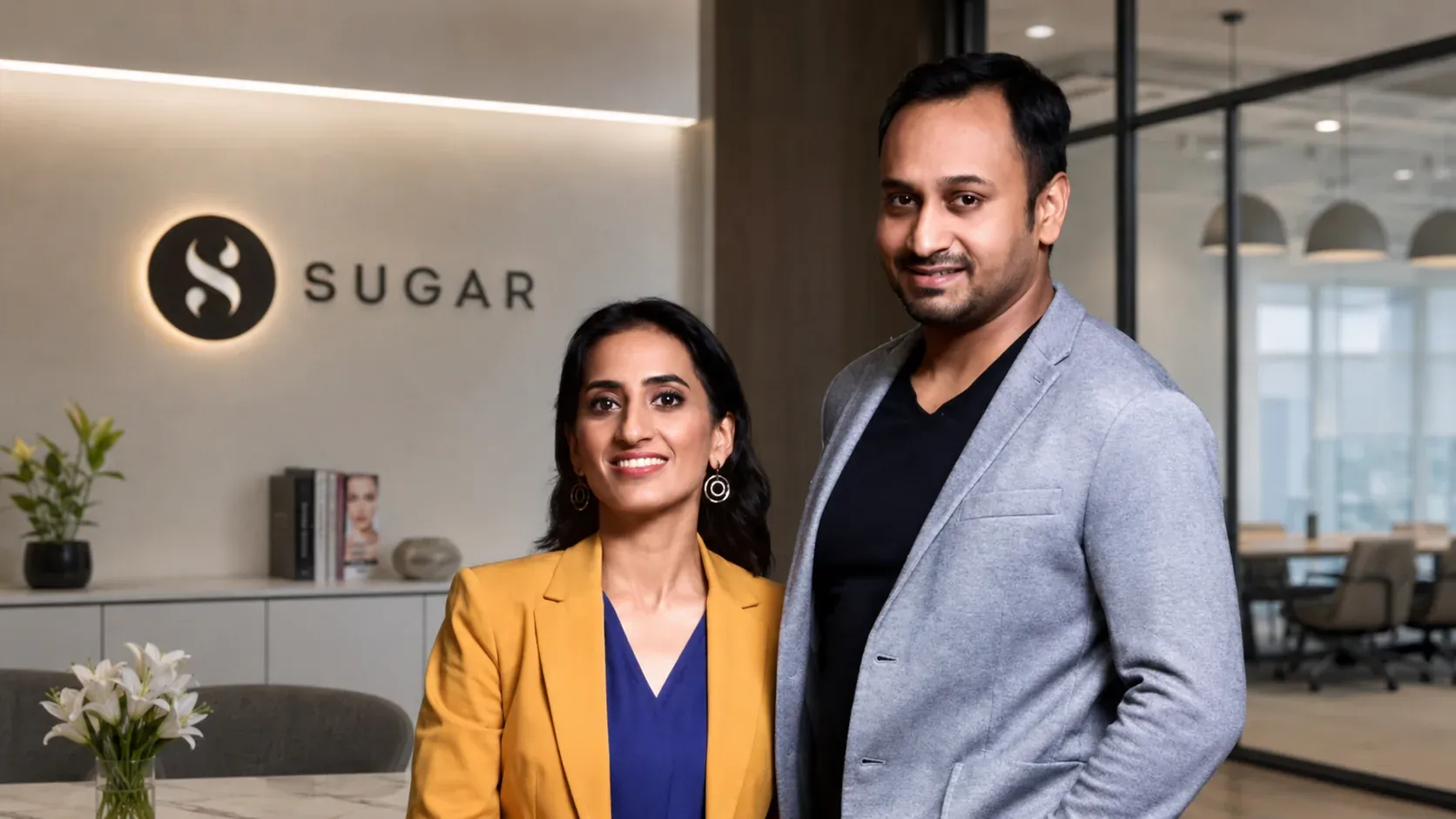
SUGAR Cosmetics, the homegrown colour cosmetics brand co-founded by Vineeta Singh, has raised $15.3 million in a funding round from A91 Partners, adding to a growth-stage capital base that has helped the company establish itself as one of India's more recognisable direct-to-consumer beauty labels. The round comes as India's colour cosmetics and personal care category continues to draw sustained investor interest, buoyed by rising discretionary spending among younger, digitally native consumers.
SUGAR's trajectory since its founding has been closely tied to Singh's own profile as one of India's most visible women entrepreneurs, and the brand has built a reputation for pairing bold, trend-forward product lines with an aggressive omnichannel retail strategy spanning e-commerce, marketplaces and physical retail counters.
The transaction also arrives during a period of heightened competitive intensity within India's beauty and personal care sector, where consumer spending on colour cosmetics has grown steadily even as the number of brands competing for that spending has multiplied considerably faster, compressing customer acquisition economics across the category and making sustained institutional backing an increasingly important competitive advantage.
Retail and brand strategy professionals note that India's colour cosmetics category has historically underperformed relative to skincare and personal care in terms of per capita spending compared with mature Western and East Asian markets, a gap that industry analysts view as representing significant remaining headroom for growth, provided domestic brands like SUGAR can continue expanding both product sophistication and geographic reach into smaller cities where organised beauty retail remains comparatively underdeveloped.
The involvement of A91 Partners, a growth-stage investment firm with a track record of backing consumer brands across India, suggests continued confidence in SUGAR's ability to defend its market position against both international beauty conglomerates and a wave of newer, venture-backed challenger brands that have entered the category over the past several years. Colour cosmetics remains one of the more competitive corners of India's D2C landscape, with brand loyalty often hard-won through a combination of product innovation, influencer-driven marketing and retail distribution depth.
For SUGAR, the fresh capital is expected to support continued expansion of its physical retail footprint alongside further investment in product development, as the brand looks to defend share in a market where new entrants continue to compress margins even as overall category growth remains healthy.
SUGAR's omnichannel approach, spanning its own direct-to-consumer website, major e-commerce marketplaces, and an expanding network of physical retail counters within larger beauty and department store formats, reflects a distribution strategy that has become increasingly standard among India's more mature D2C beauty brands, as founders have recognised that digital-only distribution alone rarely provides sufficient reach to compete with established beauty conglomerates that have decades of physical retail relationships.
Industry estimates place India's colour cosmetics market growth rate consistently in the double digits annually, outpacing overall retail growth, a trajectory that has attracted an expanding roster of both domestic challenger brands and international entrants, making sustained differentiation through product innovation, brand storytelling and retail execution increasingly critical for any single player hoping to defend share over a multi-year horizon.
SUGAR's growth story has also become something of a reference point within India's broader conversation about women-led entrepreneurship. Singh has been vocal about the structural challenges women founders face in raising capital, a gap that industry data continues to bear out: women-led startups in India have historically captured a disproportionately small share of total venture funding relative to their share of overall founder representation.

Against that backdrop, a growth-stage cosmetics brand with a woman co-founder successfully raising fresh institutional capital carries a symbolic weight that extends beyond the deal's dollar value. It reinforces a pattern industry observers have flagged over the past two years: women-led consumer brands, particularly in beauty, wellness and personal care categories, have increasingly been able to access later-stage capital even as earlier-stage funding gaps for women founders persist across other sectors.
Data compiled by industry researchers tracking India's startup funding landscape has consistently shown that while women represent a meaningfully growing share of the country's overall founder population, the proportion of total venture capital reaching women-led ventures remains substantially below that representation, a gap that widens further at growth and late funding stages, making transactions of this kind, involving established, revenue-generating women-led consumer brands, particularly notable within the broader funding data.
For diaspora entrepreneurs and investors following India's consumer sector, SUGAR's continued fundraising success under a visible woman co-founder offers a tangible, ongoing case study in how gender representation at the founder level can coexist with, and arguably reinforce, strong commercial execution, a narrative that industry bodies focused on women's entrepreneurship have increasingly highlighted in their broader advocacy work.
The broader competitive backdrop for SUGAR remains intense. India's beauty and personal care market has attracted a steady stream of new entrants over the past three years, ranging from celebrity-backed labels to international brands expanding aggressively into the country, all competing for shelf space and social media attention in a category where consumer preferences shift quickly.
How SUGAR deploys its new capital, whether toward retail expansion, product innovation, or deeper investment in its direct-to-consumer digital channels, will likely determine whether the brand can extend its early-mover advantage into a more durable, diversified beauty conglomerate, or whether it will need to keep raising and spending aggressively simply to defend the ground it has already won.
Singh's public visibility as both an entrepreneur and vocal advocate for addressing structural barriers facing women founders has arguably amplified the broader symbolic significance of SUGAR's continued fundraising success, offering other aspiring women entrepreneurs in India's consumer sector a visible reference point for what sustained, multi-round institutional backing can look like when a brand successfully builds lasting customer loyalty alongside its growth metrics.
As SUGAR deploys its new capital, business leaders across India's beauty and consumer sectors will be watching closely whether the brand can convert growth-stage funding into durable category leadership, a milestone that would further reinforce the broader argument that women-led consumer brands, once past the earliest funding stages, can compete successfully for the same growth capital available to their male-led counterparts.
The bottom line for TIGI's readers: SUGAR's continued fundraising success is both a consumer-brand story and a data point in the broader, still-unfinished conversation about capital access for India's women entrepreneurs at growth stage.