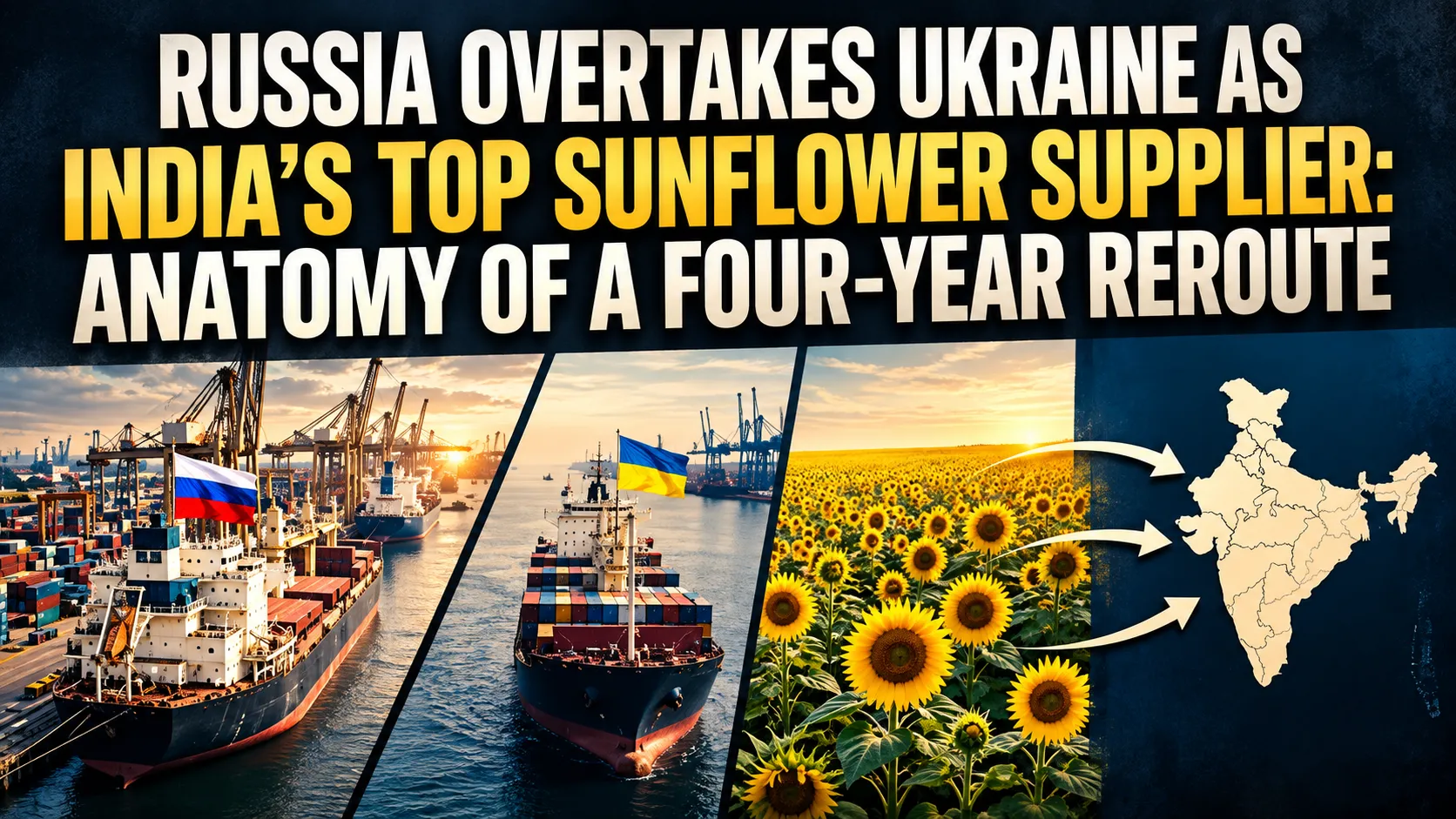
India's decision to cut import duties on edible oils ahead of the festive season was, on its face, a straightforward measure against food inflation. The detail tells a more complicated story. The government reduced the duty on sunflower oil by 11 percentage points, twice the 5.5 percentage-point cut applied to palm and soybean oils. Because Russia has become India's leading source of sunflower oil, the decision carries a geopolitical subtext at a time when New Delhi's energy and trade ties with Moscow are under intense scrutiny from Washington.
An industry official told Business Standard that it was "natural that it would see the steepest decline", given that sunflower oil prices had risen fastest. Crude sunflower oil averaged $1,496 a tonne in August 2026, up 18.4 per cent from $1,264 a year earlier. Crude palm oil rose 9.4 per cent over the same period and soybean oil 7.9 per cent. A larger duty cut for the oil whose price had risen most is consistent with a policy aimed at stabilising retail prices.
India's import dependence
India is the world's largest importer of edible oils, relying on overseas supplies for more than half of its consumption. It imports between 2.5 million and 3.3 million tonnes of sunflower oil a year, alongside much larger volumes of palm oil from Indonesia and Malaysia and soybean oil from Argentina and Brazil. Sunflower oil is favoured in southern and western Indian households and in food processing, and its price is watched closely during the festival months when demand for cooking oil rises.
Russia and Ukraine dominate global sunflower oil supply. Before 2022, Ukraine was India's primary source. The war disrupted Black Sea shipments, and Russia steadily expanded its share. India imported 1.22 million tonnes of sunflower oil from Russia between November 2025 and August 2026, out of total sunflower oil imports of 2.48 million tonnes over the period. Volumes from Russia were about 14 per cent lower than a year earlier, but higher prices lifted the value.
According to Russian export data, sunflower oil shipments to India earned $1.17 billion between January and July 2026, up 34.7 per cent from $868.8 million a year earlier, on volumes of 859,000 tonnes. Russia is expected to harvest a record crop of about 20 million tonnes of sunflower seed in 2026-27, while Ukraine's output is forecast at about 11 million tonnes, suggesting ample supply from both countries in the coming year.
The diplomatic balance
The timing puts the duty cut in a sensitive diplomatic context. Commerce Minister Piyush Goyal is preparing to meet US Trade Representative Jamieson Greer at the G20 Trade Ministerial this week, against the backdrop of a US law that authorises tariffs of up to 100 per cent on India in connection with its purchases of Russian energy. Any policy that increases India's payments to Russian exporters, even in food, is likely to be noticed in Washington.
Former diplomat M.K. Bhadrakumar argued that India should pursue "trade relations in terms of our economic situation and national priorities". That view reflects a long-standing position in Indian foreign policy circles: that India's trade decisions should be driven by domestic economic needs rather than by alignment with any single power. External Affairs Minister S. Jaishankar has repeatedly articulated a similar principle in defending India's energy purchases.
From a purely economic standpoint, the case for cheaper sunflower oil is strong. Food inflation weighs disproportionately on lower-income households, and edible oil is a staple. Reducing duties lowers landed costs and gives refiners room to pass on savings. Refiners and processors, represented by bodies such as the Indian Vegetable Oil Producers' Association, led by Sudhakar Desai, are closely tracking how quickly lower duties feed through to landed costs and shelf prices.
Farmers' concerns
Duty cuts are rarely popular with domestic oilseed farmers. Lower import prices can depress prices for groundnut, mustard, soybean and sunflower seed grown in India, reducing incentives to expand domestic production. The government has for years sought to raise domestic oilseed output under national missions for edible oils, including a push on oil palm cultivation in the North-East and Andhra Pradesh. Import liberalisation during price spikes works against those long-term goals.
The wider agri-commodity trade, including the India Pulses and Grains Association headed by Bimal Kothari, is also watching how the government calibrates import policy this season. The edible oil market has seen repeated adjustments to duties over the past five years as the government has balanced consumer prices against farm incomes, and frequent changes make it harder for processors and farmers to plan sowing, crushing and stocking decisions.
What it means for prices and business
For consumers, the duty cut should translate into lower shelf prices for sunflower oil over the coming weeks, provided international prices remain stable and refiners pass through the savings. For food companies, snack makers and restaurants, cheaper oil eases margin pressure at a time when other input costs, including energy and packaging, are elevated because of the oil shock.
The broader inflation picture explains the urgency. Energy prices have been elevated for months because of disruption in the Strait of Hormuz, lifting transport and packaging costs across the food chain. A weak, El Niño-affected monsoon has raised concerns about the kharif harvest, including oilseeds. In that setting, edible oil is one of the few food items where the government can act quickly through tariffs, because such a large share of supply is imported. Cutting duty on the fastest-rising oil offers the most direct route to visible relief before Diwali.
For importers, the change may shift sourcing further towards Russia, given its record crop and competitive pricing, though Ukrainian supply remains significant. Freight and insurance costs on Black Sea routes, and payment channels for Russian trade, will affect how the benefits are distributed.
The bigger picture
The sunflower oil decision illustrates the growing overlap between food security, trade policy and geopolitics. India's energy imports from Russia attract most of the attention, but agricultural trade is also becoming a factor in the diplomatic ledger. As the United States sharpens tools such as secondary tariffs and Section 301 investigations, and as the G20 debates the weaponisation of trade in food, even routine duty adjustments acquire strategic significance.
For New Delhi, the calculation remains the same as in energy: secure affordable supplies for a large, price-sensitive population, and manage the diplomatic consequences. For businesses along the edible oil value chain, the lesson is that policy volatility is likely to persist. Those that diversify sourcing, hedge price risk and stay close to regulatory signals will be best placed to navigate a market in which a festival-season duty cut can double as a line in a geopolitical negotiation.