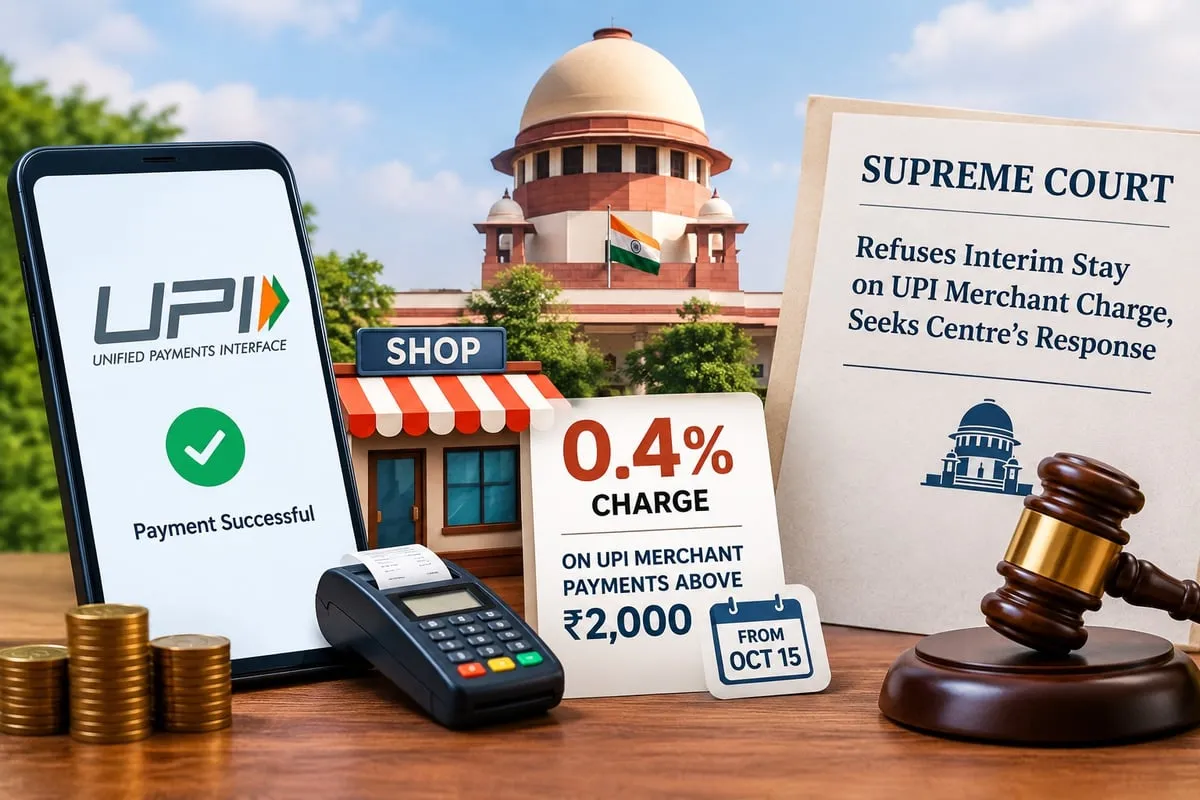
India's Supreme Court on Monday refused to halt the government's plan to charge a merchant discount rate (MDR) on larger payments made through the Unified Payments Interface (UPI), leaving the policy on track to take effect on 15 October. The decision ends the prospect of an early reprieve for merchants who say the levy will raise their costs, though the legal challenge itself remains open.
A bench of Chief Justice of India Surya Kant and Justices Joymalya Bagchi and V Mohana issued notice to the Centre, the Reserve Bank of India (RBI), the National Payments Corporation of India (NPCI) and the UPI and Services Steering Committee. It directed them to file responses within four weeks, but declined to grant interim relief.
The petition, filed by advocate Anjan Datta, challenges finance ministry notifications issued on 14 and 15 September. Appearing for the Centre, Additional Solicitor General N Venkataraman told the court that the charges would take effect from 15 October.
What the court asked
The bench did not treat the matter as settled. Justice Bagchi asked whether the charge was a tax or a fee and, if it was neither, what the legal basis for imposing it was. He also questioned the nature of the service for which merchants were being asked to pay. Reports of the hearing quoted the court as describing the dispute as "more technical and less legal", which helps explain why it was unwilling to freeze a payments policy before hearing the government in full.
For the payments industry, that combination is significant. The levy will start on schedule, but the government must still defend its legal footing in court, and the final outcome could shape how future charges on digital public infrastructure are designed.
How the new charge works
The framework applies only to specified person-to-merchant (P2M) transactions. Under its terms:
Eligible merchant payments above ₹2,000 attract an MDR of 0.4 per cent, capped at ₹300 for transactions of ₹75,000 and above.
Person-to-person (P2P) transfers and merchant payments of up to ₹2,000 remain free.
Certain essential and thin-margin sectors will pay a flat ₹5 charge, while capital-market transactions carry an MDR of 0.02 per cent.
Merchants receiving up to ₹1 lakh a month through UPI QR codes are exempt.
The government has said customers will not be required to pay the MDR separately. The charge sits within the merchant payment system, meaning it is borne by the business accepting the payment, in the same way card-acceptance fees work.
The end of an era of free payments
The significance lies in what the policy replaces. Merchant UPI payments have been free for merchants since the start of 2020, when the government mandated a zero-MDR regime to accelerate digital adoption. That decision helped turn UPI into the world's largest real-time payments system by transaction volume, and it made the QR code a fixture at kirana stores, tea stalls and pharmacies across the country.
It also created a long-running economic tension. Banks and payment apps carry the cost of processing billions of transactions a month, but under zero MDR they had no direct revenue from merchant payments. Industry groups have argued for years that the model was unsustainable for the smaller players in the ecosystem and that it discouraged investment in fraud prevention and infrastructure.
The new charge is a targeted answer to that argument. By limiting the MDR to larger ticket sizes and exempting small merchants, the government is trying to create a revenue stream for the system without undermining UPI's everyday use for small purchases.
The merchants' case
The petitioner argued that the levy could squeeze merchants' working capital, push traders to refuse UPI or split payments into smaller amounts, and ultimately raise consumer prices. The plea also questioned why UPI should be treated differently from RuPay debit cards, which continue to enjoy statutory zero-MDR protection without a monetary ceiling.
That argument has particular force for retailers selling high-value goods on thin margins. A mobile phone shop selling a ₹30,000 handset may make only a small percentage on the sale. A 0.4 per cent charge on that transaction is not trivial when multiplied across a month of sales.
The All India Mobile Retailers Association (AIMRA) has responded by calling a "No UPI Day" on 2 October, during which participating retailers plan to cover their UPI QR codes with black cloth and stop accepting UPI payments for the day. Tarvinder Singh, the association's vice-president and Delhi NCR president, said the group's objection was not to digital payments themselves.
"The association's concern was not with UPI or digital payments, but with the additional financial burden on merchants," he said.
AIMRA estimates the 0.4 per cent MDR could impose a burden of around ₹40 crore a month, or nearly ₹500 crore a year, on small mobile retailers across India. The association wants merchant UPI payments to remain under a zero-MDR structure.
What it means for fintech companies
For payment companies, the ruling removes a near-term risk. Listed fintech stocks such as Paytm and Pine Labs had rallied on hopes that MDR would be introduced on some UPI transactions, because even a small fee on high-value payments could meaningfully change the unit economics of merchant acquiring.
The detail of how the revenue will be shared among banks, payment apps and other participants will matter a great deal. So will merchant behaviour. If large merchants push customers towards cards, cash or split payments, the volume of chargeable UPI transactions could be lower than expected.
There is also a strategic question for the market leaders. Apps that dominate consumer UPI, such as PhonePe and Google Pay, have long argued that the absence of MDR made it hard to build a profitable payments business. A modest, targeted charge could support investment, but it also invites scrutiny of market concentration, which has been a recurring concern for regulators.
The road ahead
The Supreme Court's refusal to intervene means the first test of the policy will come in the market rather than in the courtroom. From 15 October, merchants will begin paying for larger UPI transactions, and the government, banks and payment companies will be able to see how behaviour changes.
The legal questions raised by the bench, including whether the charge is a tax, a fee or something else, and what service it pays for, will return when the matter is heard after the government files its reply. The answers could define the rules for charging on India's digital public infrastructure for years to come.
For consumers, the immediate effect should be limited, since the government says customers will not pay the charge directly. For shopkeepers, the calculation begins on 15 October, and the 2 October protest will show how strongly organised retail intends to push back.


