StartupsTrending5 MIN READ

Swiggy Narrows Q2 Loss to ₹922 Crore and Begins Moving Instamart to an Inventory Model, but Shares Hit a Record Low

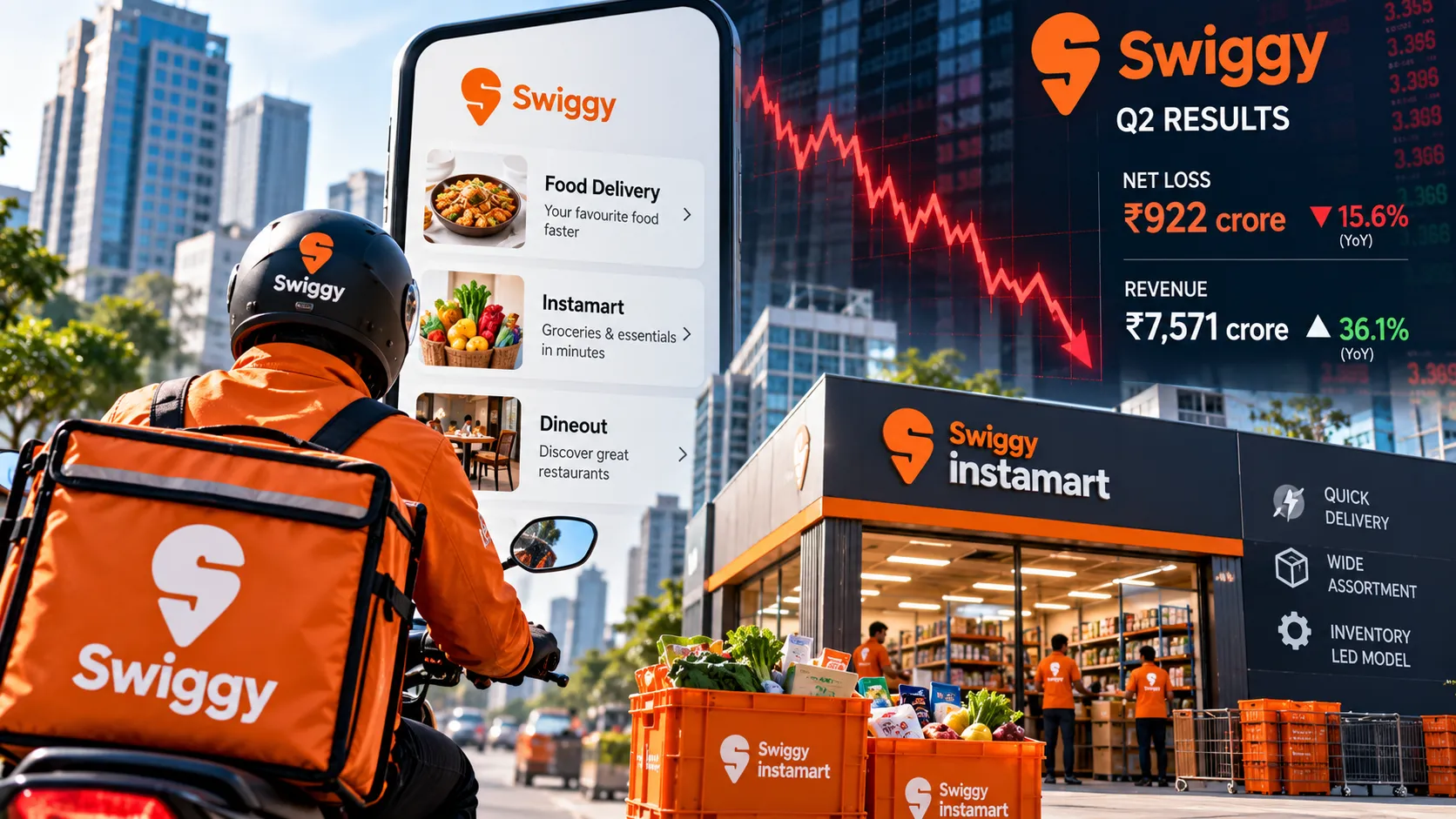
Swiggy's net loss narrowed 15.6% year on year to ₹922 crore in the July-September quarter as revenue rose 36% to ₹7,571 crore. The company said it would begin moving Instamart to an inventory-led model by mid-Q3, potentially adding 80 basis points to contribution margin. Its shares fell to a record low, about 46% below the IPO price.

By Nisha Omkumar · Author23 October 2026New
Swiggy Narrows Q2 Loss to ₹922 Crore and Begins Moving Instamart to an Inventory Model, but Shares Hit a Record Low

Swiggy reported a narrower loss for the July-September quarter and set out plans to overhaul how its quick commerce business buys and sells goods, but the results did little to lift a share price that has fallen to record lows.

The Bengaluru-based food and grocery delivery company posted a consolidated net loss of ₹922 crore for the second quarter of fiscal 2027, down 15.6% from ₹1,092 crore a year earlier, according to its stock exchange filing reported by Entrackr. The loss widened, however, from ₹791 crore in the previous quarter.

Revenue from operations rose 36.1% to ₹7,571 crore from ₹5,561 crore a year earlier. For the first half of the fiscal year, revenue grew 36.7% to ₹14,383 crore, and the net loss narrowed 25.2% to ₹1,713 crore.

Where the revenue came from

Swiggy's largest revenue contributor was Scootsy Logistics, its supply chain and distribution business, which generated ₹3,690 crore, up 44.1% from a year earlier and almost half of total operating revenue. Food delivery revenue rose 21.6% to ₹2,338 crore, while quick commerce revenue grew 33.3% to ₹1,306 crore. The remainder came from dine-out services and newer initiatives such as Bolt and Toing.

On the cost side, total expenditure rose 29.7% to ₹8,703 crore. The cost of materials jumped 47% to ₹3,443 crore, delivery and related charges rose 32.9% to ₹1,895 crore, and advertising and promotion spending climbed 24.9% to ₹1,298 crore. Employee costs fell 2% to ₹676 crore. Other income more than tripled to ₹212 crore.

Instamart's inventory pivot

The most significant announcement concerned Instamart. Swiggy said it would begin moving the quick commerce business to an inventory-led model by the middle of the October-December quarter, a transition expected to take two to three quarters, Inc42 reported.

Under the current marketplace model, Instamart connects customers with third-party sellers who own the stock in its dark stores. Under an inventory model, the company itself owns the goods it sells. That gives it more control over assortment, pricing and availability, and lets it capture more of the margin.

Management said the shift should improve Instamart's working capital cycle by eight to 10 days and that "this has the potential to add 80 bps to Instamart's contribution margin when fully rolled-out."

The change has been made possible by a shift in Swiggy's ownership. Indian rules allow inventory-based e-commerce only for companies that are owned and controlled by Indians. Swiggy's attempt in May to win shareholder approval to become an Indian-owned and controlled company received 72.36% of votes, short of the 75% required, but shareholders approved the change in August. Domestic ownership now exceeds 58%.

Swiggy's rival Eternal, which owns Blinkit, completed a similar move first. Blinkit contributed ₹19,152 crore of Eternal's ₹24,138 crore in operating revenue for the same quarter, a figure inflated by the accounting shift to inventory-led sales.
e14efd3c-6bcb-4f5d-ad43-603c38347841.png

Instamart's numbers

Instamart's net order value rose 34.8% year on year to ₹6,594 crore, and orders grew 29.3% to 130 million. But its contribution margin slipped to -1.0% of gross order value from -0.2% in the previous quarter, as Swiggy spent more on pricing and customer retention. Management said the margin was "within the range guided earlier" and that the company had "invested in differentiated assortment, availability and service quality."


“This has the potential to add 80 bps to Instamart's contribution margin when fully rolled-out.”
— Swiggy management

The quick commerce unit's adjusted EBITDA loss widened to ₹895 crore from ₹778 crore in the first quarter. Swiggy added 69 dark stores during the quarter, bringing the network to 1,240 stores across 133 cities.

A share price under pressure

Investors have been unconvinced. Swiggy shares hit a record low of ₹209.65 on the BSE on Thursday, October 22, before the results, and closed 5.01% lower at ₹211.30, giving the company a market value of about ₹61,403 crore. The stock has fallen about 26% in a month and is roughly 46% below its IPO price of ₹390, Business Standard reported. It is about 66% below its record high of ₹617, reached in December 2024, a month after its listing.

Shareholding data show a sharp change in ownership. Foreign portfolio investors cut their stake to 8.55% at the end of September from 13.96% at the end of June, while domestic institutional investors, including mutual funds, raised theirs to 29% from 22.77%.

Analysts at Motilal Oswal Financial Services said earlier that the business would need net order values of around ₹6,000 crore to break even at the EBITDA level, a milestone they estimate is at least three years away. They described food delivery execution as steady and said that "a clear path toward QC EBITDA profitability remains critical for a meaningful re-rating."

The quick commerce battle

Swiggy's struggles reflect the intensity of competition in Indian quick commerce. Blinkit, Zepto and Instamart, along with newer entrants such as Flipkart Minutes, Amazon Now and BigBasket, are racing to deliver groceries and other goods in minutes. The battle requires heavy investment in dark stores, technology, discounts and marketing.

Blinkit's scale advantage and earlier move to an inventory model have given Eternal a lead in investor perception. Eternal reported a profit of ₹125 crore for the same quarter, while Swiggy remains loss-making.

Swiggy has set a target of ₹10,000 crore in adjusted EBITDA by fiscal 2031, announced in August. Reaching it will depend on making Instamart profitable while keeping food delivery growing.

What it means for India's consumer internet sector

Swiggy's performance is being watched as a bellwether for India's listed consumer internet companies. After a wave of IPOs in 2024 and 2025, investors have become more selective, rewarding companies with clear paths to profitability and punishing those whose losses persist.

The move to inventory-led quick commerce also marks a broader shift in Indian e-commerce. As companies become majority Indian-owned, they can adopt models that were previously restricted to domestic firms, potentially changing the economics of the sector.

What comes next

Investors will focus on how smoothly Swiggy executes the Instamart transition and whether it delivers the promised margin gains. Food delivery growth, competition in quick commerce and the trajectory of losses will determine whether the stock can recover.

For now, Swiggy is betting that greater control over inventory will help it close the gap with Blinkit. The next three quarters will show whether that bet pays off. For long-term shareholders, the coming quarters will be decisive in showing whether the inventory pivot can narrow losses.

TagsSwiggyInstamartquick commerceQ2 FY27 resultsfood deliveryinventory modeldark storesEternalBlinkitScootsycontribution marginIPOnew-age stocksIndian startupsforeign ownershipFPI stakeMotilal OswalSriharsha Majetyonline groceryconsumer internet

Reader reviews

Sign in to rate and review this article.
Loading reviews…
