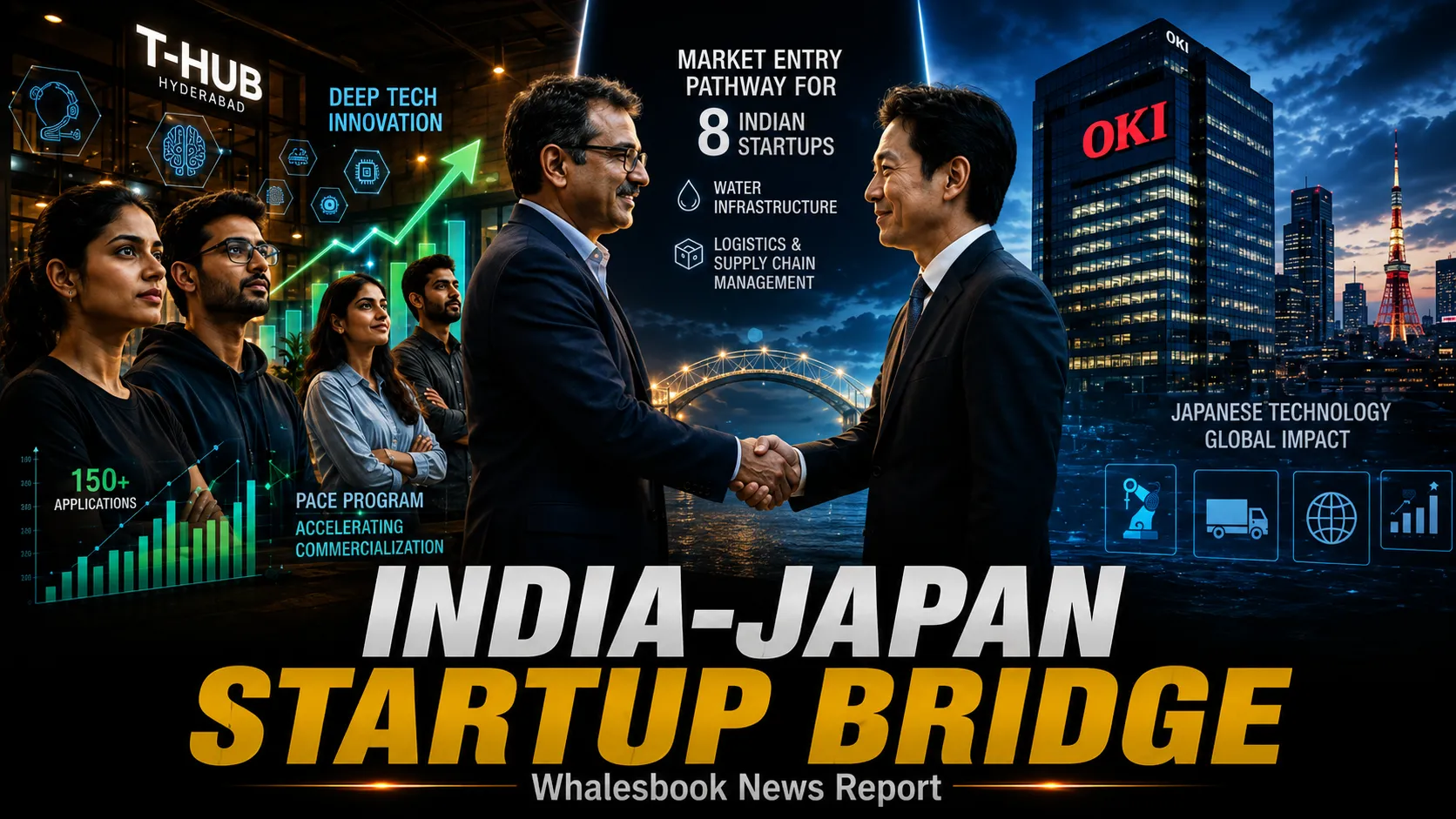
T-Hub, one of India's most prominent startup innovation hubs, has partnered with Japan's OKI Electric Industry to launch a programme selecting eight Indian deeptech startups for a structured initiative aimed at helping them enter global markets, validate their technologies against international standards, and explore commercial opportunities specifically within Japan.
The programme attracted more than 150 applications from Indian deeptech startups, according to people involved in the selection process, reflecting the scale of interest among India's hardware, robotics, sensing and advanced manufacturing startups in accessing Japanese industrial partnerships and customers.
India-Japan startup and technology cooperation has deepened steadily over the past several years, building on a broader bilateral relationship that has increasingly emphasised technology, semiconductor and critical mineral supply chain cooperation as both countries seek to reduce strategic dependence on China across a range of advanced manufacturing and technology categories.
For India's deeptech founders more broadly, the programme's oversubscription is itself a data point worth noting, underscoring both the depth of hardware-focused entrepreneurial ambition building across the country and the continuing scarcity of structured international market-access pathways available to serve it.
The T-Hub-OKI collaboration reflects a broader, deliberate push by both Indian innovation ecosystem builders and Japanese industrial players to deepen technology and startup ties between the two countries, at a time when both are seeking to diversify supply chains and technology partnerships away from an overreliance on China. For Japanese corporates like OKI, which has a long history in telecommunications and industrial electronics, partnering with Indian deeptech startups offers a route to access frontier innovation in areas like sensing, automation and embedded systems, often at a fraction of the cost of in-house Japanese research and development.
For the eight selected Indian startups, the programme offers something that has historically been difficult to secure: structured access to Japanese corporate customers, validation frameworks and market-entry support tailored to Japan's famously exacting quality and reliability standards. Deeptech startups building hardware-intensive products often face longer, more capital-intensive paths to market than their software counterparts, making corporate partnership programmes like this one particularly valuable for bridging the gap between prototype and commercial deployment.
Japanese corporates have historically approached open innovation and startup partnership programmes somewhat differently than their American or European counterparts, often preferring longer evaluation timelines, deeper technical due diligence and more structured pilot programmes before committing to broader commercial partnerships, an approach that Indian deeptech founders participating in programmes like this one have had to adapt to navigate successfully.
The scale of applicant interest — more than 150 submissions for just eight programme slots — reflects both the depth of India's growing deeptech founder pool and the relative scarcity of structured, corporate-backed pathways into demanding international markets, a gap that programmes like the T-Hub-OKI collaboration are explicitly designed to address on a small but meaningful scale.
The eight startups selected for the T-Hub-OKI programme span a range of deeptech sub-sectors, according to people familiar with the selection process, including companies working on industrial sensing, robotics components and embedded systems, reflecting the breadth of India's emerging hardware-focused startup ecosystem beyond the software-centric ventures that have historically dominated the country's startup narrative.

T-Hub, which has built a track record over the past decade of connecting Indian startups with global corporate and government partners, has increasingly focused its programming on deeptech and hardware-oriented ventures, recognising that India's software-startup success story has not yet been fully replicated in categories like robotics, advanced materials and industrial IoT. Partnerships with international corporates such as OKI represent a key mechanism for closing that gap, providing Indian founders with market access that would otherwise take years to build independently.
The initiative also fits within a broader diplomatic and economic context, as India and Japan continue to deepen bilateral technology cooperation across sectors ranging from semiconductors to clean energy. Startup-to-corporate bridge programmes like the T-Hub-OKI collaboration are increasingly viewed by policymakers in both countries as practical, ground-level mechanisms for translating high-level strategic partnerships into tangible commercial outcomes for smaller, high-potential companies.
For OKI Electric specifically, the partnership offers a low-risk mechanism for scouting emerging Indian innovation across categories including industrial sensing, embedded systems and automation technologies relevant to the company's existing telecommunications and industrial electronics business lines, without the capital commitment associated with direct investment or acquisition.
T-Hub's broader portfolio of corporate partnership programmes has increasingly served as a template that other Indian innovation hubs have sought to replicate, reflecting a growing recognition across India's startup ecosystem that structured corporate access programmes, rather than accelerator funding alone, often represent the more valuable resource for hardware and deeptech founders navigating long, capital-intensive commercialisation timelines.
Programme organisers have indicated that successful participants could progress toward pilot deployments with OKI's own business units or its broader Japanese corporate network, a potential outcome that would mark a meaningful step beyond the market validation and mentorship support that comprises the programme's initial phase.
As the eight selected startups move through the programme, their progress will offer an early signal of how effectively structured, corporate-backed market-entry initiatives can help Indian deeptech founders overcome the commercialisation challenges that have historically slowed hardware-intensive innovation, both at home and in demanding international markets like Japan.
As the eight selected startups begin their engagement with OKI and the broader Japanese market, their experience will offer Indian policymakers and ecosystem builders further evidence of which specific programme structures most effectively translate high-level bilateral technology cooperation into tangible commercial outcomes for individual companies.
T-Hub's organisers say they intend to track the eight participating startups' progress closely over the coming year, viewing the cohort's eventual commercial outcomes as a key indicator of whether the broader model of structured, corporate-backed deeptech internationalisation deserves further institutional investment and replication across other bilateral technology partnerships India is pursuing.
Programme mentors involved in the T-Hub-OKI initiative say the coming months will focus heavily on refining each startup's technical documentation and compliance readiness to meet Japanese industrial certification standards, a rigorous but essential step before any of the eight ventures can progress toward genuine commercial pilots with Japanese corporate partners across the manufacturing and logistics sectors OKI primarily serves.


