Managed workspace solutions provider Tablespace Technologies Ltd, known commercially as Table Space, has filed its Draft Red Herring Prospectus with the Securities and Exchange Board of India for a proposed initial public offering comprising a fresh issue of equity shares worth up to Rs 800 crore and an offer for sale of up to 6.55 crore shares by existing shareholders, according to the filing made on Monday, August 11.
The Bengaluru-headquartered company provides managed workspace solutions to global capability centres, Fortune 500 companies and multinational corporations, operating through what it describes as an integrated single-cheque model covering leasing, design, fit-out, operations, facilities management and compliance across the entire workspace lifecycle. According to a CBRE report cited in the DRHP, Table Space had a leased area of 9.33 million square feet as of March 31, 2026, with 98 per cent of that area located in Grade A properties across 33 key office clusters spanning eight Tier-1 Indian cities, and an occupancy rate of 92.64 per cent for its mature facilities, which the report describes as the highest among benchmarked operators in the sector.
The offer for sale component of the IPO will see several existing investors trim their holdings. Promoter entity AGS TS II Holdings Pte Ltd, ultimately owned and controlled by funds of Singapore-based global investment firm Hillhouse Investment, currently holds roughly 41.76 per cent of the company and plans to sell up to 4.98 crore shares. Founder Karan Chopra, who owns a 12.47 per cent stake, plans to sell 13.11 lakh shares, while co-CEO Kunal Mehra, who holds around 3.57 per cent, plans to sell roughly 1 crore shares. The remaining OFS comprises shares from investors Srinivas Prasad, Narendra Kumar Kamaraju, RSP Real Estate LLP and Ramachandra Venkatasubba Rao.
Table Space intends to deploy roughly Rs 550 crore from the fresh issue proceeds toward repayment or pre-payment of its existing borrowings, with the remainder earmarked for funding inorganic growth through as-yet-unidentified acquisitions and general corporate purposes. Axis Capital, BofA Securities India, CLSA India, IIFL Capital Services and JM Financial are serving as book-running lead managers to the issue, with KFin Technologies acting as registrar.
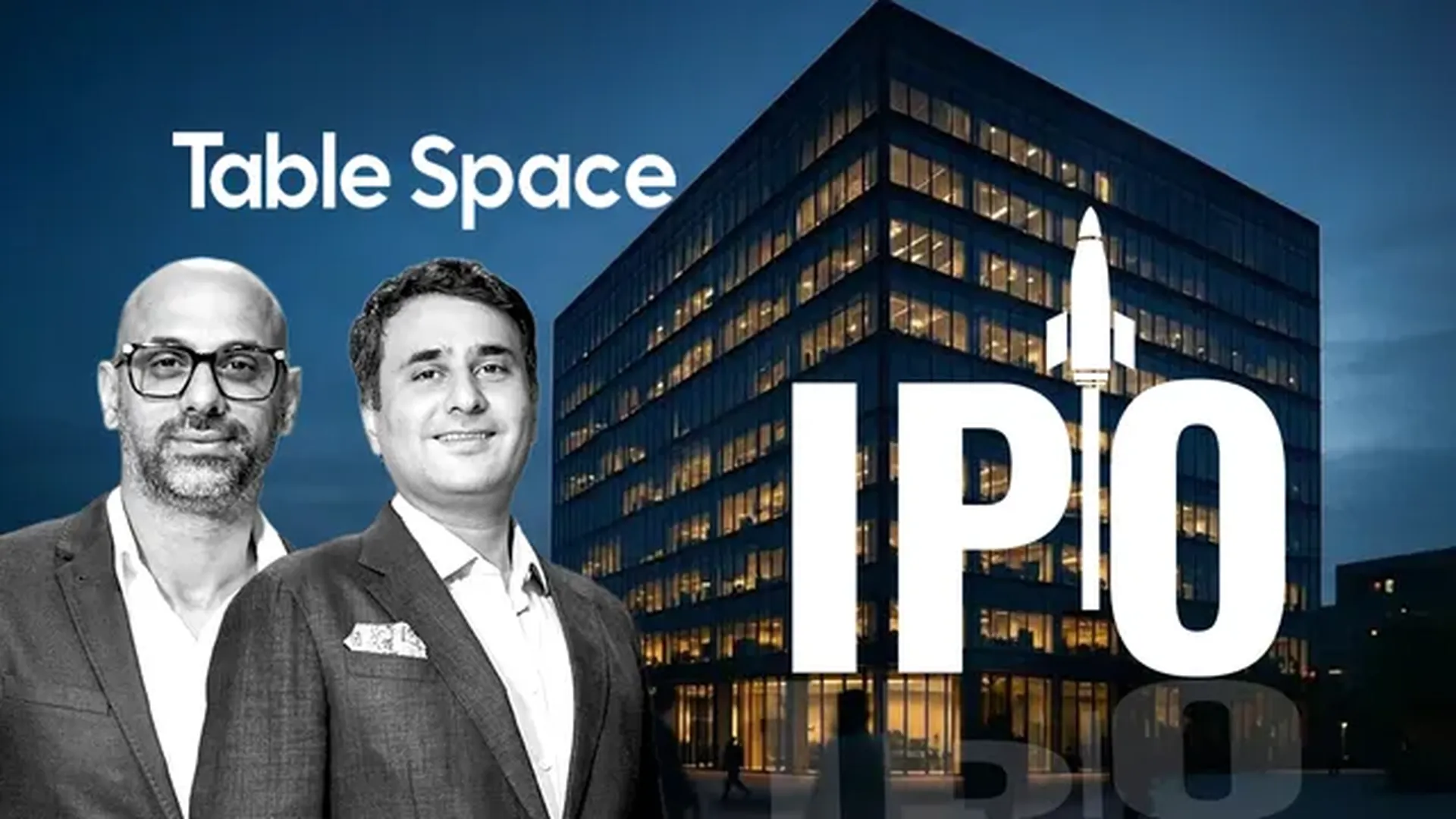
Table Space's normalised revenue for FY26 stood at Rs 2,477.68 crore, representing 56.42 per cent growth over the prior year, a rate of expansion that underscores both the strength of underlying demand for managed enterprise-grade office space in India and the company's ability to capture a growing share of that demand ahead of what promoters clearly hope will be a well-received public listing. The company had also been reported to be considering a pre-IPO placement of around Rs 160 crore, a structure increasingly common among Indian companies seeking to lock in anchor investor commitments and reduce dilution risk ahead of the broader public offering.
For India's managed workspace sector more broadly, Table Space's DRHP filing adds further evidence that flexible and managed office operators, once viewed primarily as a real estate services niche, have matured into a distinct, investable asset class with genuine public-market appetite, one increasingly defined by occupancy discipline, Grade A portfolio quality and exposure to the durable, multi-year demand generated by global capability centres rather than the more volatile shared-desk coworking model that originally defined the category a decade ago.
The global capability centre boom underpinning Table Space's growth has itself become one of the more durable structural trends in Indian commercial real estate over the past several years. Multinational corporations across banking, technology, pharmaceuticals and manufacturing have increasingly consolidated engineering, finance, analytics and shared-services functions into dedicated Indian delivery hubs, drawn by a combination of cost advantages, a deep talent pool and improving infrastructure in India's major metros. That shift has created sustained demand for exactly the kind of enterprise-grade, fully managed, single-tenant workspace product Table Space specialises in, distinct from the smaller, shared-desk coworking model that dominated the sector's earlier growth phase and proved considerably more vulnerable to economic downturns given its reliance on freelancers, startups and small businesses with shorter lease commitments and higher churn.
Table Space's IPO also arrives at a moment when Indian public markets have shown a more discerning appetite for new-age listings generally, rewarding companies with clearer paths to profitability and penalising those still burning significant cash without a credible near-term breakeven narrative. Against that backdrop, the company's decision to direct the bulk of its fresh issue proceeds toward debt repayment, rather than aggressive, unproven expansion, signals a deliberately conservative positioning intended to appeal to public-market investors wary of the kind of growth-at-all-costs stories that characterised many earlier Indian technology listings before valuations across the sector corrected sharply. Whether that conservative framing translates into strong investor demand once the issue formally opens will offer an early signal of how India's public markets are recalibrating their appetite for the broader wave of managed workspace operators now lining up to follow Table Space onto the exchanges.
The book-running syndicate assembled for the issue, spanning Axis Capital, BofA Securities India, CLSA India, IIFL Capital Services and JM Financial, also reflects the scale of ambition behind the offering, bringing together both leading domestic institutions and major global investment banks with deep experience placing Indian equity issuances with international institutional investors. That combination is typically reserved for issuers targeting substantial participation from foreign portfolio investors alongside domestic mutual funds and insurance companies, suggesting Table Space and its advisors are positioning the offering to appeal broadly across India's institutional investor base rather than relying primarily on domestic retail and high-net-worth demand, a strategy that will be tested once the formal roadshow and price discovery process gets underway in the weeks following the DRHP filing.