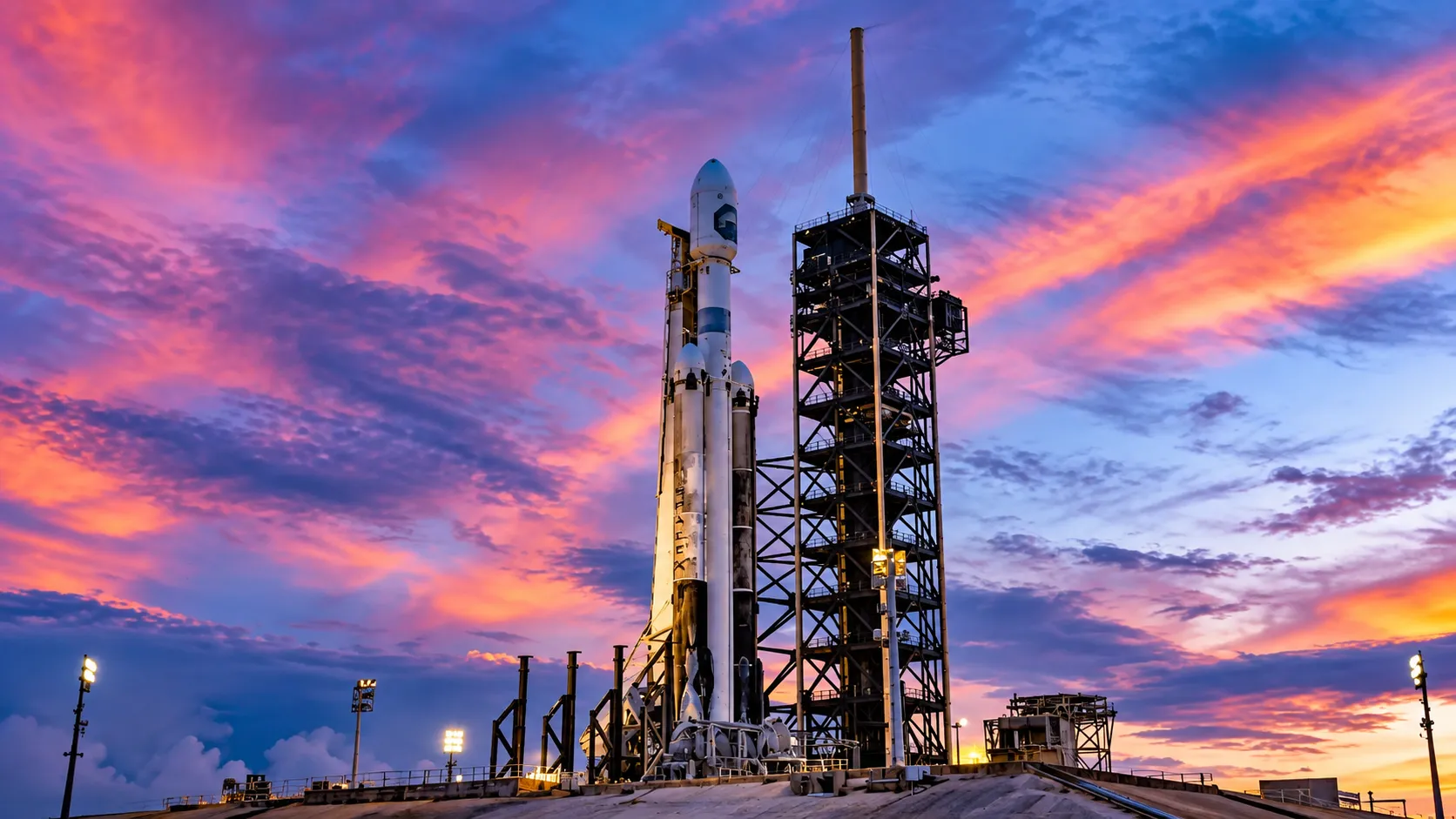
Three Indian space startups have sent new technology into orbit aboard SpaceX's Transporter-18 rideshare mission, in a launch that showcased how the country's young private space sector is moving from demonstration projects towards commercial services.
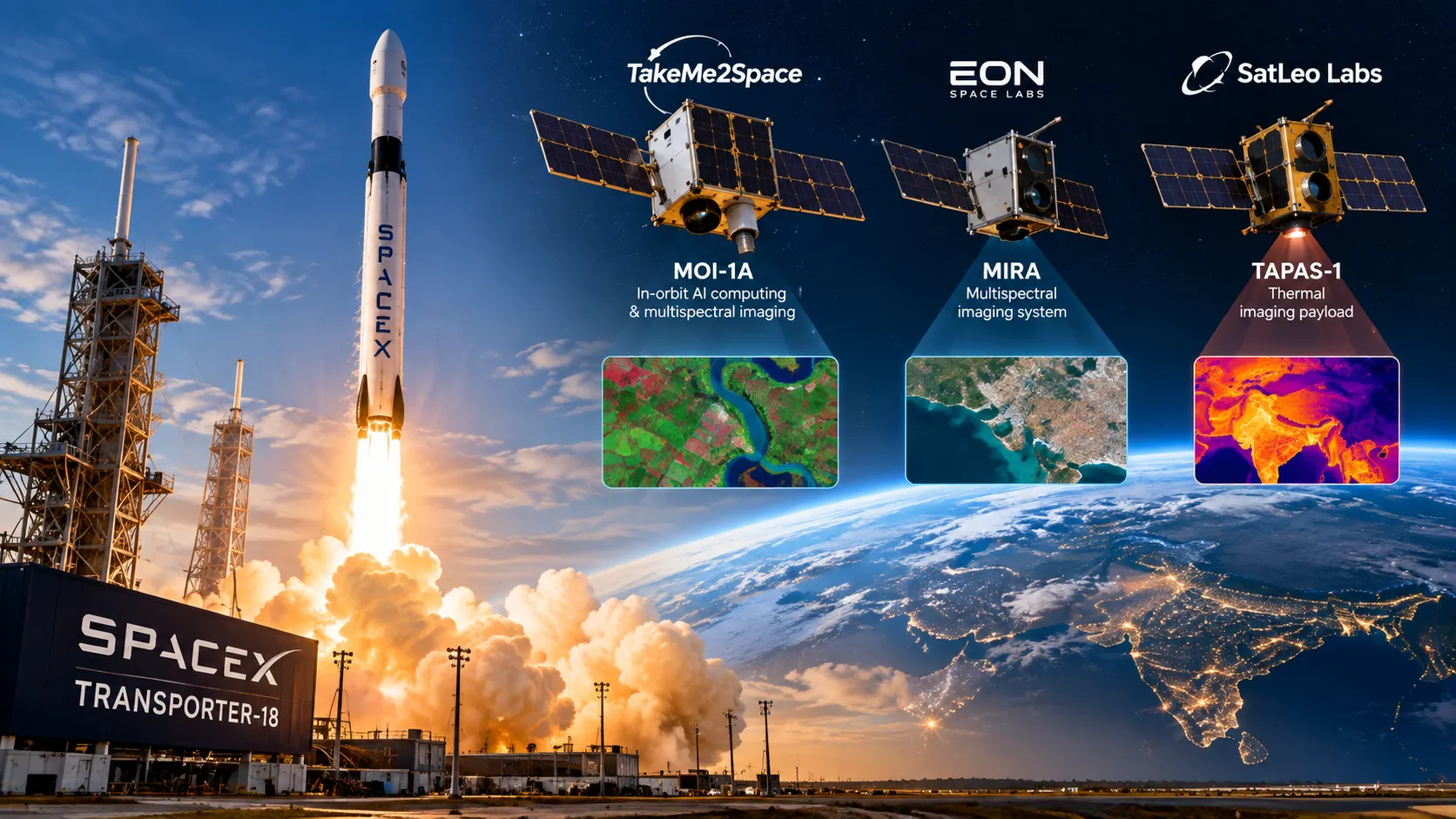
The Falcon 9 rocket lifted off from California carrying Hyderabad-based TakeMe2Space's MOI-1A satellite, which in turn hosts EON Space Labs' MIRA multispectral imaging system. Ahmedabad-based SatLeo Labs' TAPAS-1 thermal imaging payload flew on Dhruva Space's LEAP-2 satellite on the same mission, according to a report published by Inc42 on 2 October.
Pawan Goenka, chairman of India's space regulator and promoter IN-SPACe, called it "a big day for India's private space sector", saying the launch showed the "range and ambition" of the country's private space ecosystem.
The three companies are pursuing different parts of the same opportunity: making satellite data cheaper to process and more useful to customers in agriculture, defence, insurance, mining and infrastructure.
Computing in orbit
TakeMe2Space's MOI-1A is the most ambitious of the three payloads. The 14-kilogram satellite carries onboard computing capacity of 117 trillion operations per second, 2 terabytes of storage and a nine-band multispectral imager.
The company's pitch is that customers can deploy their own artificial intelligence models directly on the satellite and analyse imagery in orbit, rather than downloading vast volumes of raw data to ground stations for processing. Founder and chief executive Ronak Kumar Samantray told Inc42 that this approach could cut the volume of data that needs to be downloaded by a factor of 1,000.
He gave an example: a 2,000-kilometre stretch of synthetic aperture radar imagery could generate around 300 gigabytes of data. If an AI model instead searches for specific objects or patterns while the satellite is still in orbit, the output sent back to Earth could shrink to just a few kilobytes.
The first-generation satellites are designed for inference, meaning running trained models, rather than training them. TakeMe2Space says it has signed up 23 customers for its in-orbit inference services, around 80% of them outside India. They include international geospatial firms, while Indian educational institutions are using the platform as an orbital research laboratory.
The launch also marks a recovery from a setback. TakeMe2Space lost its earlier MOI-1 satellite in the unsuccessful PSLV-C62 mission earlier this year. Samantray said the broad architecture of the new satellite remains similar, but individual subsystems have been through several development cycles since then.
A six-satellite constellation by 2028
The startup has set out an aggressive roadmap. It plans to launch MOI-1B, its other first-generation satellite, in November aboard ISRO's Small Satellite Launch Vehicle. That spacecraft will carry a black-and-white imager mainly intended for object detection.
Two larger second-generation satellites, MOI-2 and MOI-3, are planned for 2027, most likely on Indian launch vehicles. According to Samantray, Gen-2 satellites will have roughly ten times the capacity of the first generation, with around 100 terabytes of storage each and significantly more computing power. TakeMe2Space has secured a slot on a Falcon 9 mission in late 2028 for MOI-4 and MOI-5, which would complete a six-satellite constellation.
The company also plans to add laser links between satellites so that processed data can be passed to whichever spacecraft has the best connection to a ground station. Samantray expects each Gen-2 satellite to generate around $1 million in annual revenue and is targeting about $6 million in annual recurring revenue from in-orbit computing by 2028. Further out, it is designing 1,500-kilogram-class Gen-3 satellites with around 25 kilowatts of power, potentially launching around 2029.
Seeing heat from space
SatLeo Labs describes TAPAS-1 as India's first dedicated commercial thermal payload. It uses thermal infrared sensing to measure land surface temperature, a capability with applications in urban heat mapping, crop stress monitoring, disaster response and infrastructure surveillance.
Thermal data is becoming more valuable as Indian cities face more frequent and intense heatwaves and as farmers and insurers look for better ways to detect water stress in crops. The mission will test TAPAS-1's sensing, calibration and processing capabilities in orbit. Its host satellite, Dhruva Space's LEAP-2, also carries a star tracker built by France's Sodern.
EON Space Labs' contribution is compact. Its MIRA multispectral imager weighs just 502 grams and is integrated with MOI-1A. It is designed to capture Earth observation imagery for use in agriculture, mining, marine monitoring, supply chains and insurance. ## Why processing in space matters
The economics of Earth observation have long been constrained by the cost of moving data. Satellites capture far more imagery than they can transmit during the few minutes each orbit when they pass over a ground station. That bottleneck means operators either discard data or wait, which delays insights that customers often need quickly, such as flood extents after a cyclone or crop damage before an insurance claim is settled.
Running AI models on board changes the trade-off. Instead of sending every pixel, a satellite can send only the answer: how many ships are in a port, which fields show signs of stress, where a pipeline right-of-way has been encroached. For a country such as India, where agriculture, disaster management and border security all depend on timely geospatial information, that shift could make satellite intelligence affordable for a much wider set of users, from state governments to small insurers. Commercial demand for space-based data in India is also growing from private sectors such as insurance, logistics and mining, which want frequent, affordable imagery rather than occasional surveys.
A maturing ecosystem
The launch comes as India's space sector undergoes a structural change. Since the government opened the industry to private companies and created IN-SPACe to authorise and support them, dozens of startups have emerged across launch vehicles, satellite manufacturing, ground stations and data analytics.
Investors, however, have grown more demanding. Building and launching satellites is capital-intensive, and revenue often takes years to materialise. That makes early commercial traction, such as TakeMe2Space's 23 paying customers, an important signal.
The reliance on SpaceX for this launch also highlights a gap the Indian industry is working to close. Indian startups have repeatedly turned to foreign rideshare missions because domestic launch opportunities have been limited. Samantray said he expects Indian launch services to operate more regularly by 2027, which is why the company has not yet booked launches for its next two satellites.
For now, the Transporter-18 mission gives three Indian companies a chance to prove their technology in the harshest test environment of all. If the payloads perform as designed, they will strengthen the case that Indian spacetech can compete on capability, not just cost, in the global market for space-based data.