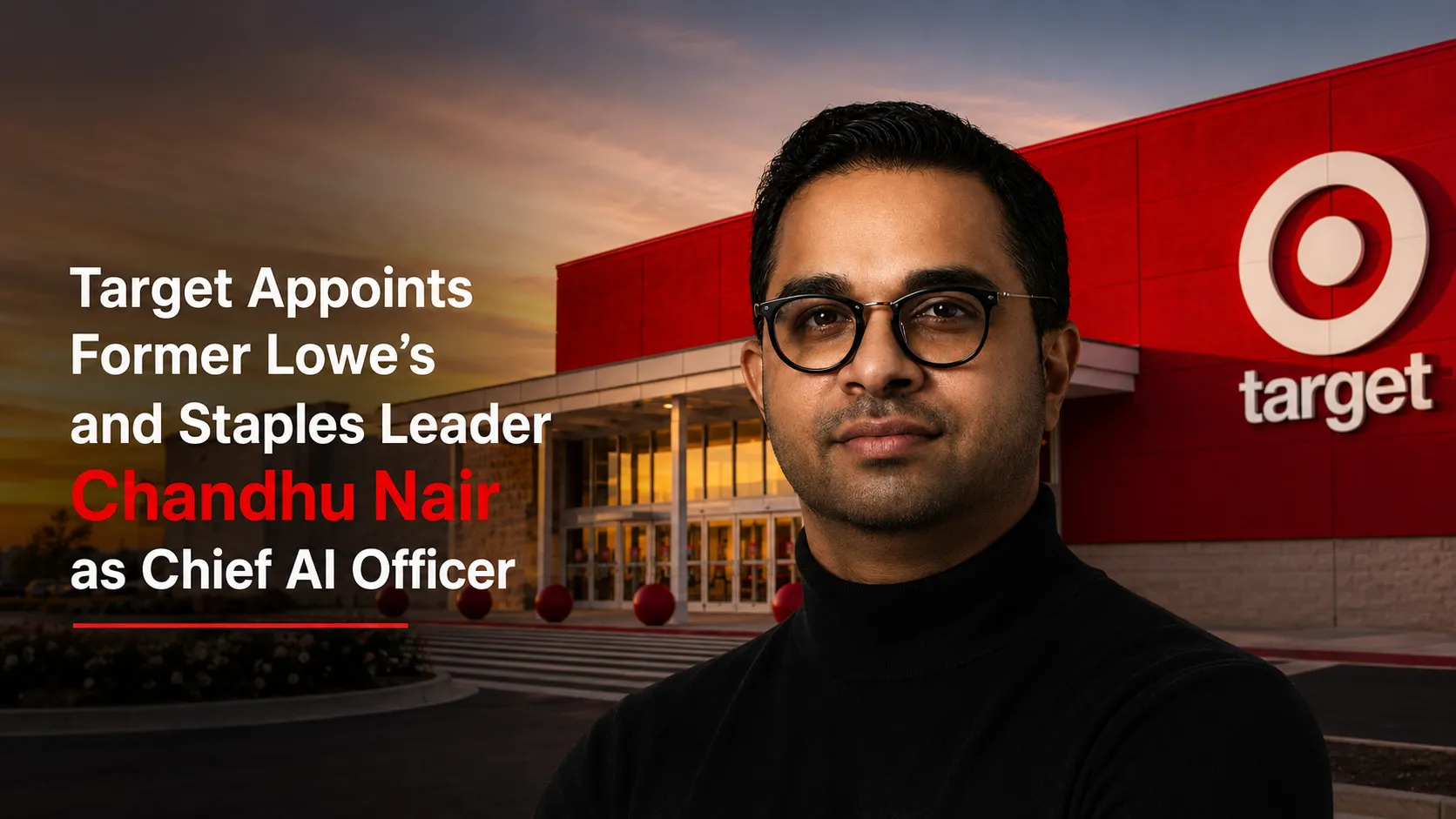
Target has created a chief artificial intelligence officer position for the first time in the company's history, appointing retail technology veteran Chandhu Nair to the newly formed role. The Minneapolis-based retailer confirmed the appointment this week, with Nair set to join the company on August 24 as senior vice president and chief AI officer, reporting into Target's executive leadership team.
The move places an Indian-origin executive at the centre of one of American retail's most closely watched technology bets, as Target and its rivals compete to translate the generative AI boom into faster decision-making, smarter inventory management and more personalised shopping experiences for tens of millions of customers.
Nair arrives at Target after more than six years at Lowe's Companies, where he most recently served as senior vice president of stores, data, AI and innovation — a role that put him at the intersection of physical retail operations and emerging technology at one of the country's largest home-improvement chains.

Before Lowe's, which he joined in 2020, Nair built a career spanning both entrepreneurship and established retail. He co-founded Merkatus Partners, a strategy consulting firm focused on business strategy and emerging technology investments in the commerce and retail space, and separately co-founded and served as chief executive of Cognitive Retail, a venture that developed and marketed advanced data analytics and automation software. Earlier in his career, Nair spent close to a decade at Staples in a series of roles, most recently as senior director and general manager of global e-commerce product and strategy, and he also held positions at Gap.
That blend of operator and founder experience is central to how Target is framing the new role. Rather than positioning artificial intelligence as a standalone research function, the company has signalled that Nair's mandate will be to weave AI capabilities directly into existing business priorities — merchandising, store operations and the guest experience — instead of building a parallel strategy that sits apart from how Target already runs its business.
In comments accompanying the announcement, Nair described his approach as starting with outcomes rather than technology for its own sake, emphasising that the value of AI would be judged by how it supports Target's existing strengths in its stores, merchandising and team, rather than by the sophistication of the underlying models. He said his first priority on joining would be to spend time with teams across the business and see operations through the eyes of guests, team members and partners before setting a formal roadmap.
Target paired the announcement with a second leadership move, promoting Purvi Shah — the company's current vice president of user experience design — to senior vice president of user experience. Shah has spent four years shaping Target's digital and in-store experience systems, including work on a conversational shopping feature built for ChatGPT that the company rolled out earlier this year. Target has said the AI and UX functions are intended to work in close coordination, reflecting a broader industry view that artificial intelligence delivers the most value to retailers when paired tightly with how customers actually interact with a brand.
The appointment places Target within a rapidly broadening group of major US companies that have created dedicated chief AI officer positions over the past two years, a list that includes technology majors such as Meta, Google and IBM alongside firms in pharmaceuticals, consulting and professional services, including Eli Lilly, Pfizer, Accenture and PwC. Industry research cited by several outlets covering the appointment has pointed to a sharp rise in adoption of the role, with large organisations reporting dedicated AI leadership roughly three times more often than they did just a year earlier.
Target's retail peers have already staked out competing approaches to the same challenge. Walmart has pushed AI tools and autonomous agents across large parts of its operations, Gap has struck a partnership with Google's Gemini models, and Best Buy has arrangements in place with both OpenAI and Google. Target's decision to consolidate AI strategy under a single accountable executive, rather than distributing it across existing technology and merchandising leadership, marks a distinct organisational choice as the company works to keep pace with rivals investing heavily in the same capabilities.
For the Indian diaspora in American business, Nair's appointment extends a now-familiar pattern of Indian-origin executives reaching senior technology leadership at major US consumer companies, following a wave of similar appointments across retail, consumer goods and financial services over the past year. What distinguishes this particular move is the specificity of the mandate: Nair is not being asked to run a research lab, but to make artificial intelligence legible and useful across one of the largest physical retail footprints in the United States — inventory systems, in-store operations and guest-facing digital tools alike.
How Target measures success under its first chief AI officer will be closely watched by the wider retail sector, particularly given how publicly competitors have staked their own AI strategies. For now, the company has signalled that the test will not be the scale of its AI ambitions but their integration — whether artificial intelligence quietly makes shopping easier, gives store teams better tools, and helps the business make faster, more confident decisions, rather than existing as a separate initiative distinct from Target's core retail operations.