TechFuture Tech5 MIN READ

Tata Communications to Invest Up to $450 Million in 10,000-Km Fibre Network Built for India's AI Boom

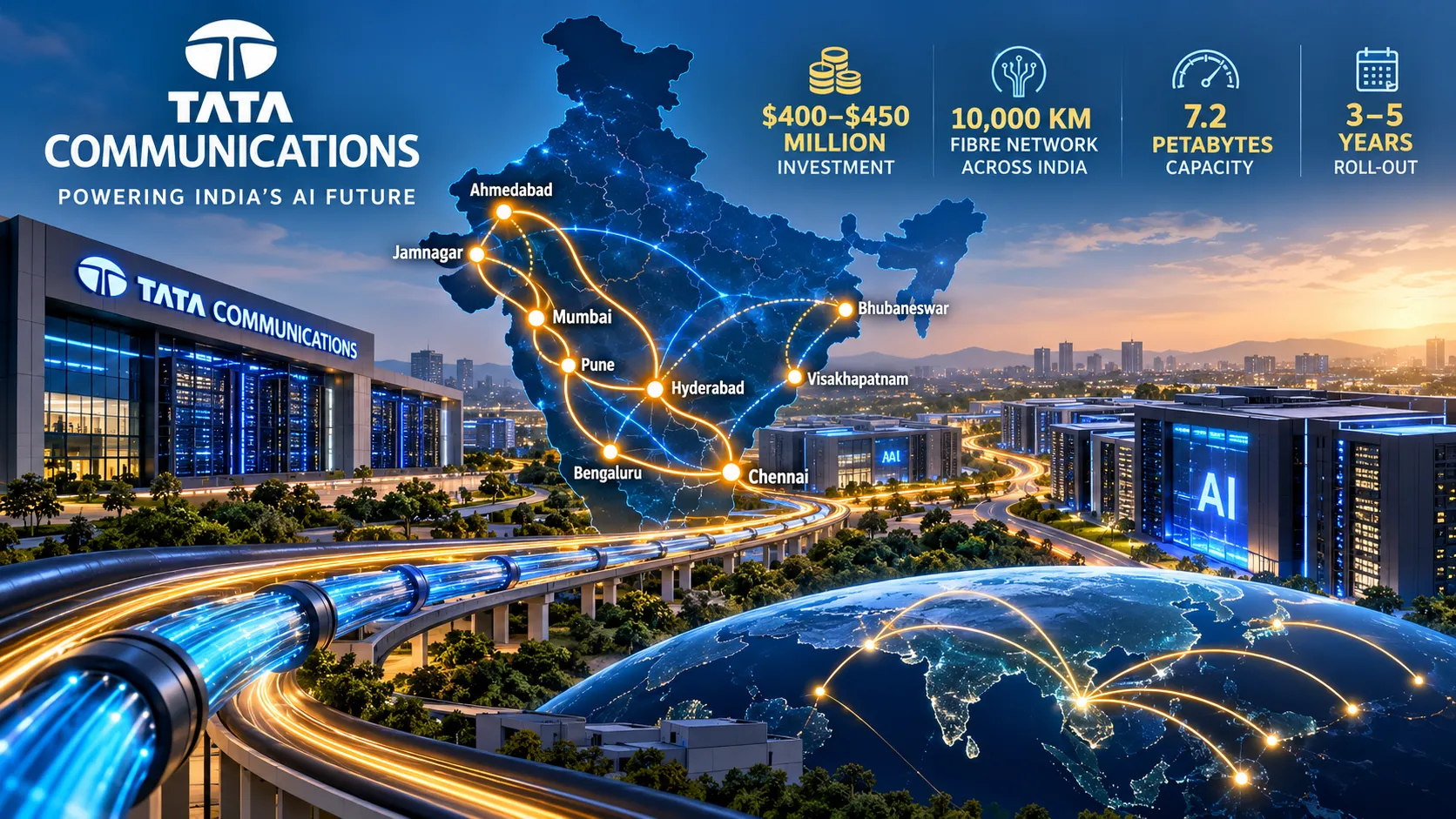
Tata Communications will invest $400–450 million over three to five years to build a 10,000-km fibre network with 7.2 petabytes of capacity, linking India's major data-centre hubs to serve hyperscalers, neo-clouds and AI labs.

By Shaym Kumar · Author27 October 2026New
Tata Communications to Invest Up to $450 Million in 10,000-Km Fibre Network Built for India's AI Boom

Tata Communications has announced plans to invest between $400 million and $450 million to build a 10,000-kilometre fibre network across India, designed to connect the country's fast-growing data centres and support the surge in artificial intelligence workloads.

The network, to be built over the next three to five years, will have a capacity of 7.2 petabytes and will link key data-centre clusters and AI hubs, the company said on 26 October. It will be integrated with Tata Communications' global network, creating what the company describes as an end-to-end connectivity fabric for AI.

The investment will be funded from the company's operating cash flows.

Three Phases, Key Corridors

The build-out will proceed in three phases. The first will cover the Mumbai–Pune–Hyderabad–Chennai corridor, linking several of India's largest data-centre markets. The second will connect Hyderabad, Visakhapatnam and Chennai.

The third phase will extend the network across a broader set of locations, including Bhubaneswar, Visakhapatnam, Bengaluru, Chennai, Mumbai, Ahmedabad and Jamnagar, reaching data-centre ecosystems on India's east coast and in western India, including GIFT City in Gujarat and other strategic sites.

The corridors reflect where data-centre investment is concentrated. Mumbai remains India's largest data-centre market, benefiting from its role as a landing point for international subsea cables. Chennai is the second major cable landing hub and a growing data-centre location, while Hyderabad and Pune have attracted large campuses from global and domestic operators. Visakhapatnam has emerged as a site for large AI data-centre projects, and Jamnagar is home to major industrial and digital infrastructure investments.

Why AI Needs New Networks

Generative and agentic AI place very different demands on networks from traditional internet traffic. Training and running large AI models involves moving enormous volumes of data between data centres, often with strict requirements for low latency and high reliability. Companies increasingly distribute AI workloads across multiple facilities, requiring high-capacity links between them.

Tata Communications said traditional networks are not designed for these demands. Chief executive Ganesh Lakshminarayanan estimated that data-centre-to-data-centre connectivity in India could grow into a market worth more than $1 billion over the medium term, as data-centre capacity expands towards a projected 19 gigawatts of IT load.

Who It Will Serve

The company is targeting hyperscale cloud providers, neo-cloud companies that rent GPU capacity, AI platforms and frontier model laboratories, digital-native businesses, software-as-a-service providers and large enterprises deploying AI.

"A growing proportion of our expansion is being driven by anchor customer commitments and contracted demand," Lakshminarayanan said, suggesting that the company has lined up customers before committing to the full investment.

Rupesh Chokshi, chief product and technology officer, said the capacity would be sold to multiple customers under long-term contracts rather than reserved for the company's own use. "Capacity will not be kept captive," he said. "Building our own dedicated fibre gives us owner economics, durable long-term revenue, and 25-year asset longevity."

The Financial Case

Tata Communications reported a profit of ₹335.6 crore on revenue of ₹6,704 crore for the September quarter. Its net operating cash flow was ₹1,562 crore in the first half of the current financial year and ₹4,479 crore in the 2026 financial year, providing the internal resources to fund the build-out.

The company expects revenue and margins from the new network to ramp up as fibre is lit, with Chokshi pointing to "meaningful financial contributions kicking in around FY28-FY29". Long-lived fibre assets with long-term contracts can generate stable, predictable cash flows, making them attractive to investors once utilisation builds.

“Capacity will not be kept captive.”
— Rupesh Chokshi, Chief Product and Technology Officer, Tata Communications

A Global Network Player

Tata Communications, part of the Tata Group, operates one of the world's largest subsea cable networks, with more than 500,000 kilometres of subsea cable and over 200,000 kilometres of terrestrial network. The company traces its origins to Videsh Sanchar Nigam Limited, India's former state-owned international telecoms carrier, which the Tata Group acquired in 2002.

In June, Tata Global Network announced plans for a Mumbai–Singapore subsea cable and joined a consortium building a Chennai–Singapore cable expected to be ready for service in late 2029. Integrating its domestic fibre with these international routes would allow customers to move data seamlessly between Indian data centres and global cloud regions.

79083421-1080-4566-acfc-61b0da545a65.png

India's Data-Centre Boom

The investment comes amid a surge in data-centre construction in India. Global cloud providers including Amazon Web Services, Microsoft and Google have announced multibillion-dollar investments in Indian cloud regions, while domestic conglomerates such as Reliance, Adani and the Tata Group have unveiled large data-centre and AI infrastructure projects.

Government policy has supported the trend. Data localisation requirements for certain categories of data, incentives offered by states and the IndiaAI Mission's push to expand computing capacity have all encouraged investment. Rising digital consumption by India's large and growing internet population adds to demand.

Power and Connectivity Bottlenecks

As data-centre capacity expands, connectivity and power have emerged as critical bottlenecks. Data centres require reliable, high-capacity links to each other and to the wider internet, and building new fibre routes takes time and significant capital. Projects that secure network capacity early may gain an advantage in attracting AI customers.

Power availability is the other constraint, with large AI facilities requiring hundreds of megawatts of electricity. NITI Aayog has recently issued a framework requiring grid readiness checks for large data centres, underlining the scale of the challenge.

Competition for the AI Backbone

Tata Communications will not be alone in building high-capacity links between Indian data centres. Telecom operators Reliance Jio and Bharti Airtel own extensive fibre networks and have expanded into data centres, while infrastructure players and state-backed entities such as RailTel and Power Grid's telecom arm also lease fibre capacity. Global hyperscalers sometimes build or buy their own dark fibre to connect their facilities.

The company's differentiation lies in combining domestic routes with its international subsea network, allowing customers to move data seamlessly from Indian data centres to cloud regions abroad. For global AI developers and cloud providers serving Indian users, an integrated domestic and international network could simplify operations and improve performance. Winning long-term anchor contracts early will be critical in a market where several well-capitalised players are competing for the same customers.

What Comes Next

The company has set out a three-to-five-year timeline for the build-out, starting with the Mumbai–Pune–Hyderabad–Chennai corridor. Its success will depend on securing anchor customers, executing construction efficiently and competing with other fibre providers, including telecom operators and infrastructure companies that are also investing in high-capacity networks.

For India, the project is another sign that the country is building the physical foundations needed to become a major AI hub. Fibre, power and data centres may be less glamorous than AI models, but without them, the country's AI ambitions cannot be realised.

TagsTata CommunicationsFibre NetworkAI InfrastructureData CentresHyperscalersNeo-CloudConnectivityMumbaiChennaiHyderabadGIFT CityGanesh LakshminarayananSubsea CablesTelecomIndia

Reader reviews

Sign in to rate and review this article.
Loading reviews…

