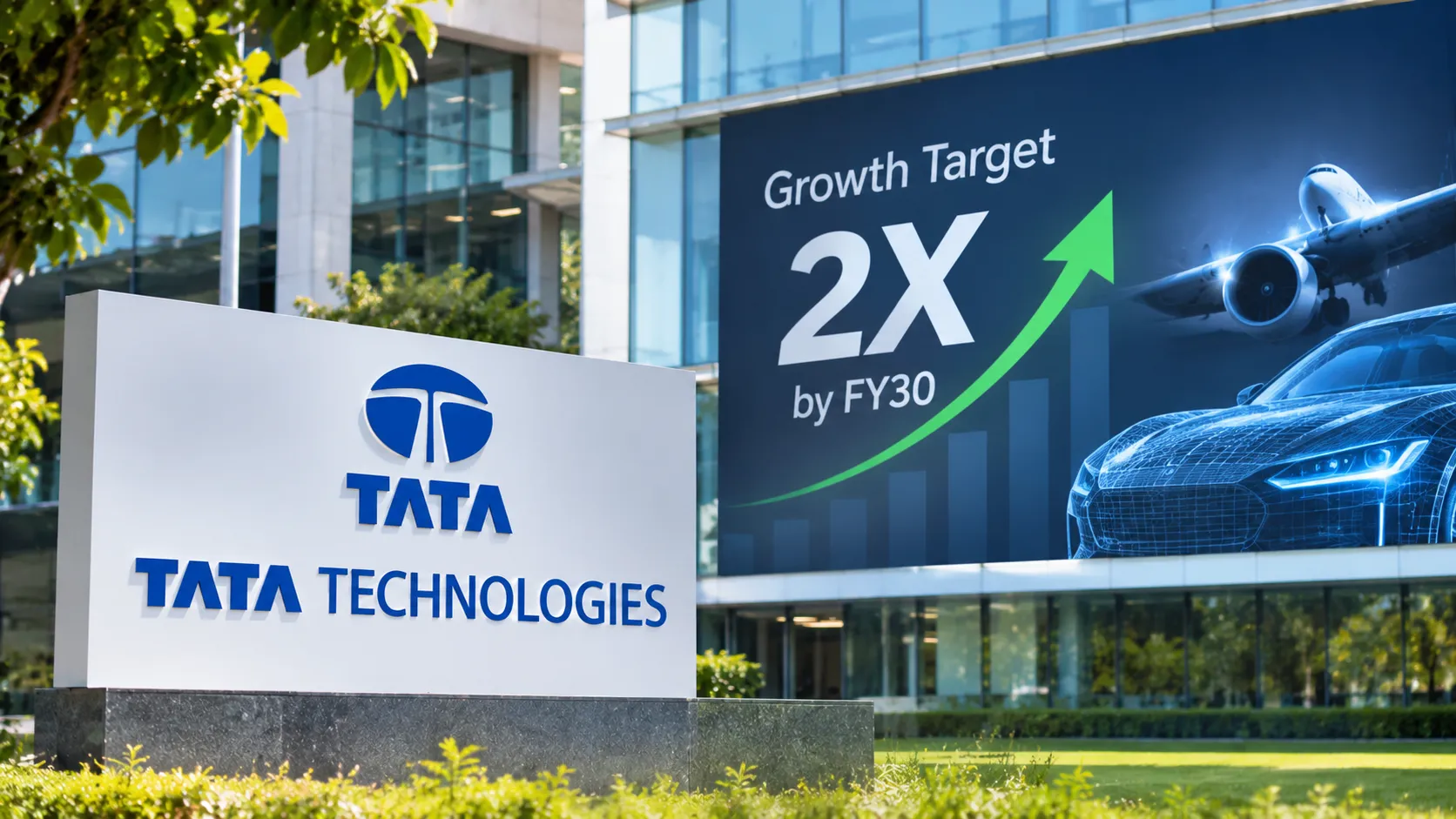
On a day when most Indian technology stocks fell, one Tata Group company stood out after laying out an ambitious plan to double its size.
Shares of Tata Technologies rose as much as 9.3% to an intraday high of ₹717.80 on the National Stock Exchange on Thursday, November 19, according to Business Standard. The rally followed the engineering services company's investor day, where management presented targets for the 2030 financial year.
The targets
Tata Technologies is targeting revenue of $1.1 billion to $1.3 billion by FY30, compared with about $620 million in FY26, according to Business Standard. That implies compound annual growth of about 15% to 20%.
The company aims to raise its operating EBITDA margin above 20%, from 15.5% in FY26. It is also targeting aerospace revenue of $100 million by FY28 and plans to double its software business over the next three years.
Sunny Agrawal, head of fundamental research at SBI Securities, said management outlined an "ambitious FY30 growth roadmap," according to Business Standard.
What Tata Technologies does
Tata Technologies provides engineering research and development (ER&D) and digital services, primarily to manufacturing companies. Its clients use it to design and develop products, from vehicles and aircraft to industrial machinery. The company has deep roots in the automotive industry, with Tata Motors and Jaguar Land Rover among its largest customers.
The company listed on Indian stock exchanges in November 2023 in one of the most anticipated IPOs of that year, the first by a Tata Group company in nearly two decades.
The growth engines
The targets rest on several growth areas, according to Business Standard: a software business, aerospace, and AI-led engineering, including AI-driven product development and software-defined vehicles.
Software-defined vehicles are cars whose features and functions are increasingly controlled by software, which can be updated over the air. As carmakers shift to this model, they need engineering partners with expertise in software, electronics and systems integration, creating opportunities for companies like Tata Technologies.
Aerospace is a significant growth market, as aircraft makers and suppliers face heavy order backlogs and engineering talent shortages. Indian engineering services companies have expanded their aerospace capabilities to capture outsourcing demand.
Standing out in a weak IT sector
The rally was notable because Indian IT stocks were under pressure. The Nifty IT index fell for a third consecutive session on Thursday, down about 6.5% over three days, amid concerns about the impact of AI on traditional IT services and expectations of higher US interest rates.
Engineering services companies have generally been seen as better positioned than traditional IT services firms, because their work involves physical products and specialised domain expertise that is harder to automate. Demand for ER&D services has been supported by the electric vehicle transition, digitalisation of manufacturing and the growth of connected products.
The automotive challenge
Tata Technologies' heavy exposure to the automotive industry is both a strength and a risk. The industry is investing heavily in electric vehicles and software, but many carmakers are also under financial pressure, particularly in Europe, where demand has been weak and competition from Chinese manufacturers intense.
Jaguar Land Rover, a key client, has faced challenges, including a cyberattack in 2025 and lowered profit guidance. Tata Motors' passenger vehicle business reported a loss in the September quarter. Diversifying beyond automotive, into aerospace and industrial sectors, is therefore an important part of the company's strategy.