ThinkMetal, a Chennai-based deeptech startup that builds compact metal 3D printing systems, has raised ₹27 crore in a funding round led by IAN Alpha Fund, with participation from 3i Partners and existing investors.
The company, co-founded by chief executive Sabyasachi Ghosh and chief technology officer Arushi Sharma, announced the round on October 13. It will use the capital for product development and research, to drive adoption among industrial customers, to expand its library of printable materials, and to build in-house capabilities for processing new materials.
The round marks a step up for a company that raised about $800,000 in seed capital in early 2025. ThinkMetal says it has moved beyond technology development into enterprise pilots and is now working towards larger commercial deployments with manufacturers in aerospace, defence, space, automotive and electric mobility.
Making metal printing accessible
Metal additive manufacturing, the industrial term for 3D printing in metal, has transformed how high-value parts are designed and produced. It allows engineers to create complex geometries that are impossible or prohibitively expensive with traditional machining, consolidate several components into one and produce small batches without costly tooling.
The technology has also been expensive. The dominant industrial method, laser powder bed fusion, typically requires large, costly machines, controlled facilities and specialist handling of fine metal powders. That has kept metal printing largely in the hands of big aerospace companies, medical device makers and well-funded research centres.
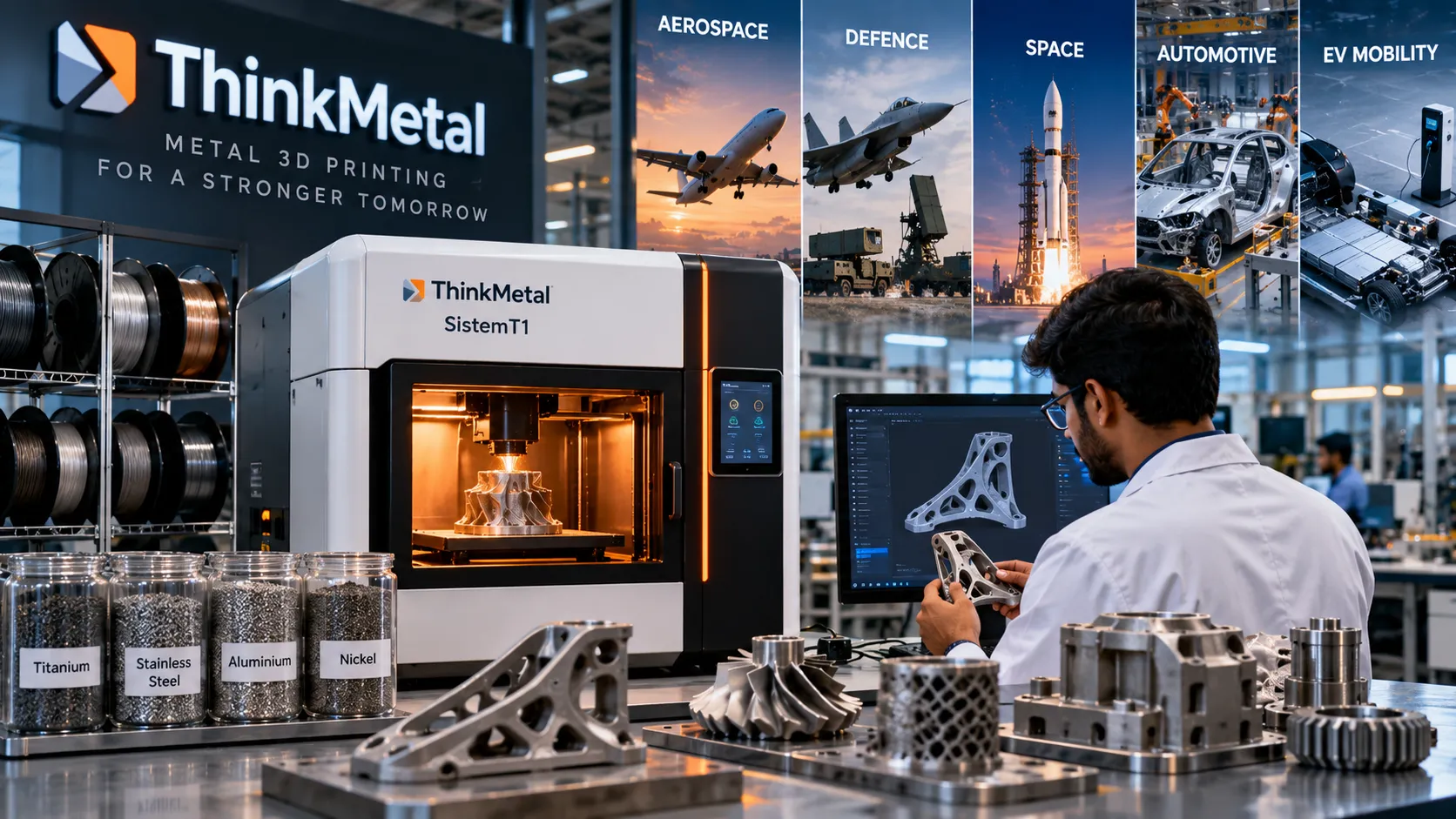
ThinkMetal is trying to change that. Its core product, the SistemT1, is a compact metal additive manufacturing system that uses a patented two-step process built around the company's proprietary FuseX metal filament technology. Parts are first printed using metal-loaded filament and then processed in a furnace to produce dense metal components. The company offers an end-to-end ecosystem that includes software for converting 3D CAD models, the printer, its patented filaments and the furnace.
ThinkMetal claims its technology can produce high-value precision metal parts up to 10 times faster and at about half the cost of conventional methods. These figures are the company's own and have not been independently verified, but they show the scale of the value proposition it is putting to customers.
Who it is selling to
The startup is targeting small and medium-scale manufacturers, particularly Tier-1 toolmakers and prototype shops that supply original equipment manufacturers in the automotive, aerospace and defence industries. For these businesses, the ability to produce precision metal parts in-house, quickly and at lower cost, can shorten development cycles and reduce dependence on external suppliers or imported components.
That positioning fits several powerful trends in Indian industry. Defence manufacturing has been a major policy priority, with the government pushing to indigenise equipment and components. India's space sector has opened to private companies, creating demand for lightweight, complex metal parts produced in small volumes. And the shift to electric vehicles is forcing automotive suppliers to redesign components and tool up for new products, often under tight timelines.
In each case, the ability to print a functional metal prototype or low-volume part within days rather than weeks offers a clear competitive advantage.
The team and the technology
Ghosh and Sharma first worked together as engineering students at SRM University, where they collaborated on a team entry for the SpaceX Hyperloop Pod Competition. They later gained experience at a 3D printing startup, leading research and development efforts, before founding ThinkMetal in March 2021.
The company has built a substantial intellectual property base for an early-stage firm. According to lead investor IAN Alpha Fund, ThinkMetal has filed more than 17 intellectual property applications covering its materials, processes and systems. In a hardware business, protected know-how in materials science can be as valuable as the machine itself. Proprietary filaments also create a recurring consumables revenue stream once printers are installed.
With Sharma leading technology as CTO, ThinkMetal also adds to the still-small number of Indian deeptech hardware companies with a woman in a top technical leadership role. Investors and policymakers have increasingly highlighted this gap in the ecosystem.
Policy tailwinds
ThinkMetal's ambitions align with India's stated industrial strategy. The Ministry of Electronics and Information Technology published a National Strategy for Additive Manufacturing in 2022, setting out plans to build a domestic ecosystem of machines, materials, software and skilled workers so that India could capture a larger share of the global 3D printing market rather than relying on imported systems. Defence procurement rules that favour indigenous suppliers, and the opening of the space sector to private companies through IN-SPACe, add further demand for locally developed manufacturing technology.
Chennai is a natural base for such a company. The city and its surroundings form one of India's largest manufacturing clusters, home to major automotive plants, a growing aerospace and defence supplier base and a dense network of toolmakers and component suppliers, exactly the customers ThinkMetal is trying to reach.
Investor appetite for hard tech
IAN Alpha Fund is the venture fund associated with the Indian Angel Network, one of the country's largest angel investor groups. 3i Partners joined the round alongside existing backers. The deal comes amid a notable rise in investor interest in Indian deeptech. Startups in the category raised about $290 million in the July–September quarter of 2026, according to Inc42 data, up sharply from a year earlier, even as overall startup funding grew only modestly.
Hardware deeptech companies face distinctive challenges. Product development cycles are long, capital requirements are higher than in software, and customers in regulated industries such as aerospace and defence demand rigorous qualification before they commit to production use. The move from pilots to commercial deployments is often the hardest step, and it is the stage ThinkMetal says it is entering now.
The road ahead
ThinkMetal's priorities for the new capital are telling. Expanding its materials library will determine which industries and applications it can serve, since different sectors need different alloys with specific mechanical and thermal properties. Building in-house materials processing should give the company more control over quality and costs. Converting enterprise pilots into repeat orders will be the clearest signal to the next round of investors that the business can scale.
The opportunity is considerable. If compact, lower-cost metal printing systems can deliver industrial-grade parts reliably, they could put a capability once reserved for the world's largest manufacturers within reach of thousands of smaller Indian factories. For a country trying to move up the manufacturing value chain, that would be a meaningful shift, and ThinkMetal is betting it can be one of the companies that makes it happen.