
StartupsTrending5 MIN READ

Tonbo Imaging Sets ₹665–700 Price Band for ₹852 Crore IPO as India’s Defence-Tech Bet Goes Public

Bengaluru’s Tonbo Imaging has fixed a ₹665–700 price band for its ₹852.1 crore offer-for-sale IPO, valuing the thermal-imaging and defence electronics maker at about ₹4,010 crore as public investors weigh a falling topline against India’s defence-indigenisation push.

By Aravind Kumar · Author13 October 2026New
Tonbo Imaging Sets ₹665–700 Price Band for ₹852 Crore IPO as India’s Defence-Tech Bet Goes Public

Tonbo Imaging, the Bengaluru-based maker of thermal-imaging systems, weapon sights and missile seekers, has fixed a price band of ₹665 to ₹700 per share for its initial public offering. The pricing puts one of India’s best-known defence-technology startups in front of public-market investors at a time when the country is spending heavily to build a domestic arms-electronics base.

The issue is worth ₹852.1 crore and consists entirely of an offer for sale (OFS) of roughly 1.22 crore shares. Tonbo itself will receive none of the proceeds. At the top of the band, the company would be valued at about ₹4,009.8 crore, or roughly $480 million. Anchor investors bid on October 14, the issue is open to the public from October 15 to October 19, and shares are expected to list on the NSE and BSE on October 23 after allotment on October 21.

The listing comes in a crowded week for Indian primary markets. Manufacturing platform Zetwerk is running its own much larger offering over the same dates, and investors will be weighing both companies’ claims on a market that has grown more selective about new-age stocks after a run of volatile debuts.

A pure exit, and a smaller one than first planned

Because the IPO is an OFS, it is best read as a liquidity event for early backers and founders, not a capital raise. Selling shareholders include co-founders Arvind Kondangi Lakshmikumar, Ankit Kumar and Cecilia D’Souza, along with investors CEAQ Technologies and Artiman Partners. Individual shareholders Timothy Guy Mitchell and Ramesh Radhakrishnan are also listed among the sellers.

The final offer is materially smaller than first proposed. Tonbo’s draft red herring prospectus had contemplated selling up to about 1.81 crore shares. The cut to around 1.22 crore shares reduces the supply hitting the market and suggests the selling group would rather keep more of its stake than sell aggressively into a market that has punished stretched valuations.

The valuation itself marks a significant step-up. When Tonbo raised a ₹175 crore Series D round in April last year from Florintree, Tenacity Ventures and the Export-Import Bank of India, the round reportedly valued the company at about ₹1,500 crore. The IPO price implies a more than two-and-a-half-fold increase in roughly 18 months.

The offer is split in the standard way for a company of Tonbo’s profile: 50% for qualified institutional buyers, 15% for non-institutional investors and 35% for retail investors, with a small employee reservation. Retail investors can bid in lots of 21 shares, which works out to ₹14,700 at the upper end of the band. JM Financial and IIFL Capital Services are the book-running lead managers, and KFin Technologies is the registrar.
d172638a-48c1-4e45-8bdc-940d2c920e7b.png

From a lab spin-out to a defence exporter

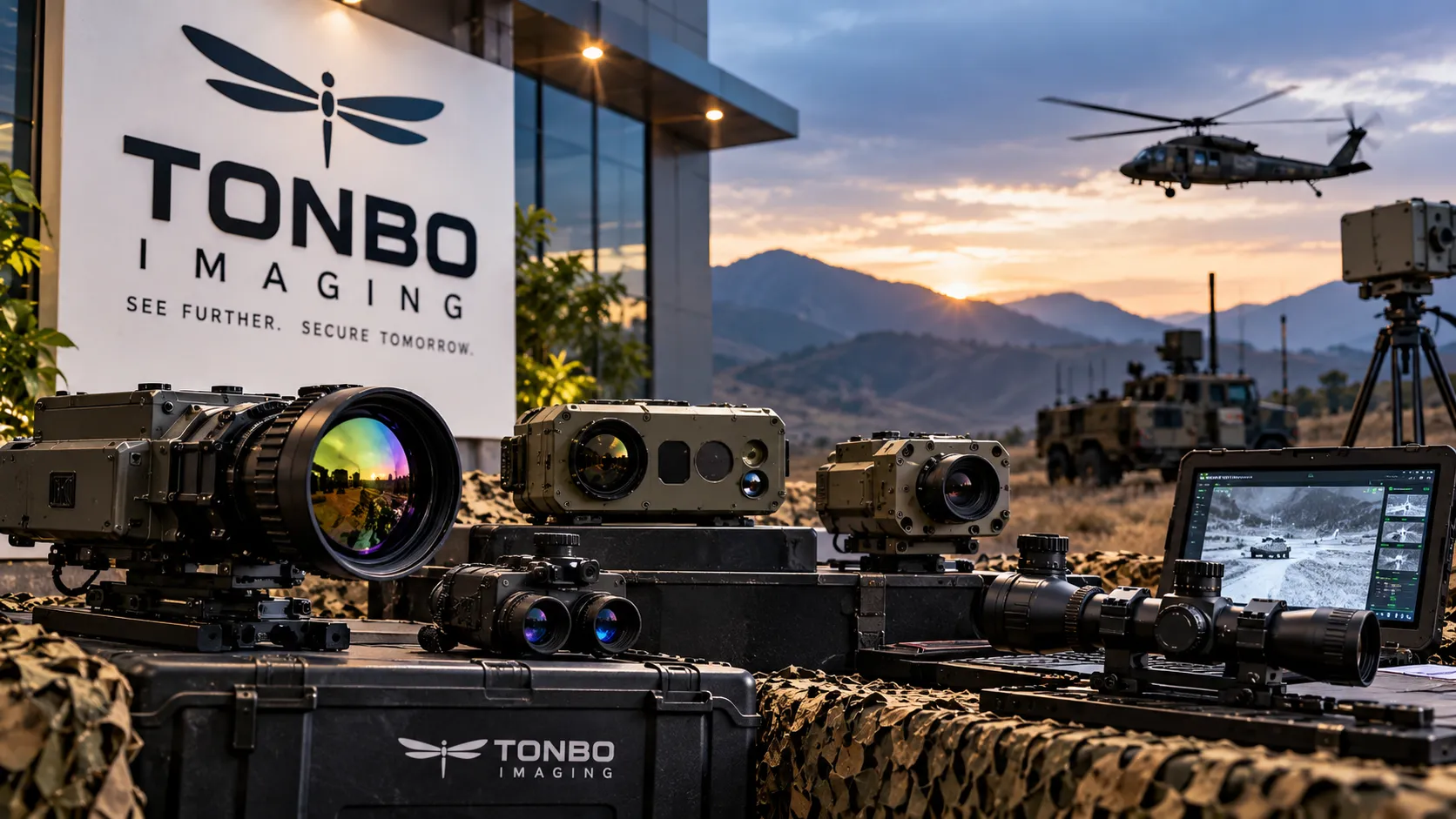
Tonbo traces its roots to 2003. Its current shape dates from 2012, when a promoter buyout turned it into a dedicated defence and security manufacturer. It now designs and builds night-vision and thermal-imaging cores, rifle and weapon sights, surveillance payloads and seeker components, the electro-optical systems that let soldiers, vehicles and munitions see in darkness, smoke and bad weather.

The company says more than 28,000 of its systems had been deployed across 24 countries as of June 30, 2026. It has also positioned itself as the backbone of India’s small thermal-imaging export trade, claiming a 94.3% share of the country’s thermal-imaging exports between FY24 and FY26. Few Indian private companies can point to that kind of export share in a defence niche, and it is a large part of why Tonbo has become a reference case for the government’s “Make in India” defence push.


“Tonbo’s listing will test whether public investors are prepared to pay for strategic capability before the earnings fully arrive.”
— The Impactful Global Indian

The numbers investors will scrutinise

The financials are where the debate starts. Tonbo’s revenue fell to ₹362.65 crore in FY26 from ₹469.08 crore a year earlier, a decline of about 22.7%. Profit after tax dropped to ₹50.88 crore from ₹72.76 crore. The first quarter of FY27 was weaker still: revenue of about ₹36 crore and a net loss of ₹17.7 crore, according to figures reported by Moneycontrol.

Defence revenue is notoriously lumpy. Large government and export orders are typically booked and delivered in irregular batches, and a single delayed contract can swing a year’s numbers. Investors will want management to show how much of the decline reflects timing and how much reflects lost business or pricing pressure. The size and quality of the order book, the concentration of revenue among a handful of defence customers, and working-capital cycles, where receivables from government buyers can stretch for months, are likely to dominate analyst calls ahead of the subscription window.

At the upper end of the price band, the IPO values Tonbo at roughly 79 times its FY26 earnings and about 11 times its FY26 revenue. That is a premium multiple for a company whose topline is shrinking, and it rests on the assumption that recent weakness is temporary.

The bull case: policy tailwinds and strategic scarcity

Supporters of the issue will point to the policy backdrop. India has steadily expanded its list of defence items that must be procured from domestic suppliers, and both the armed forces and paramilitary services have been modernising night-fighting and surveillance capabilities. Electro-optics is one of the segments where import substitution has been most visible, and Tonbo is among the few private players with proven export credentials.

Listed Indian defence stocks have also commanded rich valuations since the government’s indigenisation drive gathered pace, which gives Tonbo’s bankers a set of comparables that look expensive by global standards. For long-term investors, the attraction is scarcity: there are very few ways to get public-market exposure to a pure-play Indian defence-electronics designer with intellectual property in thermal cores and seekers.

What to watch before October 19

The Tonbo offering lands just as investors are reassessing India’s deeptech sector. Funding for deeptech startups rose sharply in the third quarter, and the government’s ₹1 lakh crore Research, Development and Innovation Fund is beginning to deploy capital. A strong reception for Tonbo would signal that public markets are ready to back hardware-heavy, research-led companies with long sales cycles, not just consumer internet and software businesses.

A weak one would send a different message. With the entire issue going to selling shareholders, subscription demand from institutions on day one and the grey-market response will be read as a referendum on whether a defence-tech growth story can command a premium while its earnings are under pressure.

For India’s startup ecosystem, and for the global Indian diaspora that has backed many of its deeptech founders, the stakes go beyond one company. Tonbo’s listing will test whether public investors are prepared to pay for strategic capability before the earnings fully arrive, a question that every Indian defence and space startup now preparing for the public markets will be watching closely.

TagsTonbo ImagingIPODefence TechThermal ImagingOffer for SaleIndian StartupsDeeptechMake in IndiaDefence ExportsJM FinancialIIFL CapitalNSEBSEBengaluru

Reader reviews

Sign in to rate and review this article.
Loading reviews…
